
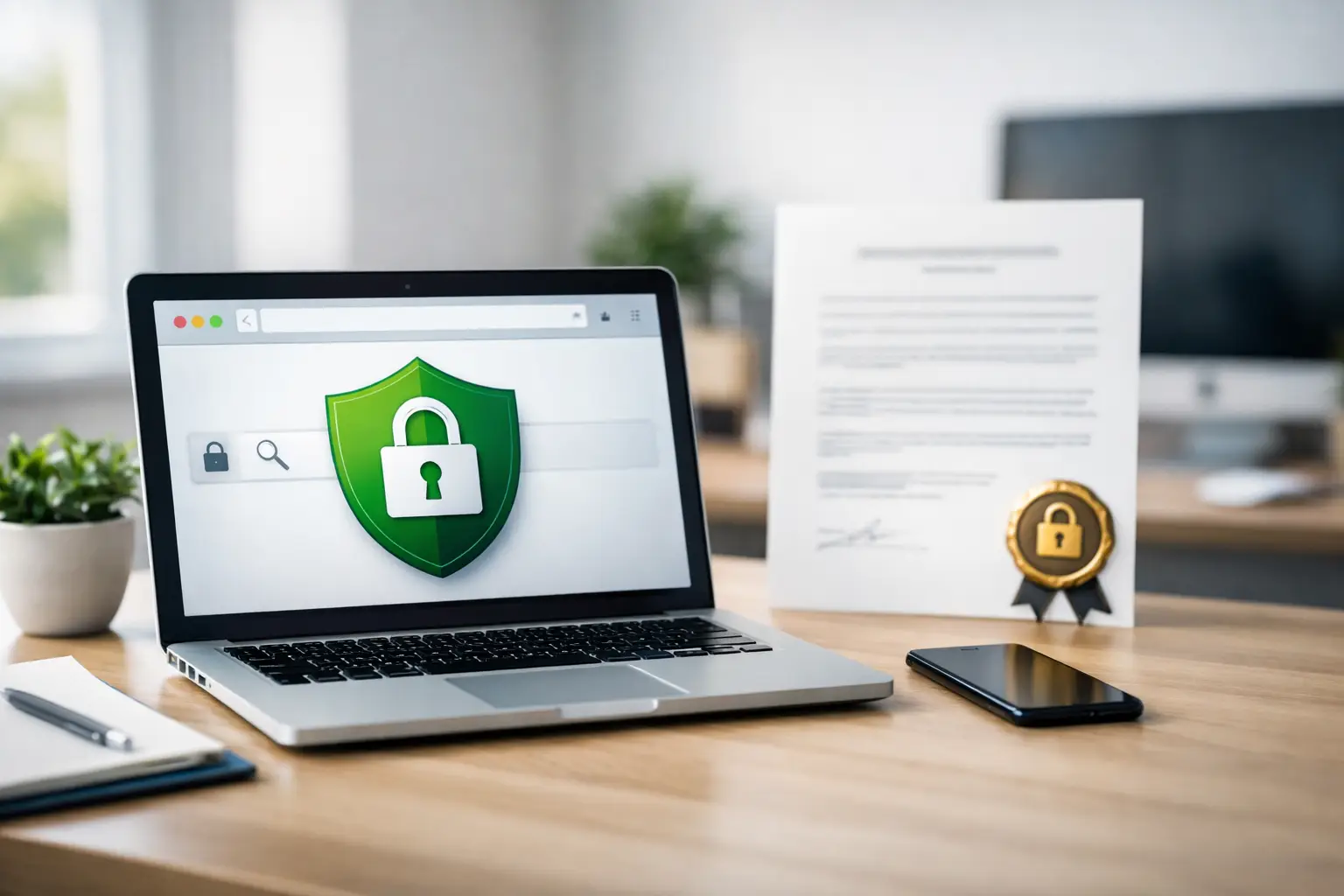
A customer has found your website, checked your service and is ready to send an enquiry or pay for an order. Then they see a browser warning saying the connection is not secure. For a small business, that moment can cost more than one sale. An SSL certificate for small business website security is not a technical extra. It is a basic sign that your business takes customer information, payments and trust seriously.
The good news is that SSL does not need to become another job on your list. Once it is correctly installed and managed, it works quietly in the background, protecting the connection between your website and the people using it.
What an SSL certificate actually does
SSL stands for Secure Sockets Layer, although the modern technology behind it is generally called TLS. Most business owners only need to know the practical result: SSL encrypts data travelling between a visitor’s browser and your website.
That means details entered into a contact form, login area, booking system or checkout cannot be easily read if intercepted in transit. A working certificate also changes your website address from HTTP to HTTPS and displays the padlock symbol in most browsers.
The padlock is not a guarantee that every business is genuine or that every page is free of risk. It tells visitors that their connection to the site is encrypted and that the site has been issued a certificate for its domain. That distinction matters, but so does the first impression. People are far more likely to stay on a site that looks safe.
Why SSL matters to small businesses
Large retailers have recognisable names and expensive marketing behind them. A local electrician, consultant, salon, tradesperson or independent online shop has less room for doubt. Visitors often decide within seconds whether a business looks credible enough to contact.
Without HTTPS, modern browsers may display warnings that make your website appear neglected or unsafe. Even when you never take card payments, a basic enquiry form collects names, email addresses, phone numbers and messages. That is personal data your customers expect you to handle responsibly.
SSL also supports search visibility. Google has treated HTTPS as a ranking signal for years, though a certificate alone will not move a weak website to the top of search results. It works alongside useful page content, clear service information, mobile performance, local relevance and sound on-page SEO. Think of it as essential groundwork, not a shortcut.
For online shops, the case is even clearer. Payment providers, shopping platforms and customers all expect a secure checkout. Trying to sell through an unsecured site creates unnecessary friction at the point where confidence matters most.
Which SSL certificate for a small business website is right?
There is no need to overpay for a certificate simply because the choices sound technical. The right option depends on the structure of your website and what it handles.
Domain validation certificates
A Domain Validated, or DV, certificate proves control of the domain name. It is the standard choice for many brochure websites, portfolios, local service sites, landing pages and smaller online shops. It provides the same strong encryption as more expensive certificate types and can usually be issued quickly.
For most small businesses, this is the sensible starting point. Customers need a secure connection, not an unnecessarily complicated purchase.
Organisation and extended validation
Organisation Validated certificates involve checks on the business behind the website. Extended Validation involves more detailed verification. These may suit organisations with particular procurement requirements, regulated sectors or clients who request formal verification.
They do not provide stronger encryption than a DV certificate. Their value is in the extra identity checks, so choose them only when there is a genuine business reason. Browser displays have also changed over time, meaning visitors may not see the obvious visual differences businesses once expected.
Wildcard and multi-domain certificates
If your website uses several subdomains, such as shop.yourbusiness.co.uk, bookings.yourbusiness.co.uk and members.yourbusiness.co.uk, a wildcard certificate can cover subdomains under one main domain. A multi-domain certificate is designed to protect more than one distinct domain name.
These can reduce administration for growing businesses, but only if you actually need them. A straightforward website on one domain should not be paying for extra coverage it will never use.
Free versus paid SSL: what is the real difference?
Free certificates are widely used and can deliver perfectly good encryption. Paid certificates can be useful where you need a particular validation type, multiple domains, specialist support or a provider that manages the certificate as part of a wider service.
The key question is not whether the certificate has a price tag. It is whether it is correctly installed, renewed before expiry and configured across every version of your website. A free certificate that is managed properly is better than a paid certificate that expires unnoticed.
This is where a managed website service can save real time. Instead of trying to understand certificate files, renewal notices and hosting settings, you have one team responsible for keeping the website secure and available. 1stNet AI includes SSL as part of its done-for-you website, hosting and maintenance approach, so customers can focus on enquiries, orders and growth rather than technical administration.
SSL setup mistakes that undermine trust
Installing a certificate is only the first stage. Small configuration errors can still leave visitors with warnings or an incomplete sense of security.
One common issue is mixed content. This happens when a page loads securely over HTTPS but still pulls an image, script, font or embedded resource through an insecure HTTP address. Browsers may flag this or block the resource. It can affect how pages display and damage customer confidence.
Another issue is failing to redirect all HTTP versions of the site to HTTPS. Your website should have one preferred, secure address. Otherwise, visitors and search engines can reach different versions of the same page, which creates confusion and may weaken SEO signals.
Certificates also expire. The result is a highly visible warning page that can stop customers before they ever see your website. Automatic renewal is helpful, but it should be monitored, especially if your domain, hosting or DNS settings have changed.
Finally, SSL is not a substitute for broader website security. It protects data in transit. It does not fix an out-of-date website platform, weak passwords, poorly managed user access or vulnerable plugins. A secure small-business website needs regular software updates, dependable hosting, backups and someone who can respond when something needs attention.
A simple way to check your website
Open your website in a private browser window and look at the address bar. It should begin with HTTPS, without a warning message. Test your contact form, booking process and checkout if you have one. Then visit a few key pages on mobile as well as desktop.
If your browser flags the site, do not ignore it or hope customers will. Ask your website provider to check the certificate status, HTTP-to-HTTPS redirects and mixed-content issues. This is normally a quick technical fix when handled early, but it can become costly when it is discovered only after lost leads or abandoned baskets.
Put security on the same footing as your shopfront
Your website often meets customers before you do. It should look professional, load securely and make it easy for someone to take the next step without second-guessing your business. SSL is one of the smallest parts of a website build, yet it carries an outsized message: this business is open, legitimate and ready to handle my enquiry properly.
Choose the certificate that fits your site, make sure renewals and redirects are owned by someone reliable, and leave the technical chasing to a team that does this every day. That gives your customers one less reason to hesitate and gives you more time to turn their interest into revenue.