
You can post every day and still get nothing useful from it. That’s the trap most UK owners fall into, a feed full of likes, a few polite comments, and no enquiries, no bookings, no sales. If your social media work doesn’t push someone towards a website visit, a direct message, or a checkout, it’s just noise with better lighting.
The UK market is already saturated with social use, which is exactly why vanity metrics are such a waste of time. Ofcom reported that 93% of UK adults were online in 2021, and 92% were online in 2024, with social networking among the most common activities, so the question isn’t whether people are there, it’s whether your content makes them act (DreamGrow summary of Ofcom’s UK data, Ofcom media use research). In the UK, 64% of adults use social media for news, which is another reason engagement has to be treated as a discovery layer, not a pretty counter at the bottom of a post (Sprout Social’s metrics guide citing Ofcom).
Table of Contents
What Social Media Engagement Really Means
For a UK small business, engagement only matters when it points to something useful, a website visit, an enquiry, a booking, or a sale. Hearts and polite comments can make a post look busy, but they do not pay invoices. If the numbers do not help you see who is moving closer to buying, they are noise.
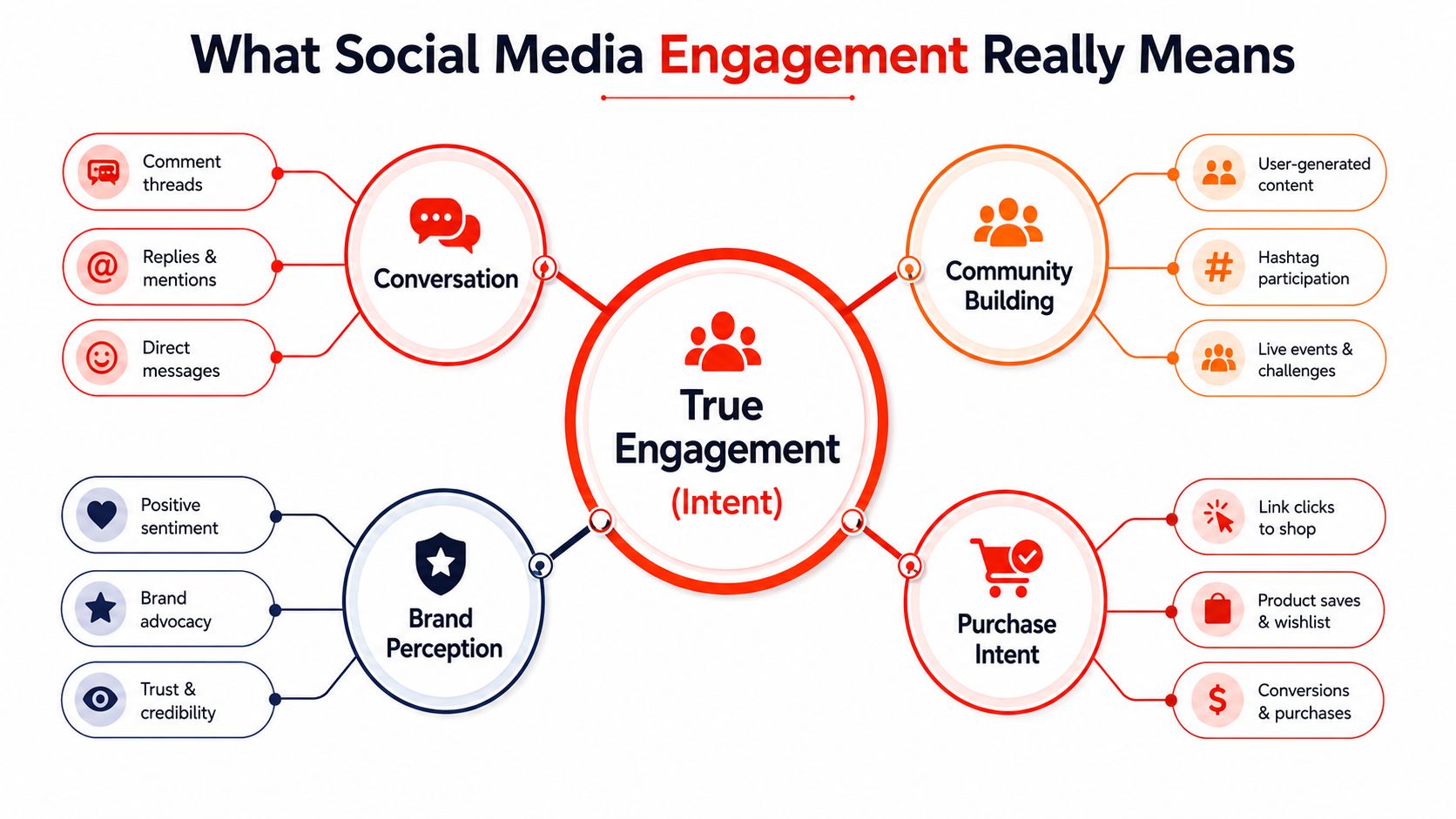
Social media engagement is any measurable interaction between a brand and an audience on a platform, but the type of interaction matters more than the raw total. A like is a nod. A comment is a conversation. A save says, “I’ll come back to this.” A link click says, “I want something beyond the app.” The difference matters because social platforms now sit inside everyday media habits, not on the edges of them.
Passive reactions and active responses
Passive reactions are the quick taps. Likes, reactions, and brief views usually mean the post did not put people off and may have caught their eye for a moment. That helps, but it does not tell you whether the content drove interest or revenue.
Active responses carry intent. Comments, shares, saves, profile visits, direct messages, and link clicks are stronger signals because the person has put in more effort. Treat a warm comment thread differently from a stray like, and treat a click differently again from both.
Practical rule: if a post gets attention but no action, it is content. If it gets comments, saves, or clicks, it starts becoming marketing.
A working definition you can run your business on
For a small business, social media engagement means measurable interaction that can be linked to attention, interest, and action. If it does not help you understand who is leaning in, what they want, and whether they moved closer to buying, it is not doing enough work.
That definition is stricter than many use, but it keeps owners from confusing applause with demand. It also gives you a cleaner standard for reporting, because the question becomes simple. Did this content move a buyer forward, or did it just look busy?
The Core Metrics That Actually Matter
Likes are applause. Comments are conversation. Shares are recommendations. Saves are bookmarks. Clicks are the point where someone leans toward your business instead of just acknowledging it. If you run a local service business, those signals should never be treated as equal.
Start with exposure, not vanity totals
A technically solid way to measure social media engagement rate is to use engagement rate = (total engagements ÷ impressions or reach) × 100 (PMC research on engagement measurement). That formula is better than follower count because it tells you how well the content performed among the people it reached. The same post can look weak on a large account and strong on a smaller one, so comparing raw totals is lazy reporting.
Here’s the practical distinction. Reach counts the people who saw the post. Impressions count how often it was delivered. Both matter, but impressions-based reporting is usually the cleaner test because it reflects actual delivery. In UK campaigns, that matters even more when organic and paid distribution behave differently.
Read each metric for what it means
- Likes and reactions are the lightest signal. They tell you the content was acceptable or mildly appealing, nothing more.
- Comments show active response. For local firms, they often reveal questions, objections, or buying triggers.
- Shares act like recommendations. When someone sends your post onwards, they’re attaching your content to their own judgment.
- Saves are a strong usefulness signal. People save how-tos, checklists, and comparison posts because they expect to use them later.
- Clicks are the closest public engagement proxy for commercial intent. If the post links to a service page, quote form, or product page, clicks matter more than any visible reaction.
- Dwell time is harder to read directly on every platform, but when people stay with a carousel, open a document, or watch longer video, you’re seeing attention depth, not just reach.
Comments indicate active response, shares increase second-order reach, and clicks are the closest engagement proxy for downstream conversion intent.
A simple filter for each post
Ask three questions. Did it start a conversation? Did it travel beyond the original audience? Did it move someone towards a website action? If the answer to all three is no, the post may have been pleasant, but it wasn’t effective.
Benchmarks by Platform and Business Type
Benchmarking social media performance without context is how owners end up calling solid posts “bad” and weak posts “great”. A LinkedIn consultancy, a Facebook restaurant, and a TikTok product brand are not playing the same game. Platform norms, audience size, and content style change the numbers you should expect.
Read the platform before you read the percentage
External benchmark guides from Adobe and Hootsuite point to broad platform differences, with LinkedIn typically stronger for B2B conversation and Instagram, Facebook, X, and TikTok varying by format and audience behaviour (Adobe Express benchmark guide, Hootsuite engagement guide). Use that as a cue, not as gospel. The right benchmark is the one that matches your channel mix and your audience quality.
The table below gives a practical way to read performance without pretending every account should hit the same number.
| Platform | Nano (under 10k) | Small (10k-100k) | Mid (100k-500k) | Typical content type |
|---|---|---|---|---|
| Higher than larger accounts, especially on Reels and carousels | Usually softer than nano accounts, but still strong for saves and shares | Lower than smaller accounts because audience size dilutes the rate | Reels, carousels, Stories | |
| Often strongest in local community groups and event-driven posts | Moderate, especially for local offers and conversation posts | Usually lower, unless community management is strong | Groups, Reels, local updates | |
| Can be high when posts are personal, useful, or document-led | Often strong for B2B thought leadership | Typically lower as reach broadens beyond the core network | Polls, documents, text posts | |
| TikTok | Can spike fast when content hits a niche | Rate depends heavily on format and relevance | Can fall as scale increases | Short-form video, stitches, replies |
| X | Often driven by reply culture and topicality | Can perform well on timely commentary | Usually weaker unless the account is highly active | Updates, threads, replies |
Why smaller accounts often look better
Nano and small accounts often show healthier rates because the audience is tighter and more relevant. That doesn’t mean they’re better businesses. It means the audience is more likely to care, interact, and convert. A local builder with 4,000 highly relevant followers can beat a larger but sleepy account if the goal is enquiries, not ego.
Separate organic from paid
Paid posts and organic posts should not be judged by the same rule. Paid content is buying delivery, so the audience is broader and often cooler. Organic content relies more on relevance and community. If you merge them in one report, you’ll fool yourself quickly.
Platform-Specific Tactics and Content Examples
A strategy document is useless if nobody can post from it on Tuesday morning. Small businesses need formats they can produce, not glossy ideas that need a studio, a scriptwriter, and a full-time editor. Good engagement comes from repeatable habits, not heroic one-off campaigns, and it only matters when it leads to a website visit, an enquiry, or a sale.
Instagram, Facebook, and LinkedIn with UK-friendly angles
On Instagram, use carousels, Reels, and Stories. A plumber can post a before-and-after carousel showing a bathroom repair, then finish with one line that invites local enquiries. A small ecommerce shop can turn a product demo into a Reel and ask a simple choice question in the caption. A service business can use Stories for quick polls, because that is easier than waiting for comments. If you want the post to do more than collect likes, pair it with a clear link and a landing page built for that offer.
Facebook works best when the business is local, familiar, or community-led. Use groups, events, short updates, and customer questions. A family-run restaurant can post a weekly specials board and ask which dish should stay on the menu. A trades firm can share a job completion photo and invite reactions from nearby homeowners. For local audiences, Facebook often works more like a neighbourhood noticeboard than a brand channel, so keep the ask simple and the next step obvious.
LinkedIn rewards clarity and utility. Use plain-text posts, document posts, polls, and short case examples. A consultancy can turn common client questions into a post that invites DMs. A B2B founder can share a blunt lesson from a recent project and ask what others are seeing. If you are writing for search as well as social, this guide to SEO copywriting will help you shape the message so it works on both channels.
TikTok and X need sharper intent
TikTok works when the content is quick, practical, and human. Show the process, answer one question, or react to a real customer concern. A jeweller can show the making process. A small salon can show a transformation. A retailer can turn a customer FAQ into a short reply video. Use CapCut for quick edits, add captions in Canva, and keep the hook tied to one clear customer problem. Overproduce it and you kill the point.
X is built for speed and commentary. Short takes, responses to industry chatter, and direct replies keep it alive. That does not mean you need to post constantly for the sake of it. It means every post needs a clear reason to exist, because on X, weak posts disappear fast. If you are running a local service business, use it for timely comment, customer support, or a sharp view on an issue your buyers care about.
Useful habit: reuse the same business question in different formats, a carousel on Instagram, a discussion post on LinkedIn, and a short reply video on TikTok. The platform changes, the intent stays the same.
A simple weekly mix that a small team can sustain
- One educational post that answers a customer question.
- One proof post that shows work, results, or process.
- One interaction post that asks for a choice, opinion, or vote.
- One traffic post that pushes a page with a clear next step.
That mix is realistic for a small UK team and gives you a balanced read on what drives conversations, clicks, and leads. Track the clicks with UTM parameters in Google Analytics 4, and use Bitly or Rebrandly if you want cleaner short links in the post. If the click does not lead to a page, form, booking page, or call, it is noise.
Turning Engagement Into Website Visits and Sales
Engagement without attribution is decoration. If someone likes your post but never reaches your site, submits a form, books a call, or buys, you’ve created activity, not outcomes. That’s fine for a hobby account. It’s not fine for a business.
Build the path before you publish the post
The simplest fix is to use trackable links, clear landing pages, and deliberate calls to action. UTM-tagged links tell you which post drove the visit. Link-in-bio tools such as Linktree or Beacons can help if you need multiple destinations, but they only work if each button has a purpose. A “learn more” button is vague. A “book a survey” or “get the price list” button gives the click a job.
The page matters too. Social traffic usually underperforms on a generic homepage because the visitor has already clicked with a specific expectation. A dedicated landing page that matches the post copy, offer, and visual style is cleaner and easier to convert from. That’s especially important for a local service or product launch where the next step should be obvious.
Move warm people out of the feed
Comment-to-DM workflows can work well when a post generates genuine interest. If someone asks for pricing, availability, or a sample, the fastest route is often a private conversation. The point isn’t automation for its own sake. The point is to stop losing warm intent in public threads where it goes nowhere.
If you need a broader traffic framework, this guide can help shape the next step: how to increase website traffic.
Use the right outcome as the real score
For some posts, the win is a click. For others, it’s a qualified enquiry. For a recruiting campaign, the win might be a sign-up. For retention work, it could be repeat engagement from existing customers. The old mistake is trying to judge every post by the same number.
Practical rule: if a post earns engagement but can’t be tied to a website visit or a business action, treat it as a brand signal, not a performance win.
A useful test is whether you can tell, within a week, if the post is working. If you can’t connect the engagement to traffic, leads, or sales, the setup is wrong, not just the content.
A Simple Weekly Reporting Template
A weekly report should fit on one page. If it takes a half-day to read, nobody will use it. The owner needs a clean view, the freelancer needs a clear brief, and the VA needs a repeatable structure.
Weekly reporting table
| Metric | Source | How to calculate | What to ask |
|---|---|---|---|
| Reach | Platform analytics | Use the platform’s reported reach | Did the post get in front of the right audience? |
| Engagement rate by platform | Platform analytics | (Total engagements ÷ impressions or reach) × 100 | Which platform earned the strongest response? |
| Top three posts | Platform analytics | Rank by engagement rate, clicks, or enquiries | What did these posts have in common? |
| Link clicks | Platform or link tool | Count clicks on tracked URLs | Did the post move people towards the site? |
| Website sessions from social | Website analytics | Sessions attributed to social traffic | Did social actually send visitors to the site? |
| Enquiries or sales from social | CRM, inbox, checkout | Count attributed actions | Did engagement lead to revenue or a qualified lead? |
A dashboard layout that cuts the noise
Start with three questions every week. What performed best, what underperformed, and what action should change next week? That keeps the report tied to decisions rather than buried in charts. Then add one short note per platform, no essay, just the pattern.
A good owner report has four parts. Performance, top posts, traffic, and business outcomes. If a team member can’t read it in a few minutes, it’s too complicated.
Use a four-week view, not a one-post panic
One post can mislead you. Four weeks of data show whether the pattern is real. If comments keep rising but clicks don’t, your content may be interesting but not persuasive. If clicks rise and enquiries don’t, the landing page may be the bottleneck. If nothing moves, the content or targeting is off.
That kind of reporting is where small teams stop guessing and start managing.
Underserved Angles and Your 90-Day Action Plan
A UK small business does not win social media by chasing the loudest crowd. It wins by finding the people who will visit the site, send the enquiry, book the slot, or buy the product, then building content around that path. A lot of mainstream advice pushes the same playbook, Instagram Reels, viral trends, and broad “post more” guidance, while ignoring local Facebook Groups, WhatsApp communities, older buyers, rural audiences, and the people who prefer a direct answer over a performance. Public engagement guidance says you need to understand how each audience already uses media and remember that actual reach is different from potential reach, and work on underserved communities means meeting people where they already are, not where a trend tool says they should be (Public Engagement guidance).
Public reactions are not the whole story
A like is a reaction. It is not a result.
For a UK business, the question is whether engagement leads to something useful, such as a website visit, an enquiry, a booking, a sale, or a sign-up. Research on UK-relevant outreach shows social media can help with recruitment in rural areas, and paid or unpaid ads can support engagement, enrolment, and retention of underrepresented groups in digital health research (PMC study on engagement and recruitment). That does not mean every business should run campaigns like a research project. It means you should stop treating likes as the finish line and start tying each post back to a business outcome. If your social activity is not linked to your wider website marketing strategy, it is just noise.
A 90-day plan that’s genuinely manageable
- Weeks 1 to 2, audit and set direction. Check which platform brings traffic, which posts generate comments or clicks, and which audience segments are invisible. Decide what outcome matters most, enquiries, bookings, sales, or sign-ups, then set one clear target for each channel.
- Weeks 3 to 6, test content formats. Try three formats per platform, not ten. Keep the topic stable so you can see what changes the response. Use one format for conversation, one for proof, and one for traffic.
- Weeks 7 to 12, standardise winners and report against revenue. Keep what works, cut what doesn’t, and tie the best posts back to website actions and business results. Build the next round of content around the posts that produced real movement, not the ones that filled the feed.
The point is simple. If a post gets attention but no site visit, no enquiry, and no sale, it has not done its job.
Match the channel to the community
If your customers spend their time in Facebook Groups rather than scrolling Instagram, use the group first. If they are local and practical, publish answers to the questions they ask before they ring or click. If they are B2B decision-makers, use LinkedIn posts that attract comments from people who can buy, not from people who just like a neat graphic. Engagement is contextual, so the channel has to fit the audience and the buying behaviour.
That is where small businesses stop copying generic advice and start building a channel mix that suits the people they want to reach.