

You’re probably in the same spot as many UK business owners. You need a website to go live soon. You’ve looked at a few hosting plans, and now every provider seems to make the same promise with different jargon. Shared, VPS, cloud, uptime, SSL, backups, CDN. It starts to feel less like buying a business service and more like sitting an exam you never revised for.
That confusion is expensive. A website isn’t just a set of files on a server. It’s where customers check whether you’re credible, look established, and trust you enough to call, book, or buy from you. Hosting affects all of that.
For most small businesses, the question isn’t which badge sits on the hosting company’s homepage. It’s the hosting model that gets your site online quickly, keeps it secure, and stops you from losing time to technical admin after launch.
Launch your website fast with a domain, SSL,
hosting & maintenance included. In an hour.
1stNet.AI website team. We transform your online presence with a stunning website.
Call us now at 0204 577 2255. Don’t miss this chance to boost your brand!
All our work comes with a 30-day money-back guarantee.
WE OFFER AN INTERACTIVE LIVE CHAT SYSTEM TO DESIGN YOUR WEBSITE.
Table of Contents
- Choosing Web Hosting Should Feel Like a Business Decision, Not a Tech Exam
- Decoding Web Hosting Types with a Simple Analogy
- Your Essential UK Hosting Checklist for 2026
- Which Hosting Is Best for Your Business Scenario
- The Hidden Costs and Headaches of Cheap Hosting
- The Smart Choice: Why a Fully Managed Service Wins
- Get Your Professional Website Online in an Hour
Choosing Web Hosting Should Feel Like a Business Decision, Not a Tech Exam
The biggest mistake I see is treating hosting like a tiny line item to buy later. Someone chooses a cheap plan first, then tries to bolt on design, security, support, maintenance, and SEO afterwards. That almost always creates friction because the website ends up split across too many suppliers and dashboards.
A better approach is simpler. Start with the business outcome. Do you need enquiries from local customers, online sales, or a credible site that supports referrals and repeat business? Once you answer that, judging hosting becomes easier. You’re not buying server space. You’re buying reliability, trust, and time back.
As of 2026, approximately 83% of small businesses have a website, which means a dependable online presence is no longer optional. In mature digital markets like the UK, site performance has become a competitive differentiator because customers already expect every serious business to be online, as noted in these small business website statistics from Network Solutions.
What business owners actually need from hosting
Most owners don’t want control panels and server settings. They want four things:
- A site that loads properly so visitors don’t bounce before reading the first line.
- A site that stays online when someone searches for you after seeing your van, leaflet, advert, or LinkedIn post.
- A secure setup so you don’t have to worry about certificate warnings, malware, or lost files.
- A clear support path when something breaks, and you need a human answer.
Practical rule: If a hosting option saves a few pounds but adds hours of admin, it isn’t the cheaper option for a small business owner.
The right decision usually comes down to responsibility. Who handles updates, backups, performance tuning, security hardening, and troubleshooting? If the answer is “you”, then the monthly price is only part of the story.
Why comparison tables often mislead
Most “best web hosting for small business” lists compare providers as products. That’s useful up to a point, but it misses the day-to-day reality of running a site. A small business doesn’t just need a host. It needs a working setup that includes launch, protection, and ongoing care.
That’s why the stronger question is this: do you want a hosting plan, or do you want a website service that removes technical drag from your week?
Decoding Web Hosting Types with a Simple Analogy
Hosting is easier to understand when you compare it to property. Each model gives you a different balance of cost, privacy, performance, and maintenance effort.
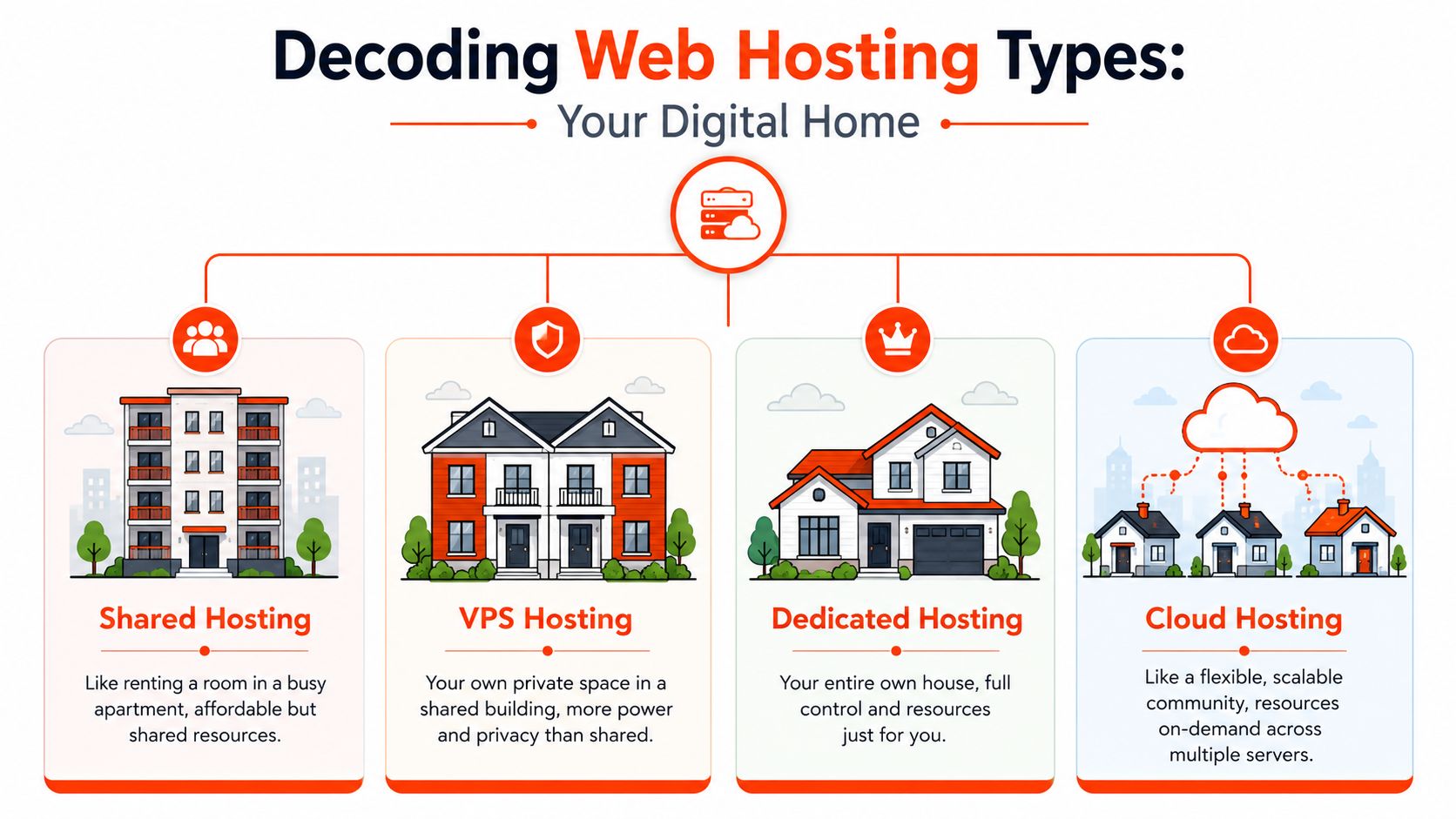
Shared hosting is the busy flat.
Shared hosting is like renting a flat in a large building. It’s affordable, easy to move into, and often fine for a basic brochure site. But you share the building’s resources with many neighbours.
If another site on the same server gets busy, your site can feel it. That doesn’t mean shared hosting is always bad. It means it’s best suited to simple websites with modest traffic and low technical demands.
For a local service business with a few pages and a contact form, shared hosting can work. For a shop, booking platform, or content-heavy site, its limits often start to show.
VPS hosting is your own townhouse
A VPS gives you a more private slice of the building. Using the housing analogy, it’s closer to a townhouse or semi-detached home. You still sit within a larger structure, but your space is more defined, and your resources are more predictable.
Many growing businesses land here. You get stronger performance and more room to grow, but usually at the cost of more setup responsibility unless the VPS is managed for you. That’s the catch many owners miss. Better infrastructure doesn’t automatically mean less hassle.
A more powerful server helps only if someone is actively maintaining it.
Dedicated and cloud hosting serve different jobs.
A dedicated server is your detached house. Everything is yours. That gives you control and isolation, but it also means more responsibility and higher cost. Most small businesses don’t need this unless they run something unusually demanding or highly specialised.
Cloud hosting is more flexible. Think of it as living in a modern development where resources can shift as needed. It can be useful for websites with variable demand, especially when traffic patterns aren’t consistent.
Here’s the practical version:
| Hosting type | Best fit | Main trade-off |
|---|---|---|
| Shared | Small brochure sites, early-stage websites | Lower cost, but shared performance |
| VPS | Growing firms, shops, busier business sites | Better resources, more complexity |
| Dedicated | Large or specialised setups | Control, but higher management burden |
| Cloud | Sites need flexibility and easier scaling. It can | It would be harder to judge on value |
The underlying hardware matters too. UK-based hosting with NVMe storage can improve page load speed by up to 40% compared with standard SSD-based shared hosting, according to this UK hosting performance analysis. For a small business, that matters because visitors don’t separate “hosting speed” from “business quality”. They see a website that feels quick or sluggish.
Your Essential UK Hosting Checklist for 2026
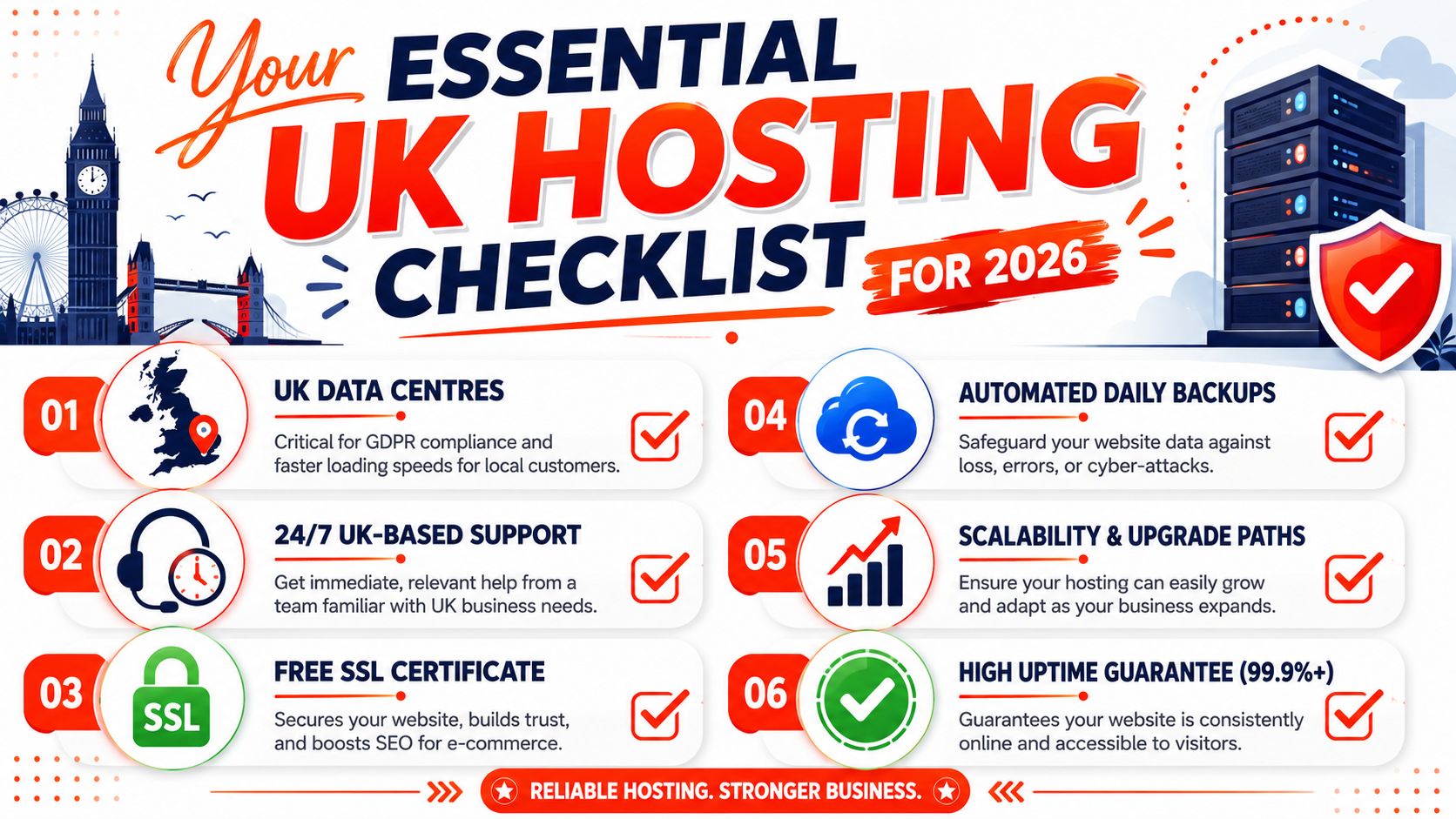
If you only remember one part of this guide, make it this checklist. These are the features I’d consider must-haves for a customer-facing UK business site.
Thenon-negotiables
UK data centres
This is about speed and data handling. If your customers are mainly in Britain, local infrastructure usually gives a better experience and a cleaner compliance position.SSL is included by default
Every serious business site should load securely with HTTPS. If SSL is an add-on or hidden upsell, that’s a warning sign.Automated daily backups
Backups aren’t exciting until you need one. A plugin conflict, accidental edit, or malware issue is much easier to fix when yesterday’s clean version is readily available to restore.Support that understands business urgency
When your site is down, you don’t need generic replies. You need clear answers and ownership.Scalability without a rebuild
Good hosting should let your site grow without forcing a painful migration the moment traffic improves.A serious uptime commitment
A 99.9% uptime guarantee is the minimum standard, while stronger providers offer 99.99% uptime, which can reduce potential downtime risk by over 70% annually, according to CNET’s small business hosting review.
A quick buyer check before you pay
Before buying, ask these questions:
Where is my site hosted?
“Europe” is broader than “UK”. Ask for clarity.What’s included without extra fees?
SSL, backups, maintenance, migration, email, and support often sit in the small print.Who handles my domain and web hosting together?
If you’re unsure how domains fit into the bigger picture, this plain-English guide on what a domain name is is worth reading before you commit.What happens after launch?
Many plans help you get online, then leave security and updates to you.
Buyer check: If the plan looks cheap because essentials are excluded, it isn’t a bargain. It’s a partial service.
A proper checklist protects more than your website. It protects your ability to take enquiries, process orders, and avoid being dragged into technical maintenance you never wanted in the first place.
Which Hosting Is Best for Your Business Scenario
The right answer depends on what your business needs the website to do. Not every company needs the same setup, and not every low-cost plan fails. Context matters.
The local tradesperson
A plumber, electrician, roofer, or locksmith usually needs a site that acts like a strong digital business card. It should load quickly, show service areas, display reviews, and make calling from a mobile easy.
In that case, the priority isn’t endless server power. It’s dependable uptime, SSL, simple editing, and support when something stops working. Shared hosting can be enough if it’s well managed. Poorly managed budget hosting usually isn’t.
A trade site often succeeds because it’s tidy, fast, and trustworthy. It doesn’t need to be technically fancy.
The growing online shop
An online craft shop has a different profile. Product pages, checkout, stock changes, payment integrations, and promotional peaks put more pressure on the hosting environment. Here, performance and security matter more than shaving the monthly fee.
This kind of business is usually better served by a stronger platform, such as a managed VPS or managed cloud hosting. The owner needs backups, malware protection, and the ability to scale during busy periods, but still wants someone else to handle technical maintenance.
If your site takes payments, reliability stops being a nice-to-have and starts affecting revenue directly.
The consultant who needs to launch fast
A new consultant or small agency often has a different problem. They don’t need a complex stack. They need to look credible next week, not next quarter.
For them, the best web hosting for a small business is often the setup that removes decision fatigue. Domain, SSL, hosting, maintenance, and launch support in one place usually beats managing separate suppliers. The hosting itself may be technically simple, but the service around it becomes the main value.
Here’s a practical match-up:
| Business scenario | Top priority | Best fit |
|---|---|---|
| Local tradesperson | Reliability and trust | Managed shared hosting or simple all-in-one service |
| Growing online shop | Security and performance | Managed VPS or managed cloud |
| New consultant | Fast launch and low admin | Fully managed bundled service |
The best choice is the one that matches your bottleneck. Some owners need more power. Many need fewer moving parts.
The Hidden Costs and Headaches of Cheap Hosting
Cheap hosting works like an iceberg. The low monthly price is the visible tip. Most of the actual cost sits beneath the surface, where you only notice it after something goes wrong.
The first hidden cost is time. A plan can look affordable until you spend your Friday afternoon dealing with SSL issues, plugin conflicts, support delays, or unclear renewal terms. A business owner shouldn’t have to become a part-time hosting technician to save a small amount each month.
The cheap plan is only the visible part.
The second hidden cost is risk. For UK firms, data sovereignty is one of the most overlooked issues. According to this review of UK hosting providers, 41% of small-business data breaches stemmed from providers lacking UK data centres. That’s not just a technical detail. It can create compliance problems and expose businesses to avoidable trouble.
If you’re budgeting a new site, it helps to understand the full picture. This guide to the cost of a website is useful because it frames hosting as one part of the total website spend, not the whole decision.
What usually goes wrong
Cheap plans tend to fail in familiar ways:
Support is too thin
You get answers, but not ownership. That matters when the site is down, and you need someone to solve the problem, not explain it vaguely.Security is treated as an extra.
Malware scanning, proper backups, and active monitoring are often left out or pushed into paid add-ons.Performance drops at the wrong time.
Your site may feel fine when traffic is light, then struggle when a promotion, referral, or seasonal spike arrives.Renewals and extras distort the actual cost.
The headline number looks attractive. The practical monthly running cost often doesn’t.
Cheap hosting is rarely judged on a calm day. It’s judged on the day your contact form stops working, your checkout fails, or your homepage disappears.
For some very small sites, a low-cost plan can be enough. But “enough” only works when the service still covers the basics properly. If it doesn’t, the savings vanish quickly.
The Smart Choice: Why a Fully Managed Service Wins
For most small businesses, the strongest hosting decision isn’t a product comparison. It’s choosing a service model in which one team handles launch, infrastructure, and post-launch care.
That matters because unmanaged setups create handoffs. One company sells the domain. Another provides the hosting. A freelancer builds the site. A plugin vendor handles forms. When something breaks, each party can point the finger at the other.
Why the service model works better
The best managed approach removes that fragmentation. It treats the website as an operational asset that must remain healthy after launch.
That’s especially important because post-launch care is often where small firms get caught out. A 2025 UK SME Digital Survey found 57% of small businesses experienced site downtime or malware within 6 months due to unmanaged hosting, as reported in Forbes Advisor’s hosting guide. The issue isn’t just launch quality. It’s what happens after launch.
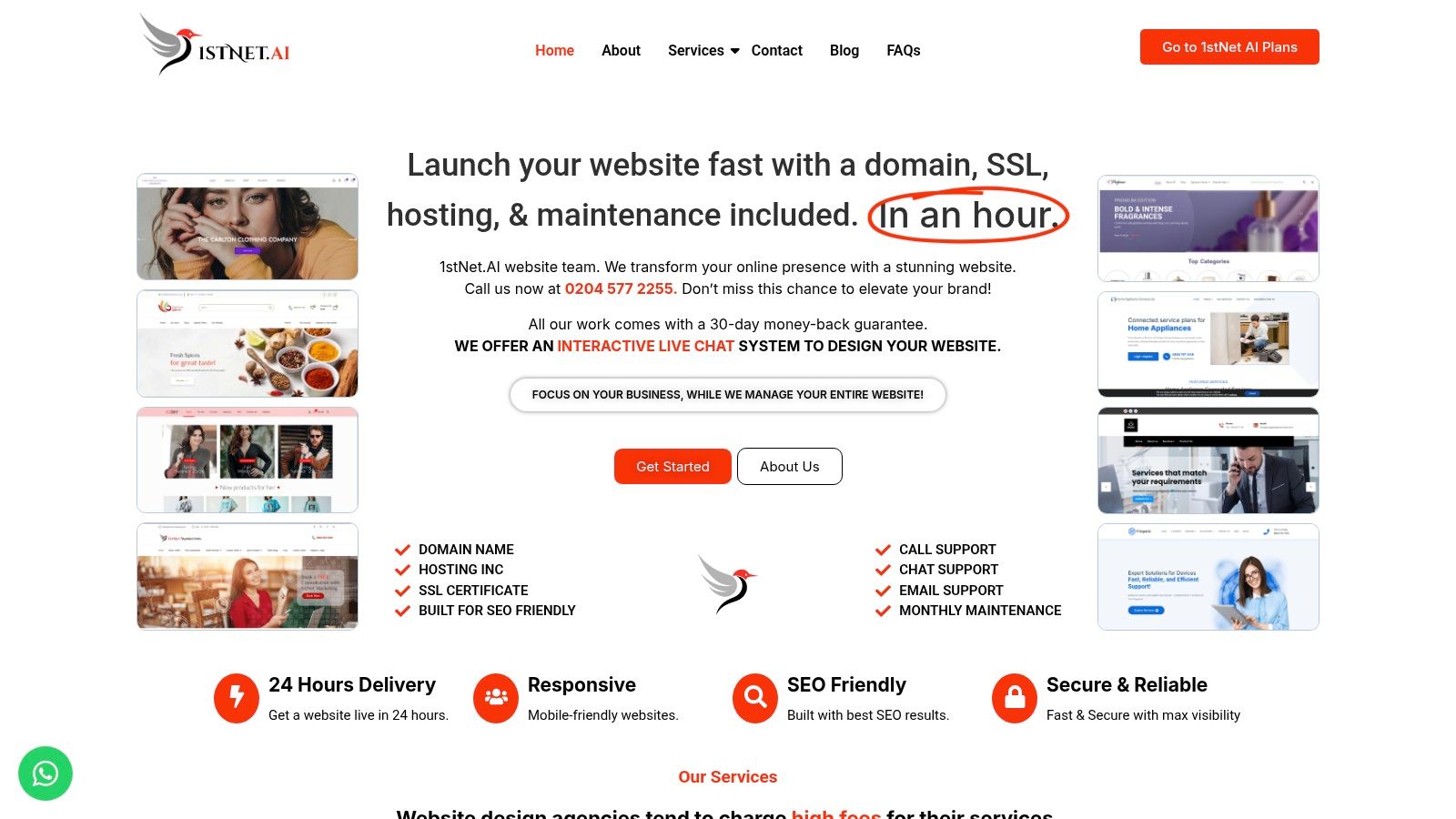
One example of this service model is website design and hosting from 1stNet AI Ltd, which bundles domain registration, SSL certificates, hosting, maintenance, and support into a single managed process. That kind of structure fits owners who don’t want to coordinate multiple vendors.
What a managed all-in-one setup should include
When I’m evaluating a fully managed offer, I look for these signs:
One accountable team
If design, hosting, and maintenance sit together, there’s less finger-pointing when changes or fixes are needed.Launch speed without chaos
Fast delivery matters, but only when the post-launch support is already built in.Included maintenance
Updates, monitoring, security hardening, and routine care shouldn’t be afterthoughts.A clear guarantee
Confidence is easier to trust when the provider stands behind the work.
A good managed service doesn’t just put your website online. It keeps it usable, secure, and supported while you focus on your customers.
This is why I’d steer most small firms away from a purely DIY hosting decision unless they already have in-house technical capacity. A fully managed, all-in-one setup is often the more practical answer because it reduces both complexity and operational risk.
Get Your Professional Website Online in an Hour
If you’ve been circling hosting reviews for days, the shortest route to a good decision is this. Stop treating hosting as a separate technical purchase. Choose a setup that includes the website, infrastructure, and ongoing care in a single managed service.
That’s what makes the best web hosting for small businesses feel manageable. You don’t need to compare endless server plans or learn backend terminology you’ll rarely use. You need a website that looks professional, loads properly, stays secure, and doesn’t become another admin burden.
Launch your website fast with a domain, SSL, hosting & maintenance included. In an hour.
1stNet.AI website team. We transform your online presence with a stunning website.
Call us now at 0204 577 2255. Don’t miss this chance to enhance your brand!
All our work comes with a 30-day money-back guarantee.
WE OFFER AN INTERACTIVE LIVE CHAT SYSTEM TO DESIGN YOUR WEBSITE.
If you want a done-for-you website with a domain, SSL, hosting, maintenance, and support handled in one place, take a look at 1stNet AI Ltd.