
You’ve uploaded a useful video, added a sensible title, and waited for the views to arrive. A week later, the view count is barely moving, the website hasn’t received a noticeable lift, and paid promotion starts to look like wasted money.
That’s a common experience for UK small businesses. YouTube video promotion can generate awareness, enquiries and sales, but only when the video is packaged for attention, distributed beyond the channel and measured against a commercial outcome. A viral hit isn’t required. A focused video that reaches the right local or specialist audience can be far more valuable than a large, irrelevant view count.
The UK market is already heavily invested in video. Social video services including YouTube, TikTok and Instagram generated about £5.4 billion in UK online display advertising in 2023, up 19.7% from £4.5 billion in 2022, according to Ofcom’s Media Nations 2024 data. Video promotion has moved into ordinary media planning, which means small firms need a disciplined process rather than occasional boosted posts.
Why Most YouTube Videos Never Get Seen
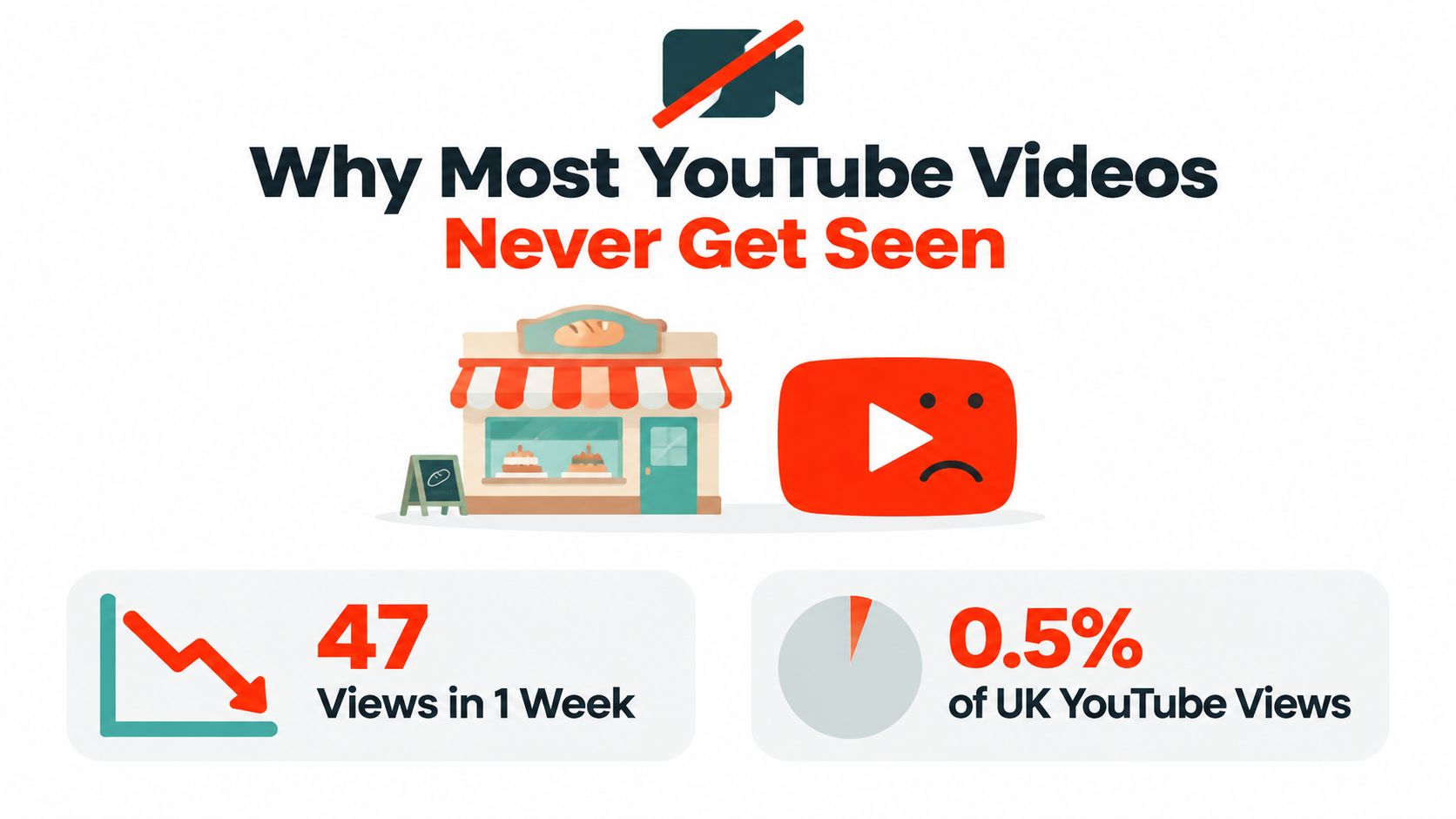
A Bristol bakery owner uploads a 90-second video showing how she decorates a celebration cake. The footage is clear, the finished cake looks impressive and the description includes the bakery’s website. After a week, it has 47 views, mainly from the owner, her staff and a few supportive customers.
The gap is between publishing a video and giving the right people a reason and route to find it. A title such as “Cake decorating video” offers little search value or curiosity. A cluttered thumbnail is easy to skip, especially beside polished creator content.
Practical rule: Treat the title and thumbnail as the advert for the video. The footage only gets a chance after someone clicks.
Three problems account for many stalled uploads:
- Weak packaging: The title does not address a clear search need, and the thumbnail lacks a strong subject, contrast or visible result.
- Limited audience signals: Early viewers leave quickly, fail to save or share the video, or ignore the question beneath it. YouTube then has little evidence about who should see it next.
- No external distribution: The business publishes once and waits. The video is not embedded on the website, included in an email or adapted into a useful clip for a relevant local community.
The UK market is competitive because online advertising already attracts substantial business investment. Ofcom reported overall UK advertising expenditure of £36.6 billion in 2023, up 5.3% year on year, with online advertising driving most of the growth, according to the UK online video advertising figures. A small business is therefore competing for attention in a mature digital market. Publishing and hoping will rarely produce measurable results.
The practical response is a distribution plan tied to the customer journey. Improve the promise, choose paid reach carefully, place the video where customers already interact with the business, and review results each week. A bakery does not need a global audience. It needs people searching for celebration cakes, wedding suppliers or dependable local bakers to understand the offer quickly and take the next step.
Optimising Your Video Before You Spend a Penny
A bakery can spend on promotion, then discover that viewers leave before the cake appears or cannot find the booking link. Fix the video’s packaging and customer path first. YouTube Studio gives you the main tools: title, thumbnail, description and pinned comment. Small changes here can improve performance without another day of filming.
Start with the promise
Build the title from three parts: the primary keyword, the benefit and a reason to care. “How to Price a Cake Order” gives the viewer a specific task and outcome. “Cake pricing tips” is broader and less useful. A Bristol bakery could use “How Much Does a Bristol Wedding Cake Cost?” if the video answers that question directly.
The title makes one promise. The opening footage must support it quickly. Avoid dramatic claims the video cannot prove. A misleading title may win the click, but early exits reduce viewing quality and weaken trust with potential customers.
Make the thumbnail readable at a glance
Use one high-contrast subject, a simple background and no more than three words. A close-up of the finished cake with “PRICE IT RIGHT” communicates faster than a collage of ingredients, tools and small text. A presenter’s face can help when their reaction or expertise is part of the story. Adding a face purely for decoration creates noise.
UK click-through-rate benchmarks are often cited at around 2% to 10%, depending on the niche. Treat that range as a prompt for testing, not a target or guarantee. If impressions increase while clicks stay weak, test a different thumbnail or title before adding budget.
Build useful context around the footage
Write a description of roughly 150 words. Start with the value statement, identify who the video helps and give one next action, such as visiting a service page or requesting a quotation. Add chapters with timestamps where they help viewers reach the relevant answer while keeping the wider structure clear.
Tags provide supporting context. They cannot compensate for an unclear subject. Add 8 to 12 specific tags, beginning with the exact-match keyword, followed by close variations, location terms and the service category. A bakery might use “cake pricing”, “Bristol cake orders” and “wedding cake consultation”, provided the video covers each topic.
Use the pinned comment to ask a real customer question. “What’s the hardest part of pricing a custom cake?” should produce more useful replies than “Like and subscribe”. Those replies expose the language customers use, which can inform future titles, landing pages and videos. If the video is part of a wider acquisition plan, connect it to our guide to increasing website traffic instead of leaving the description without a clear route onward.
Run this check before publishing:
- Read the title aloud: Is the audience and benefit obvious?
- Shrink the thumbnail: Can you understand it at mobile size?
- Check the first moments: Does the video reach the subject quickly?
- Test the destination: Does the link open properly on a phone?
- Read the comment: Does it ask something customers might answer?
Choosing the Right Paid Format on a Small Budget
A local firm with a £300 monthly limit cannot test every YouTube format properly. Choose the format according to the job: generate a response, build recognition or remind people who have already watched a video.
The ranges below are planning estimates for UK campaigns. Actual costs change with audience size, auction pressure, creative quality and targeting, so treat them as working assumptions rather than promised prices.
| Format | UK Cost Range | Best For | Minimum Viable Spend |
|---|---|---|---|
| Skippable in-stream | £0.04 to £0.12 CPV | Website traffic and leads | £10 to £20 daily |
| Non-skippable in-stream | £12 to £25 CPM | Broad brand awareness | Requires careful budget control |
| Bumper ads | £10 to £18 CPM | Retargeting and reminder messages | Better as a supporting layer |
| YouTube Shorts ads | £0.02 to £0.08 CPC | Low-friction, impulse-led purchases | Test alongside a main campaign |
Skippable in-stream is usually the strongest starting point for a local service business. Viewers can skip, which makes the opening seconds important. State the problem, audience or benefit immediately, then send interested viewers to one clear destination, such as a booking page, consultation form or product collection.
Non-skippable in-stream provides exposure for the selected duration, but exposure does not guarantee attention or action. It can support recognition campaigns, though generic creative can consume a small budget quickly. Use it only when the offer and message are already clear.
Bumper ads are short, non-skippable reminders. They work best when people already recognise the business or have watched another video. They rarely leave enough time to explain a complex service from the beginning.
Shorts ads suit offers that make sense quickly on a phone and need strong visual impact. Test them for products with a simple buying decision. Professional services often need a longer explanation before asking someone to enquire.
For total monthly spend under £300, begin with one skippable in-stream campaign and one Shorts campaign. Review both after seven days, then pause the weaker option. Keep a campaign because it supports the chosen outcome, not just because it delivers inexpensive views.
UK advertisers must follow the Advertising Standards Authority’s rules for non-broadcast advertising. Pay particular attention to claims, price presentation and creator partnerships. Disclose commercial relationships clearly and ensure every statement can be supported. That protects the campaign while keeping the message credible.
Distributing and Repurposing Beyond YouTube
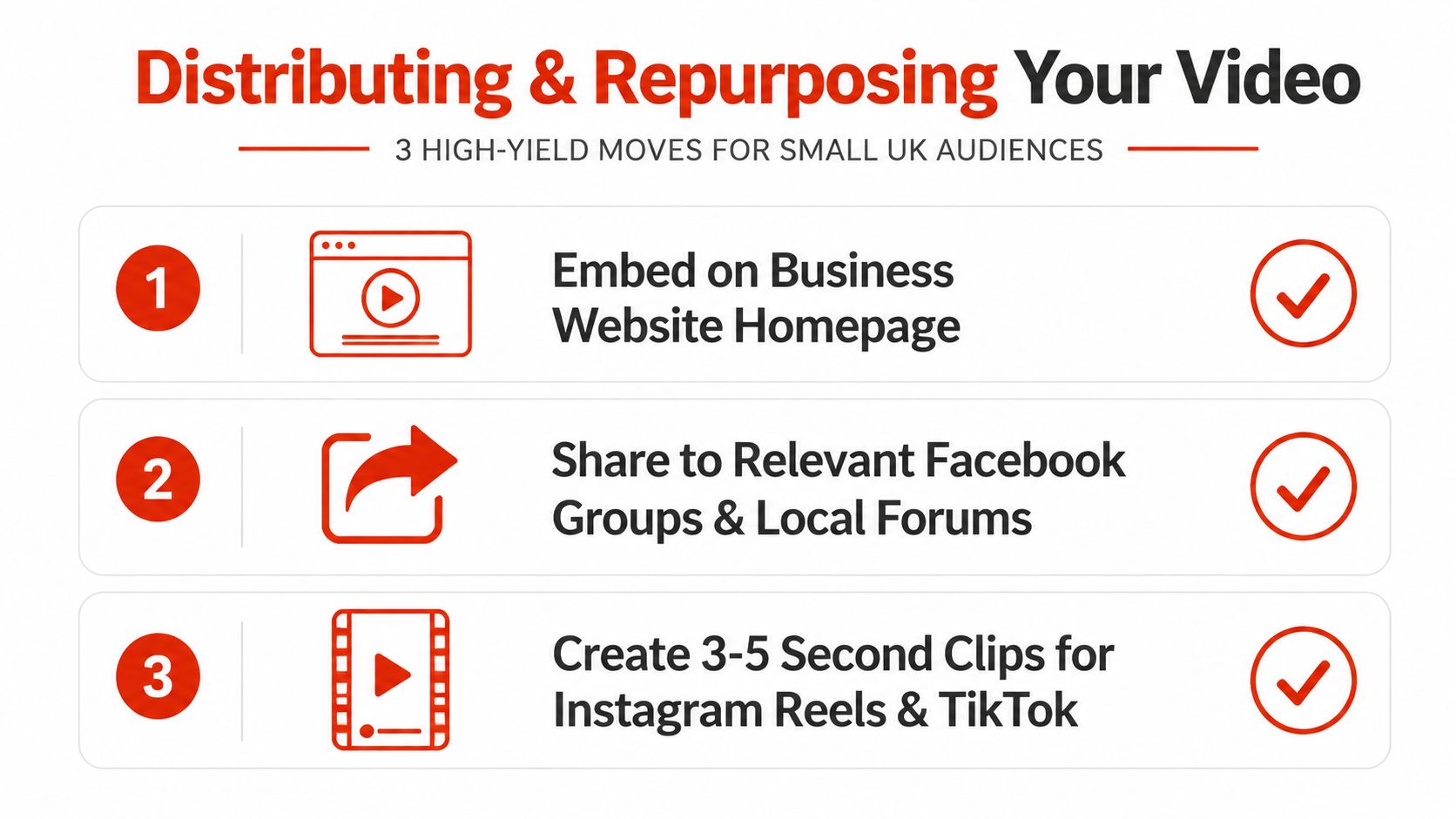
YouTube should be the main home for the full video, not the only place customers encounter it. Small businesses often have a warmer audience elsewhere, including website visitors, email subscribers, existing clients and professional contacts. Distribution works best when each channel receives a version suited to its context.
Put the full video where intent already exists
Embed the video on the most relevant website page, not automatically on the homepage. A cake-pricing video belongs near the cake-order enquiry form. A tradesperson’s boiler-maintenance video belongs beside the related service explanation. Add suitable schema markup through the website’s content system, and make sure the surrounding copy explains what the video helps the visitor decide.
LinkedIn is a strong priority for B2B firms, consultants and specialist suppliers. Don’t paste a YouTube link with “new video”. Write a short post that states the business problem, include a native preview or useful excerpt where appropriate, and make the full video the next step for people who want detail. A thoughtful post aimed at a relevant professional audience is more valuable than broadcasting the same message across every network.
Email is often overlooked because the list is small. That’s a mistake. Use a short subject line that names the benefit, then place one sentence above the link explaining why the recipient should watch. If the audience is large enough to support a meaningful comparison, test two subject lines. If it isn’t, focus on relevance and clarity instead of pretending the test is statistically conclusive.
Repurpose moments, not the entire production
A long-form video can provide several smaller assets:
- Short vertical clips: Extract the most useful moment for YouTube Shorts, TikTok and Instagram Reels. Add captions directly to the clip because many viewers watch without sound.
- Professional excerpts: Turn a clear explanation or mistake-prevention point into a LinkedIn post with a short introduction.
- Visual summaries: Pull key frames, steps or before-and-after details into a carousel.
- Email content: Use one practical takeaway rather than sending a full transcript.
The order matters. Start with the website embed because it supports visitors who already have some interest. Move next to email and targeted LinkedIn sharing, then create short-form edits if the original contains strong standalone moments. Businesses can use social media engagement support to maintain the conversations created by those posts, but no distribution service can replace a relevant message.
External sources typically account for a qualitative minority of a video’s early traffic, and the practical benchmark often cited is 5% to 15% within the first month, as outlined in UK YouTube promotion guidance. Treat that as a directional expectation, not a guarantee.
For a time-poor owner, prioritise actions by effort:
- Low effort, likely value: Add the video to a relevant website page and send it to existing contacts.
- Moderate effort, useful reach: Write a customized LinkedIn post and share it with relevant local or trade communities.
- Higher effort, additional discovery: Create several captioned vertical clips and a visual summary.
Measuring ROI and Iterating Weekly
Start with the business result, not the YouTube dashboard. Decide whether the video needs to influence enquiries, sales, bookings or email sign-ups. A video can be commercially useful without producing the largest view count, while a widely watched video can fail if it attracts people who’ll never buy.
Set up YouTube Studio to monitor viewing behaviour and connect Google Analytics 4 to the website so you can review traffic and assisted conversions. Use tracked links for campaign destinations, and keep the conversion event specific. “Visited the website” is a useful diagnostic, but “submitted a consultation form” is closer to the decision the owner needs to make.
Keep one small dashboard
A simple dashboard prevents metric collecting from becoming a substitute for marketing. Record these five numbers for each review period:
- Views: How much exposure the video received.
- Average view duration: Whether the content holds attention.
- Click-through rate: Whether the packaging earns clicks.
- Website traffic: Whether viewers continue to the intended destination.
- Assisted conversions: Whether the video helped people before the final conversion.
There isn’t a reliable universal “small channel average” that can be applied to every UK business. A local solicitor, a restaurant and a software supplier serve different audiences, budgets and buying cycles, so the table below uses a practical interpretation rather than invented benchmark figures.
| Metric | Small Channel Avg | Healthy Range | Red Flag |
|---|---|---|---|
| Views | Establish your own baseline | Rising among the intended audience | Exposure comes only from internal or personal sharing |
| Average view duration | Compare with similar videos | Viewers reach the main explanation | Viewers leave before the value appears |
| Click-through rate | Compare title and thumbnail tests | Packaging earns consistent interest | Impressions rise while clicks stay weak |
| Traffic to website | Track with tagged links | Visits reach the relevant page | Clicks go to an unclear or irrelevant destination |
| Assisted conversions | Review in Google Analytics 4 | Video appears in conversion paths | No commercial action after repeated exposure |
You can use the website marketing strategy framework to align the video with landing pages, email and search activity. The important point is consistency. The promise in the thumbnail, the message in the video and the offer on the page should describe the same customer problem.
Run a 20-minute weekly review
Spend the first few minutes identifying what worked. Did viewers respond to a particular opening, topic or traffic source? Then choose one change, such as a new thumbnail, tighter description or different destination page. Finally, decide what to cut, including an audience segment or format that produces attention without business value.
Don’t change everything at once. If the title, thumbnail, audience and landing page all change together, you won’t know which decision affected the result. Keep a short record of each change, then let the next review guide the following test.
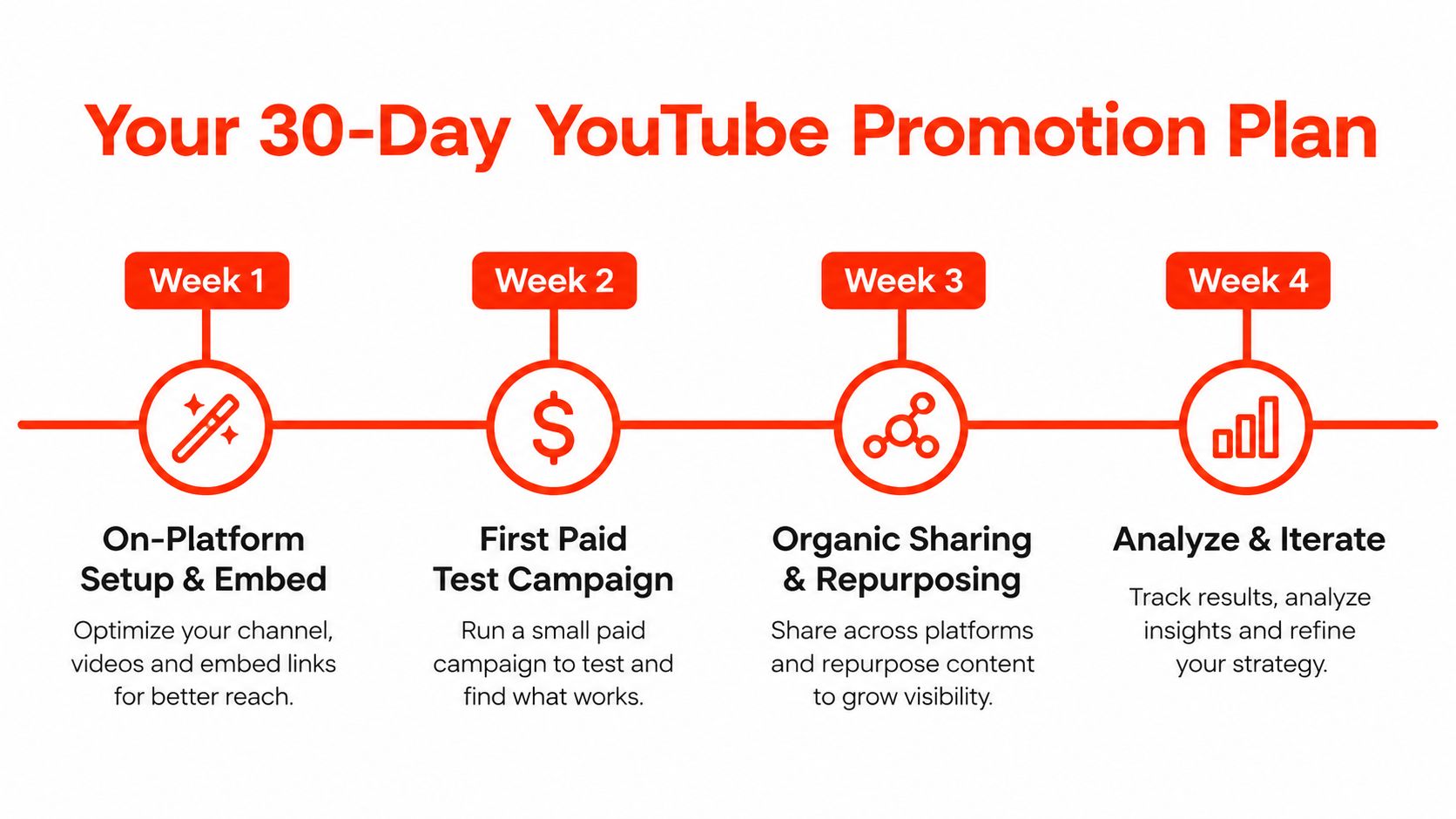
Your 30-Day YouTube Promotion Plan
A small business doesn’t need a complex content department to run a useful promotion cycle. It needs a fixed sequence that protects time, tests one clear idea and removes weak activity quickly.
Week one, prepare the asset
Spend a focused working session rewriting the title, simplifying the thumbnail, improving the description, adding chapters, loading relevant tags and writing a pinned question. Embed the video on the page most closely connected to the offer, then test the page and links on a phone.
Time required: A concentrated setup block, depending on how much is already prepared.
Success signal: The video has a clear audience, one commercial next step and packaging that makes sense without sound.
Week two, test paid reach
Launch one skippable in-stream campaign and one Shorts campaign if the video suits both formats. Keep the audience definition narrow enough to reflect the customer, and use a small daily budget rather than committing the full test budget immediately.
Time required: Campaign setup plus a short review of targeting and creative.
Success signal: One format shows stronger movement towards the chosen outcome. Cheap views alone aren’t enough.
Week three, distribute and repurpose
Place the video in an email, publish a LinkedIn post and create captioned vertical clips from the strongest moments. Share only in relevant communities where the content answers a genuine question. Avoid dropping the same sales message into unrelated groups.
Time required: A modest editing and publishing block.
Success signal: External traffic reaches the relevant page and viewers take the next step.
Week four, review and simplify
Open YouTube Studio and Google Analytics 4. Record views, average view duration, click-through rate, website traffic and assisted conversions. Pause the weaker paid format, update the packaging if clicks remain poor and keep the distribution channel that produces useful visitors.
Time required: A structured 20-minute review, followed by only the changes the data supports.
Success signal: You know what to repeat, what to alter and what to stop.
If you’ve only got two hours a week, cut in this order:
- Drop broad, untargeted promotion first: It creates activity without a clear customer path.
- Drop complex visual assets next: Keep one strong clip rather than producing a full carousel set.
- Keep the website embed and measurement: Those activities connect attention to an owned business destination.
- Keep one paid test: A controlled campaign teaches more than several unmanaged boosts.
One legal point matters for any guarantee connected to a purchase. UK consumers retain statutory rights for faulty, misdescribed or unsuitable goods, and the Consumer Rights Act 2015 provides a short-term right to reject faulty goods within 30 days of delivery, with refunds due within 14 days after the trader accepts the refund obligation. Government guidance also explains cancellation and refund rules for distance purchases in consumer returns and refunds guidance, so public guarantee wording must sit alongside, not replace, those rights.
For a website supporting your campaigns, encrypted connections matter too. The National Cyber Security Centre’s certificate guidance explains how certificates identify and authenticate clients and gateways when encrypted connections are established. That’s why SSL should be treated as part of the website infrastructure, not merely as a trust badge.
Launch your website fast with a domain, SSL, hosting & maintenance included. In an hour. 1stNet.AI website team can transform your online presence with a stunning website, including an interactive live chat system to design your website. Call us now at 0204 577 2255. Don’t miss this chance to elevate your brand. All our work comes with a 30-day money-back guarantee. Visit 1stNet AI Ltd to connect your YouTube promotion with a fast, SEO-friendly website built to turn attention into enquiries.