
Your site goes live on Monday. By Friday, you have posted on LinkedIn, boosted a Facebook update, tested a few Google Ads, and emailed your contacts. Traffic trickles in, enquiries arrive unevenly, and no one can explain what drove them.
That pattern is common in small-business launches, especially when the site was built quickly, and marketing was added channel by channel. The problem is usually coordination. The website, offer, search visibility, email follow-up, social activity, trust signals, and conversion path are handled separately, so performance drops at every handoff.
A useful plan ties each tactic to the reality of launch. If a site is built in 24 hours, the marketing setup has to be just as deliberate from day one. AI-enhanced SEO only helps if the pages are structured around real intent. A 30-day money-back guarantee can reduce hesitation, but only when it is placed where buyers expect proof and paired with clear contact details, SSL, service terms, and other trust markers that many guides skip.
1stNet AI Ltd offers website builds with domain, SSL, hosting, and maintenance included, plus a 30-day money-back guarantee. For small businesses, those details are not side notes. They affect how confident a visitor feels before they click, call, or enquire.
A strong plan connects visibility, credibility, and conversion, so the launch does not stall after the first burst of activity.
Table of Contents
Why an Integrated Website Marketing Strategy Matters
A common small business pattern looks like this. The owner launches a site, asks a freelancer for SEO, runs social posts when there’s time, starts ads when leads go quiet, and sends emails only during promotions. Nothing is technically wrong with any one move, but the parts don’t support each other.
The result is wasted effort. Paid traffic lands on pages that weren’t written to convert. Blog posts target topics that don’t match the service pages. Social activity creates attention without a clear next step. Email sends people back to a homepage instead of a focused page with a single offer.
An integrated website marketing strategy fixes that by tying every action to one system. Search brings the right visitor in. The page answers the question clearly. Trust signals reduce hesitation. Email follows up. Analytics show where people stall. That’s when marketing starts to feel controlled instead of random.
Practical rule: If your website, campaigns, and follow-up were planned by different people with different goals, your results will usually look fragmented too.
This matters even more when speed is part of the business model. A rapid launch can work well, but only if the website isn’t treated as a placeholder. It needs sales pages, search structure, conversion tracking, and visible trust elements from day one. That’s the difference between going live quickly and going live usefully.
Laying the Foundations for Marketing Success
A website can look polished and still fail commercially. In most small businesses, the issue starts before design. The core problem is that nobody defined what the website needs to do, who it needs to persuade, and what action matters most.
Start with a single commercial objective.
Pick one primary goal for the next working period. Not five. One. That might lead enquiries for a service business, booked calls for a consultant, or checkout starts for an online shop.
A simple one-page brief usually works better than a long strategy deck. Include these points:
- Business goal: State the outcome the site must support, such as more qualified enquiries or more booked consultations.
- Primary audience: Name the type of buyer, their situation, and what they’re trying to solve.
- Offer: Clarify what the business sells, how it’s packaged, and why it’s worth contacting you now.
- Proof: List the trust markers you already have, such as reviews, guarantees, company details, or response times.
- Action: Define the main conversion event, for example, a form submission, call, or live chat start.
If the brief doesn’t fit on one page, it’s often too vague.
Define the audience before you write a word.
Audience definition shapes every serious marketing decision. The wording on the homepage, the service page structure, the keywords you target, and the channels you choose all depend on it. UK small businesses that clearly define their target market are 67% more likely to succeed online.
That doesn’t mean you need a corporate persona document. It means you should know:
| Question | What to decide |
|---|---|
| Who buys | Local homeowner, operations manager, founder, retailer, tradesperson |
| Why now | Urgent problem, comparison stage, replacing a supplier, launching fast |
| What they fear | Wasting money, poor quality, hidden costs, slow delivery |
| What they need to trust | Guarantee, visible phone number, UK presence, clear process |
Buyers rarely convert because a site looks modern. They convert because the page reflects their problem accurately and removes obvious risk.
Get the technical base in place early.
Small firms lose time when setup is split across separate suppliers. Domain registration sits in one account, hosting in another, SSL is still pending, and maintenance gets ignored because nobody owns it. That’s avoidable.
For a fast start, the technical stack should be bundled and ready before campaigns begin. Domain, SSL, hosting, backups, updates, and basic on-page SEO need to be part of the launch process, not a post-launch cleanup task. If you’re reviewing providers, compare how they handle SEO-friendly web design alongside the build itself.
A practical brand positioning check before launch:
- Can a visitor tell what you do within seconds
- Does the wording match the buyer’s actual problem
- Is there one main call to action per core page
- Are trust cues visible without scrolling too far
- Is the next step easier than leaving the site
That base makes the later marketing work cheaper, cleaner, and far easier to measure.
Building SEO and Content That Drives Traffic
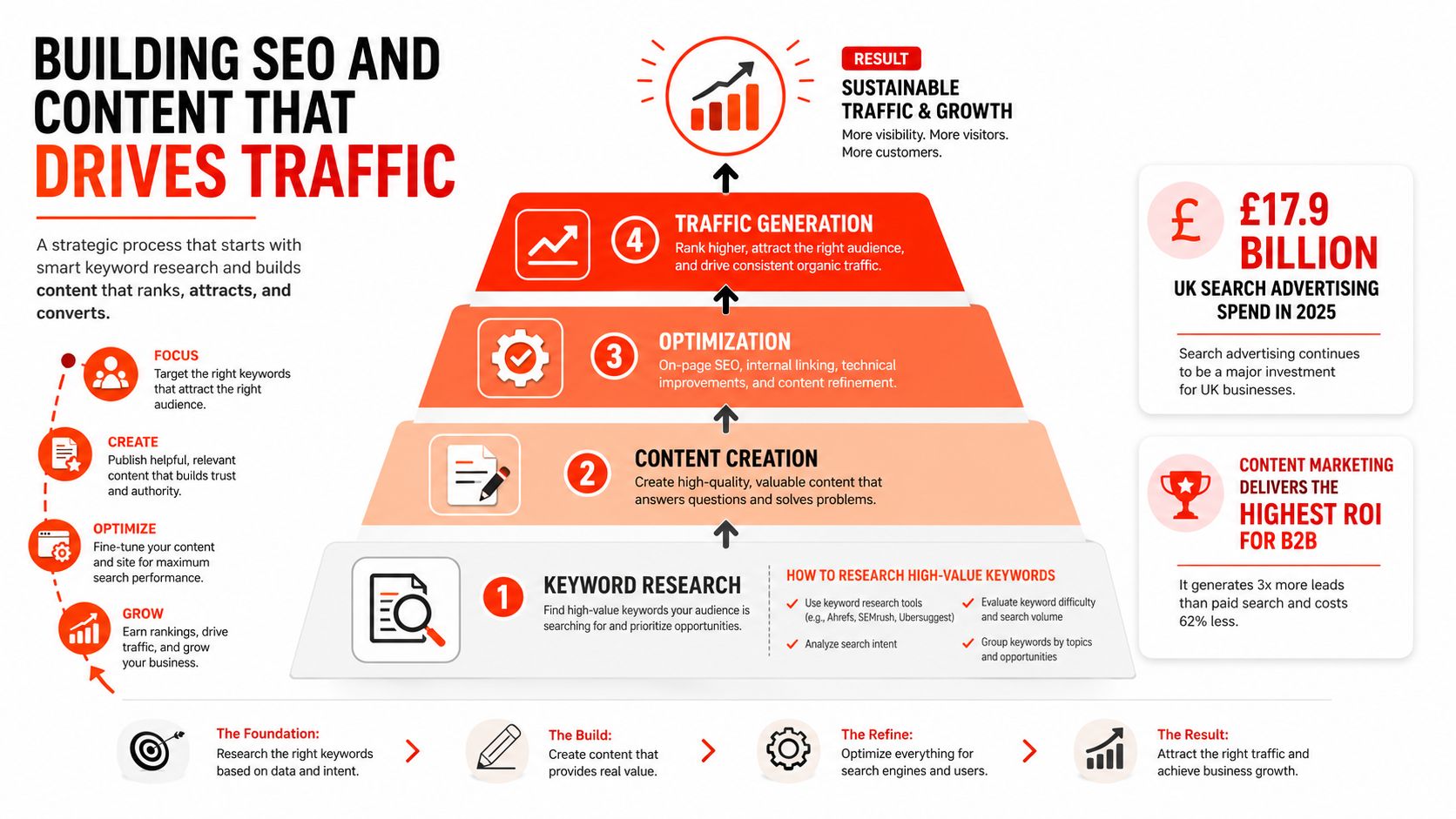
A site can go live in 24 hours and still fail to attract the right visitors if the pages are built around guesswork. Fast launch helps cash flow and momentum. Traffic only builds when the site reflects how buyers search, what AI systems can interpret, and what proof a cautious buyer needs before enquiring under a 30-day money-back guarantee.
Build around search demand and buying intent.
Small firms often waste early SEO effort on a single broad term that looks attractive in a report, yielding vague traffic. A local accountant does not need to rank for “finance”. They need enquiries from people searching for “small business accountant in Leeds”, “switch accountant”, or “how much does year-end filing cost”.
That is the working split:
- Service intent: searches tied to the service being bought
- Problem intent: searches from people trying to fix or understand an issue
- Proof intent: searches that compare options, pricing, timelines, reviews, or guarantees
Each group needs a different page type. Service pages capture commercial demand. Articles answer pre-sale questions. Proof pages handle trust, with case examples, pricing context, delivery times, and refund terms. That mix matters more on a newly launched site because both Google and AI search features need clear topical signals quickly.
Content clusters still work well, but only when the structure matches a sales path. One core service page should sit at the centre. Supporting pages should link back to it with useful context, not forced keyword anchors. For a practical framework, this guide on increasing website traffic is a solid starting point.
Structure pages for AI visibility as well as rankings
AI-enhanced search has changed what “well optimised” looks like. Ranking factors still matter, but page formatting now carries more weight because answer engines pull short, direct sections into summaries.
Pages are easier to interpret when they include:
- Question-led subheadings that match real searches
- Short opening answers before the fuller explanation
- Clear service boundaries so one page covers one main topic
- Visible trust signals such as a phone number, location, guarantee, and real business details
- Selective schema and FAQs that clarify the page instead of padding it
Trust signals are often the missing part. Many SEO guides focus on headings, internal links, and metadata, then ignore the details that help a visitor believe the business is reachable and accountable. On a small-business site, a visible guarantee, a named service area, turnaround times, and a straightforward contact route can improve both conversion quality and how useful the page feels to search systems.
For small firms launching quickly, that balance is easier to maintain with one provider handling build and optimisation together. 1stNet AI Ltd includes on-page SEO and AI visibility optimisation as part of its web offering, alongside launch, hosting, and maintenance.
A short walkthrough can help teams visualise how search, structure, and page format work together:
Batch content so publishing stays realistic
Content usually breaks down because the plan fails to account for how small teams work. A founder, office manager, or salesperson can usually review one useful page a week. They rarely have time to approve a full editorial calendar packed with opinion pieces that never support a sale.
A tighter monthly rhythm is easier to keep:
| Week | Focus |
|---|---|
| Week 1 | Update one service page |
| Week 2 | Publish one question-led article |
| Week 3 | Add one case-style proof page or FAQ expansion |
| Week 4 | Refresh internal links and calls to action |
This approach suits a 24-hour launch model because it accepts a simple truth. The first version of the site needs to be credible, indexable, and ready to sell. The next 30 days are where authority and trust build through targeted updates, better proof, and clearer answers to buyer objections.
Executing Social Outreach Email Campaigns and Paid Ads
A site can go live in 24 hours and still sit quietly for weeks if outreach starts too wide. Small firms often launch with five channels, three offers, and no clear follow-up path. The result is familiar. Clicks arrive, but trust never builds because each touchpoint says something slightly different.
Choose fewer channels and match them to buyer intent
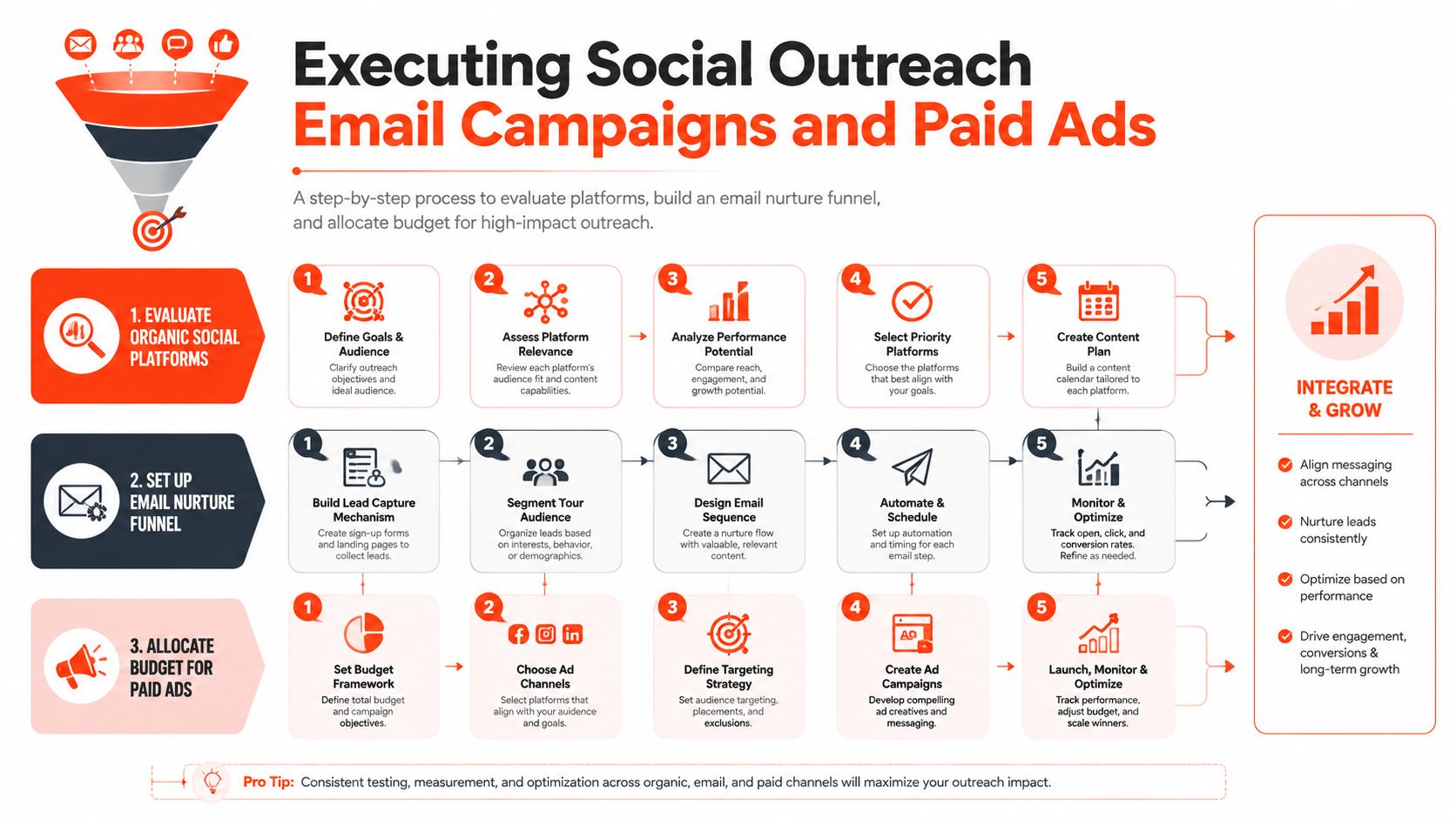
For a new or recently rebuilt site, two channels are usually enough for the first month. One should capture existing demand. The other should build familiarity and trust with people who are not ready on day one.
That choice depends on how buyers behave:
- Use social to show recent work, customer proof, and visible activity
- Use email to follow up after a visit, download, quote request, or missed enquiry
- Use paid search to reach buyers already comparing suppliers
- Use paid social to put a clear offer in front of a specific audience and test response fast
A local plumber, accountant, or clinic will often get more value from Google Ads plus email follow-up than from posting daily on several social platforms. A B2B service firm may see better results from LinkedIn outreach and short email sequences sent after a proposal view or site visit.
The trade-off is simple. Fewer channels mean less reach at the start, but stronger message control and cleaner data.
Build outreach around actions people have already taken
Broad campaigns waste time because they treat every prospect the same. Response improves when the message reflects the page viewed, the form started, or the offer requested.
Use simple triggers:
- Viewed a pricing page: send scope examples, common cost ranges, and what affects price
- Downloaded a guide: send one practical follow-up and one relevant service offer
- Started but did not finish an enquiry form: offer a call-back, shorter form, or direct email route
- Returned to the same service page: send proof, guarantees, and answers to common objections
For a 24-hour launch, polished automations matter more than anything. The first sequence only needs to do three jobs. Confirm the business is real, answer the obvious risk question, and make the next step easy.
One trust step many guides skip is aligning your outreach with your guarantee. If the site offers a 30-day money-back guarantee, mention it in follow-up emails, ad copy, and landing page headlines in the same terms. Buyers notice when that promise appears once on the site but disappears everywhere else.
If you need extra low-cost reach while the main channels are still being tuned, this list of free internet advertising sites is a practical place to test additional placements.
Use paid ads to amplify a clear offer.
Paid ads work best when the destination page is specific, the offer is credible, and the visitor can quickly verify the trustworthiness of the site. Ads do not fix weak positioning. They expose it faster.
For small businesses, paid search is usually the quickest way to test demand after launch because intent is already there. Keep the structure tight—one audience, one offer, one landing page, one conversion action. Mixing broad keywords, generic copy, and a catch-all homepage usually produces expensive traffic and weak leads.
AI-enhanced SEO can help here in a useful way. Search terms, page themes, and ad groups should support the same service language, not compete with each other. If your AI-led optimisation says buyers search for “same-day emergency electrician” but the ads send traffic to a generic electrical services page, the campaign loses relevance and trust.
Paid social needs a different standard. Use it if the creative can quickly establish credibility with a real job photo, a review excerpt, a short testimonial, or a clear guarantee. Without that evidence, the click is cheap, but the enquiry rarely follows.
Before increasing the pecheck, the four basics on every campaign page:
- Headline matches the ad or email promise
- Proof appears above the fold
- Contact action is obvious on mobile
- Guarantee, response time, or service coverage is easy to verify
That setup gives a new site a fair test. It also makes the first 30 days more useful, because every click, reply, and enquiry shows which message buyers trust enough to act on.
Optimising Conversions and Measuring Results
A site can go live in 24 hours, attract clicks in the first week, and still produce very little revenue. The usual problem is not reachable. There is hesitation on the page.
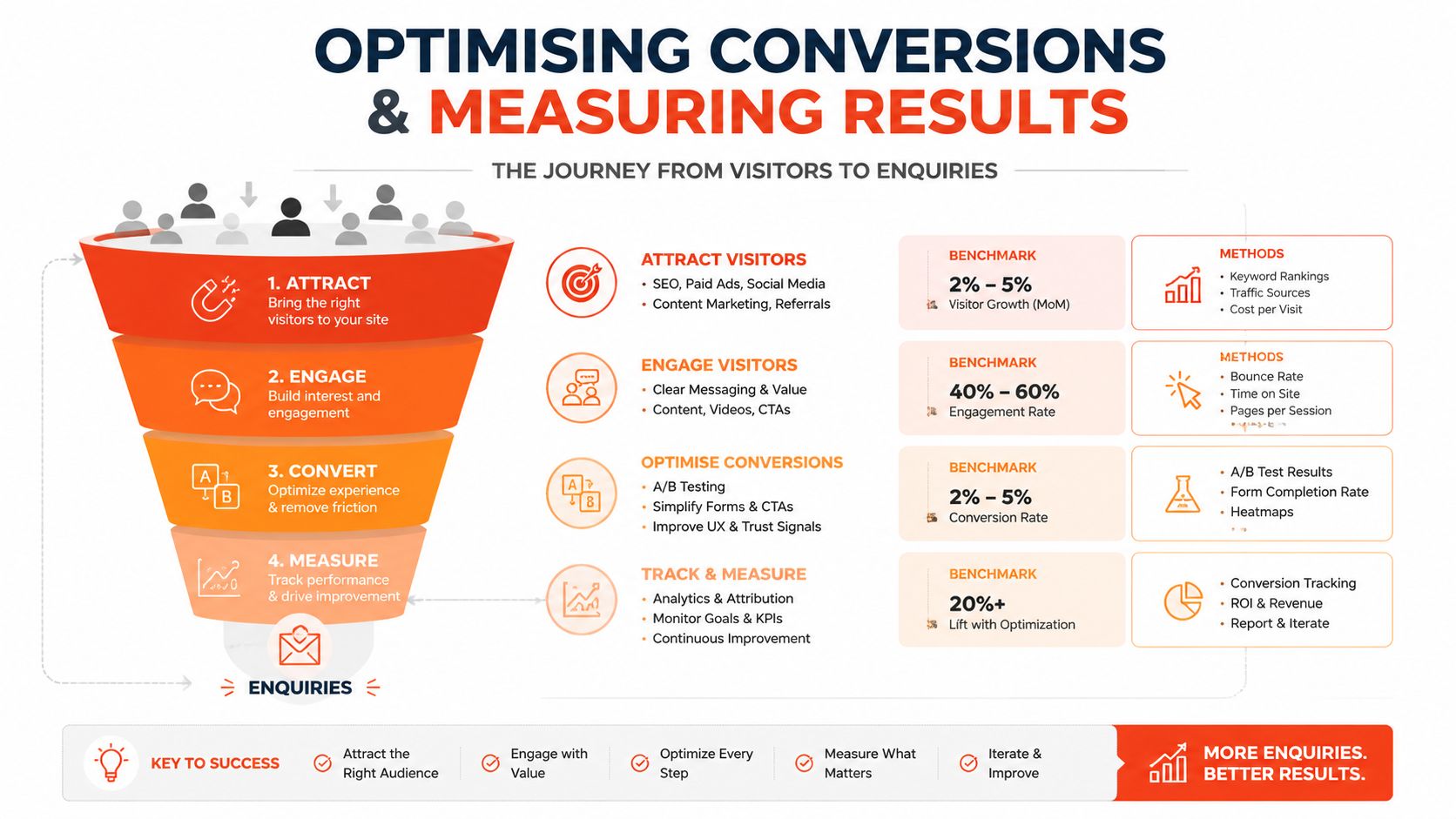
Conversion work starts with intent, not volume.
Raw traffic totals are a poor indicator of commercial performance. What matters is whether the visitor lands on a page that matches the reason they clicked, addresses the obvious objections, and provides a low-friction next step.
For a small business site, I would rather see fewer visits from people searching for a specific service than a larger batch of mixed traffic hitting a general homepage. That matters even more in AI-enhanced SEO campaigns, where search terms can be tightly mapped to service pages from day one. If the keyword theme, page copy, and conversion action line up, the site gets a fair test much earlier.
The first pages to review are usually the ones closest to revenue:
- Service pages: sharpen the main claim, add proof, and make the next action obvious
- Landing pages: remove distractions if the campaign has one offer and one goal
- Forms: ask only for the details the sales process needs
- Mobile layouts: keep trust cues, tap targets, and contact options visible without hunting
A 24-hour launch compresses build time, not buyer caution. Pages still need to feel complete, checked, and ready to transact.
Trust signals carry more weight on fast-launch sites
Small businesses often spend too long tweaking copy and too little time reducing risk. Buyers hesitate for ordinary reasons. They want to know who they are dealing with, how quickly they will get a response, and what happens if the service is not right.
Visible trust elements do that work:
| Trust element | Why it helps |
|---|---|
| 30-day money-back guarantee | Reduces the perceived cost of making the wrong choice |
| Live chat | Gives hesitant visitors a quick way to test responsiveness |
| UK phone number and company details | Shows the business is identifiable and reachable |
| Clear delivery or onboarding steps | Removes doubt about what happens after the enquiry or payment |
For businesses using a rapid launch model, these trust signals are required from day one to counter any perception that speed compromises quality. A 24-hour site launch can be a strength if the page also shows how support works, how the guarantee is handled, and how a real person can be reached.
That combination is what many generic conversion guides miss.
Measure where intent weakens
A useful reporting setup does not need to be complicated. It needs to show where people arrive, where they hesitate, and which actions produce real enquiries.
Track a short chain:
- Traffic source, so you know what brought the visit
- Landing page so you can judge message match
- Primary action, such as form submission, call, or chat, starts
- Drop-off point so you can see where interest fades
Then test changes that affect buyer confidence, not just layout preference. On a new service page, a shorter form may help. On another, stronger placement of reviews, guarantee terms, or response-time information may do more. If live chat is available, place it on high-intent pages where visitors are deciding, not as a generic widget with no context.
The aim is simple. Learn which pages earn trust quickly enough to convert while the site is still new, the SEO is still building, and the money-back guarantee still covers the first 30 days.
Phased 13-Week Implementation Roadmap
Most businesses don’t need more ideas. They need a sequence. Timing matters because some activities only work once the earlier groundwork is in place.
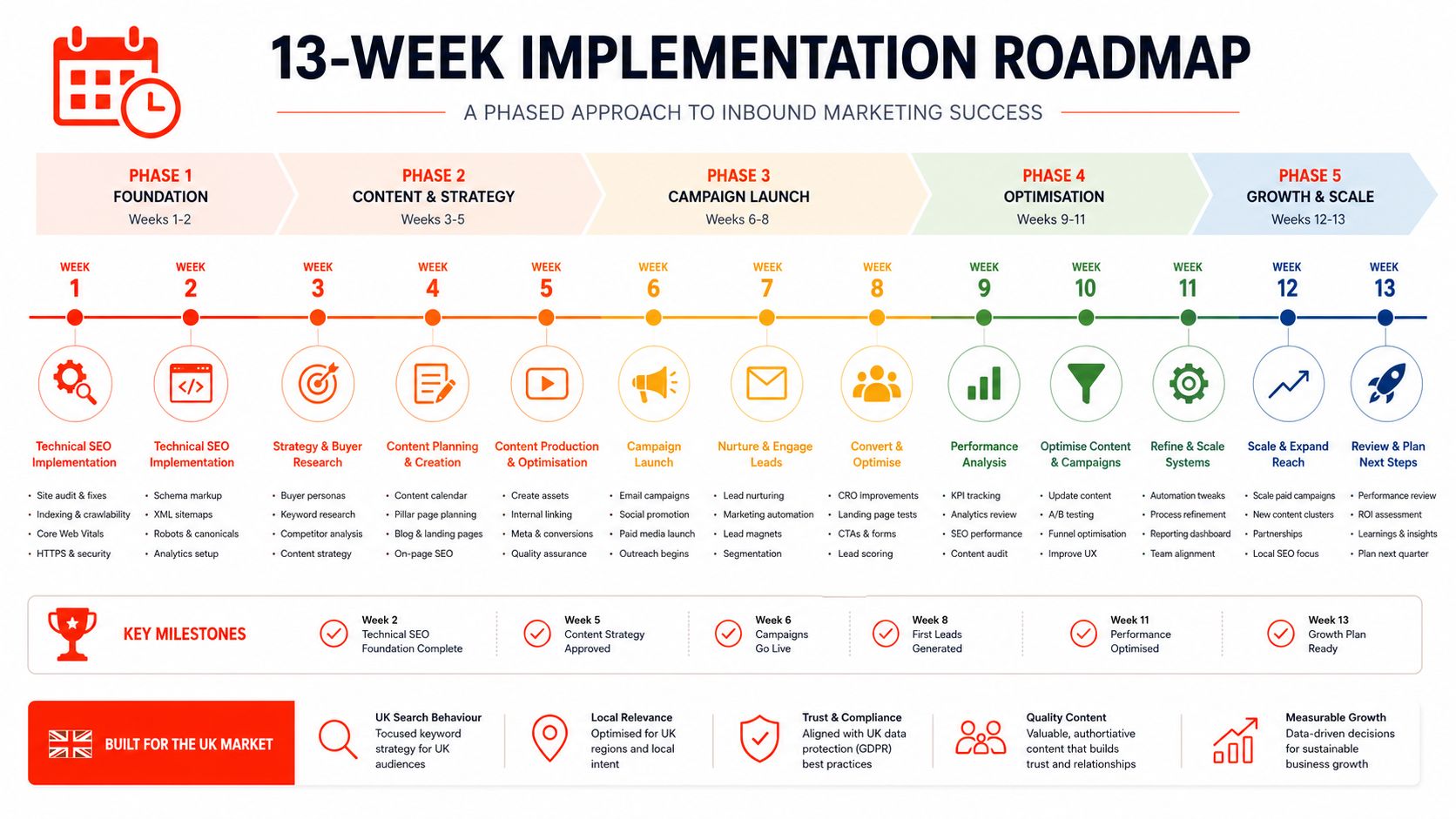
Weeks 1 to 2 set the foundation for tracking and technical work.
A UK inbound marketing methodology follows a 13-week phased sequence that covers SEO audits, content clusters, lead magnets,s and data-driven refinements. The early phase focuses on technical SEO audits, CRM integration, and conversion tracking setup.
In practice, you confirm that the site is indexable, that forms route correctly, that analytics are recording key actions, and that the main pages are commercially usable. If the site is launching on a compressed timeline, these checks need to happen before promotion scales.
Weeks 3 to 6: build the content and conversion structure
This period is for keyword and topic mapping, content clusters, and quick-win CRO updates on core pages. It’s also the point where a rushed homepage often gets corrected into a proper set of service, landing, and supporting content pages.
Use this phase to tighten:
- Internal linking between service and support content
- Lead paths from article pages into enquiry actions
- Page hierarchy so the site is easy to scan and easy to crawl
- Trust placement on the pages that receive buying-intent traffic
Weeks 7 to 1:3 publish, promote, and refine
Weeks 7 to 10 are for priority content, high-intent lead magnets, and email nurture deployment. Weeks 11 to 1313, wheneams review rankings, engagement, and conversion behaviour, then re-theme on responses rather than assumptions.
A simple roadmap view helps:
| Phase | Core activity | Main output |
|---|---|---|
| Weeks 1 to 2 | Technical setup | Tracking, audit fixes, CRM connection |
| Weeks 3 to 6 | Structure and page improvements | Topic maps, core page upgrades, CRO fixes |
| Weeks 7 to 10 | Publishing and follow-up | Priority content, lead magnet, nurture emails |
| Weeks 11 to 13 | Review and optimisation | Refinements based on rankings and conversions |
That sequence fits both a conventional launch and a rapid one. The difference is that a 24-hour launch gets you to market quickly, while the 13-week roadmap turns that launch into a system that can consistently generate and improve demand.
If you want a provider that combines rapid launch, managed hosting, SEO-ready setup, AI visibility work, and post-launch support, 1stNet AI Ltd is built for small UK businesses that need to get live quickly without juggling multiple suppliers. The 24-hour launch option, 30-day money-back guarantee, and interactive live chat workflow are practical trust features for owners who want speed without losing oversight.