Local SEO is the process of making your business visible for geographically related searches like “plumber near me” or “café in Manchester”. In the UK, 46% of all search queries are explicitly local, so if your business isn’t showing up nearby, you’re missing people who are already looking for what you sell.
You probably know the feeling. You serve a real area, you know customers are close by, and yet your phone is quieter than it should be. A competitor with a worse website, weaker branding, or patchy service somehow appears first on Google Maps, in the map listings, and in the search results below.
That gap is usually what people mean when they ask, what is Local SEO. It’s not abstract marketing theory. It’s the work that helps Google connect your business to someone nearby at the exact moment they need a service, want directions, or are ready to call.
In practice, that means more than just putting your town name on a page. Google wants a single, trusted local entity. Your business details need to match across your website, Google Business Profile, and directories. Your pages need local relevance. Your reviews need attention. Your website also needs to perform properly on mobile, because local searches often happen while people are out and ready to act.
There’s another shift worth paying attention to. A projected change in local search for 2025 to 2026 is that AI tools increasingly draw on structured business data, and one UK source says 68% of local searchers now interact with AI summaries before visiting a site (LocaliQ’s UK local SEO guide). Most Local SEO advice still stops at Google Business Profile. That’s no longer enough if you want to stay visible as search changes.
Introduction: Why Your Local Customers Cannot Find You
A customer in your town picks up their phone, searches for the service you offer, and hires someone else within ten minutes. Not because they were better. Because they were easier to find.
That is the problem Local SEO solves. It helps your business appear at the exact moment a nearby person is ready to call, book, visit, or compare options. For a UK small business, that visibility often has more impact on revenue than another social post or a prettier homepage.
If you serve a specific town, city, or catchment area, local search visibility is part of your sales infrastructure.
Many owners assume that a website means they are covered. It does not. Google still needs clear signals about where you operate, what you do, whether your details are consistent, and whether real customers trust you. If those signals are weak, nearby buyers skip past you and choose the competitor who has done the basic groundwork.
I see this a lot with trades, clinics, accountants, salons, restaurants, and service firms. The business is sound. The issue is not demand. The issue is discoverability.
The increasing importance of local visibility
Local SEO is no longer only about appearing in Google Maps. Search results now include richer business information, stronger review signals, and more AI-generated answers that summarise options before a user even clicks through.
That shift changes the job. A business with a claimed profile but messy contact details, thin location pages, or weak review signals may still exist online while losing ground in search. A business with organised business data, clear service pages, strong reviews, and mentions across trusted sites gives Google and AI systems more to work with.
That is one reason it helps to build visibility beyond your own website, including accurate listings on free internet advertising sites for local businesses. The trade-off is simple. It takes time to keep those profiles consistent, but the cost of inconsistency leads.
What local visibility actually comes down to
A few practical questions usually decide local visibility:
Can search platforms verify your business? Your name, address, phone number, opening hours, and service area need to match across the web.
Can they understand what you sell and where you sell it? Your site needs clear pages for your services and the locations you cover.
Can customers trust you quickly? Reviews, photos, recent updates, and a complete business profile help people choose you without hesitation.
Get those basics right, and you give both search engines and AI-led local results a clear, reliable picture of your business. That is how Local SEO turns “we should be getting more enquiries” into real calls, bookings, and footfall.
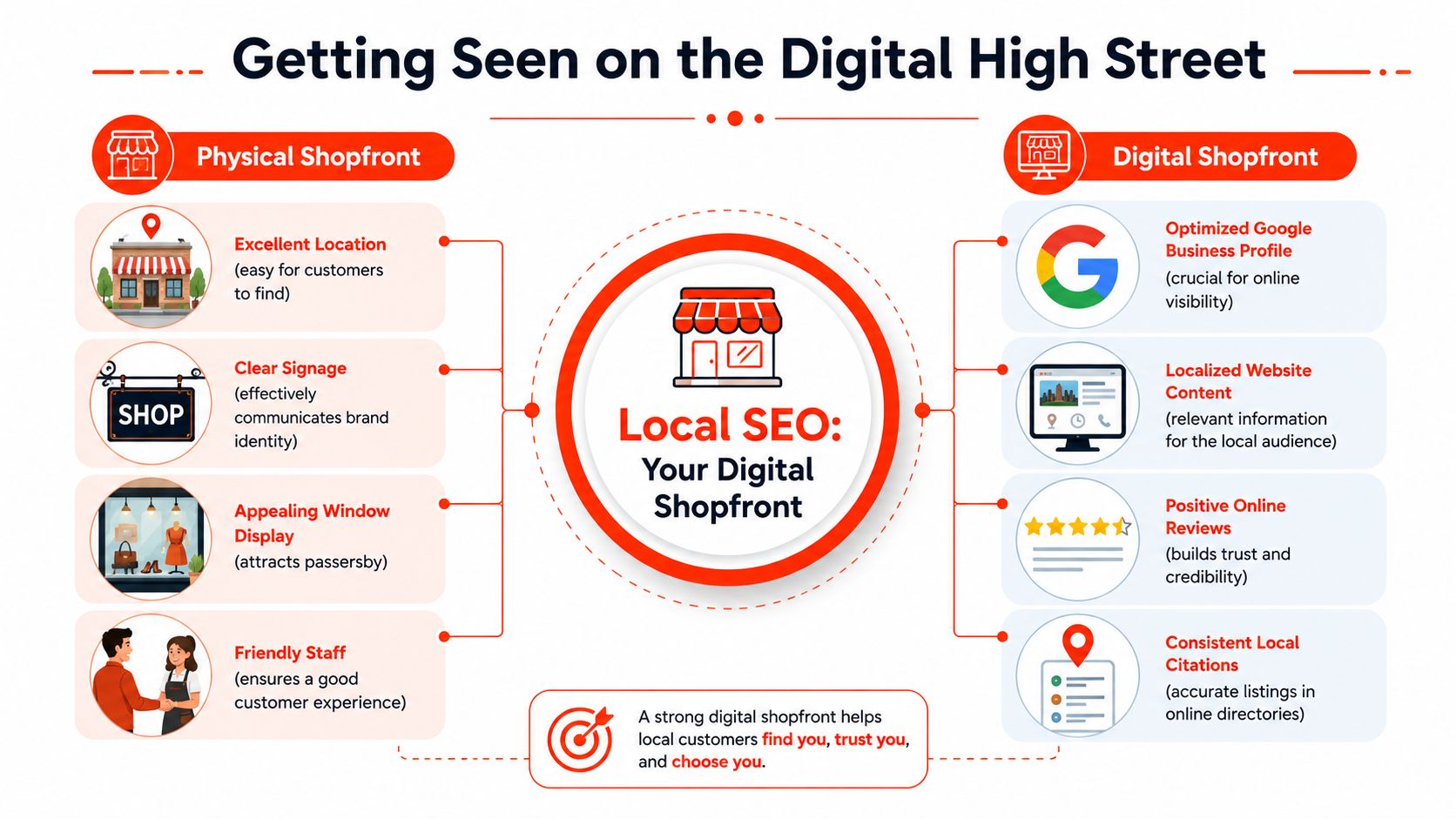
Getting Seen on the Digital High Street
A customer in Leeds needs an emergency plumber. They search on their phone, glance at the map, compare a few listings, and call one within minutes. If your business is not visible at that moment, a competitor gets the job.
That is the practical job of Local SEO. It puts your business in the places people check before they visit, call, or ask an AI assistant for a recommendation. Your website, Google Business Profile, directory listings, and reviews form your digital shopfront. In 2026, that shopfront also serves AI-driven local results that often summarise options before someone clicks a single link.
For local searches, Google usually gives you three main chances to be seen:
Area
What it is
Why it matters
Google Local Pack
The map section with three business listings
Strong visibility and high intent from people ready to act
Google Maps
Map-based business results
Good for calls, directions, and quick comparisons nearby
Localised organic results
Standard web listings below the map area
Helps people research before choosing who to contact
The Local Pack gets the attention, but the real point is trust. A business that appears established before a user has read a word of its website. That same trust signal matters for AI-led search as well. If your business data is clear, consistent, and backed by reviews, it is easier for search platforms to surface you with confidence.
Visibility usually comes from boring but profitable work. Accurate contact details. Useful service pages. Recent reviews. Complete profiles. Consistent mentions across trusted directories.
Citation building still matters here, especially for UK firms with patchy listings from old websites, old phone numbers, or a move to a new address. If you are fixing that foundation, these free internet advertising sites for local businesses are a sensible place to check where your details should appear.
Your Google Business Profile supports Local SEO. It does not replace the rest of it.
Mobile raises the standard. Local searches often happen while someone is out, busy, and ready to make a quick decision. They tap to call, check opening hours, or compare two firms side by side. If your site is slow, hard to use, or missing key information, the click you earned turns into a lost enquiry.
Good Local SEO gets you on the shortlist. A fast, clear mobile experience helps you win the job.
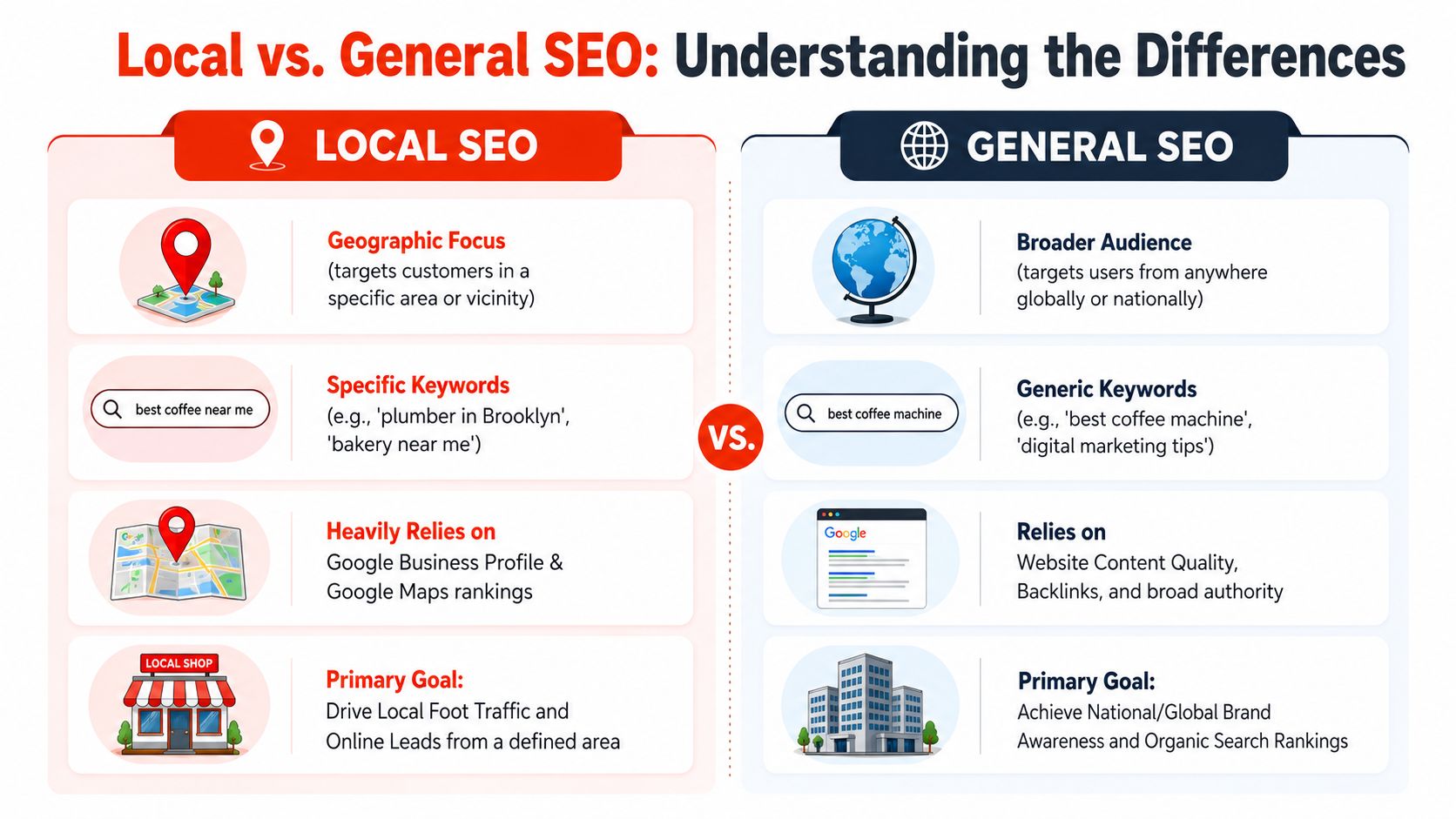
The Difference Between Local and General SEO
People often blur these together, but they solve different business problems.
General SEO is about building broad visibility. Local SEO is about being the obvious choice in a defined area. It’s comparable to the difference between becoming a bestselling author and becoming the most recommended tradesperson in your town.
A side-by-side view
Focus
Local SEO
General SEO
Audience
People in a specific place
People anywhere
Search intent
Immediate and location-based
Broader research or commercial intent
Keyword style
“boiler repair Leeds”
“How boilers work”
Key assets
Google Business Profile, local pages, citations, reviews
Content depth, backlinks, and topical authority
Main outcome
Calls, visits, local leads
Wider traffic and broader visibility
Why business owners get this wrong
A small business owner may publish blog posts, tweak page titles, and still wonder why local calls don’t improve. The missing piece is usually local intent. A page can be well written and still fail to rank locally if it doesn’t signal who you serve and where you serve them.
Local SEO also depends on signals that general SEO can ignore. Consistent business details, map relevance, proximity, and review activity play a much bigger role. If you run a café in Manchester or a plumbing business in Bristol, you don’t need to outrank the whole internet. You need to be visible to the right people nearby.
A business can have decent general SEO and weak Local SEO at the same time. That happens more often than most owners realise.
The Three Pillars of Local SEO Rankings
Local rankings usually come down to three signals that Google can quickly compare: Relevance, Distance, and Prominence. For a UK small business owner, that is useful because it turns Local SEO into a checklist instead of a mystery. It also matters more now that local results are being summarised inside AI-led search experiences. If your business data is vague, inconsistent, or thin, you are less likely to be surfaced confidently in those answers.
Relevance
Relevance is the fit between the search and your offer. If you are an emergency electrician, your website and Google Business Profile should clearly state that. If you work in specific towns, those towns should appear naturally on your core service and location pages.
Structured data helps search engines confirm what your business is, where it operates, and which services belong to which page. John Carey’s UK local SEO guide points to LocalBusiness and FAQ schema, along with complete Google Business Profile fields, as strong support for local entity understanding. That matters for normal search rankings and for AI-generated local results, which depend on clear, machine-readable business information.
In plain English, a schema is a clean, consistent labelling system for your website. It reduces ambiguity. If your site is being rebuilt, SEO-friendly web design that bakes in local signals from the start is far easier to manage than patching technical fixes onto an old build later.
Distance
Distance is straightforward. If a customer in Croydon searches for a nearby locksmith, Google will usually favour businesses close to that searcher or strongly associated with that area.
You cannot change where your premises are, but you can remove confusion. John Carey also notes the value of consistent NAP details, opening hours, geographic coordinates, and matching business information across your site and Google Business Profile. That is the technical layer.
The commercial layer is simpler. Make your service area obvious, keep your address details consistent, and give each real location enough useful content to stand on its own. AI-driven search results are likely to be even less forgiving here. If your business location data clashes across pages, profiles, and directories, systems that summarise local options may skip you rather than risk showing bad information.
A short explainer helps if you want to hear the mechanics discussed visually:
Prominence
Prominence is the strength of your reputation online. Reviews matter. So do directory mentions, local links, branded searches, recent photos, and signs that the business is active and trusted.
According to Visionary Marketing’s local SEO statistics for 2026, 70% of consumers read online reviews before contacting a local business, and stronger review activity and profile completeness are associated with better click-through performance. The same benchmark summary notes that businesses with more review volume and richer photo coverage tend to see stronger local visibility.
The trade-off is simple. Chasing review count alone is a poor strategy if the reviews are old, generic, or unanswered. A smaller stream of genuine, recent reviews, answered properly, usually does more for trust. The same goes for photos. Ten useful photos of your team, premises, vans, or finished work can help a customer more than a gallery full of stock-style filler.
Prominence also carries over into AI search. Systems that generate local recommendations look for confidence signals. A well-maintained profile, consistent mentions, and credible reviews give them more reason to include your business in the answer instead of leaving you buried under the map pack.
Common Local SEO Mistakes That Cost UK Businesses Money
Most Local SEO failures aren’t dramatic. They’re quiet mistakes that stack up until a competitor looks more trustworthy, more relevant, and easier to contact.
Mistakes that look harmless but hurt visibility
The first is inconsistent NAP data. If your website footer lists one phone number, your Google Business Profile shows a different format, and a directory still lists an old address, you create doubt. Search engines need consistency to trust local business data.
The second is treating your Google Business Profile like a one-off admin task. Owners claim it, fill the basics, and never touch it again. Meanwhile, better-organised competitors keep details up to date, upload photos, respond to reviews, and stay visibly active.
Third, businesses still underestimate reviews. That’s costly because reviews influence trust before a customer ever clicks. If you ignore them, you’re leaving one of your strongest local signals unmanaged.
If a customer takes time to leave feedback and the business never replies, that silence becomes part of the brand.
What does a better practice look like
A fourth mistake is building thin location pages for every town in reach and changing only the place name. That shortcut used to slip through more often. It’s much riskier now.
According to Cloudswitched’s UK guide to local SEO for small businesses, each location page for a UK multi-location business should contain 800 to 1,200 words of unique, locally relevant content, and thin or” ookie-cutter” town pages are frequently penalised for lacking genuine geographical proof.
That’s why stronger location pages tend to include things like:
Real service detail: Explain what you offer in that area.
Local proof: Reference neighbourhoods, service constraints, or common customer needs in that location.
Practical trust signals: Add embedded maps, accurate opening details, and genuine local testimonials where appropriate.
There’s also a measurement mistake many owners make. They build postcode pages to rank, not because those pages produce high-quality leads. One UK commentary on this issue points out a gap around proving postcode-level conversion quality, especially for non-technical owners trying to connect rankings with calls and direction requests. The ranking itself isn’t the business outcome. The lead is.
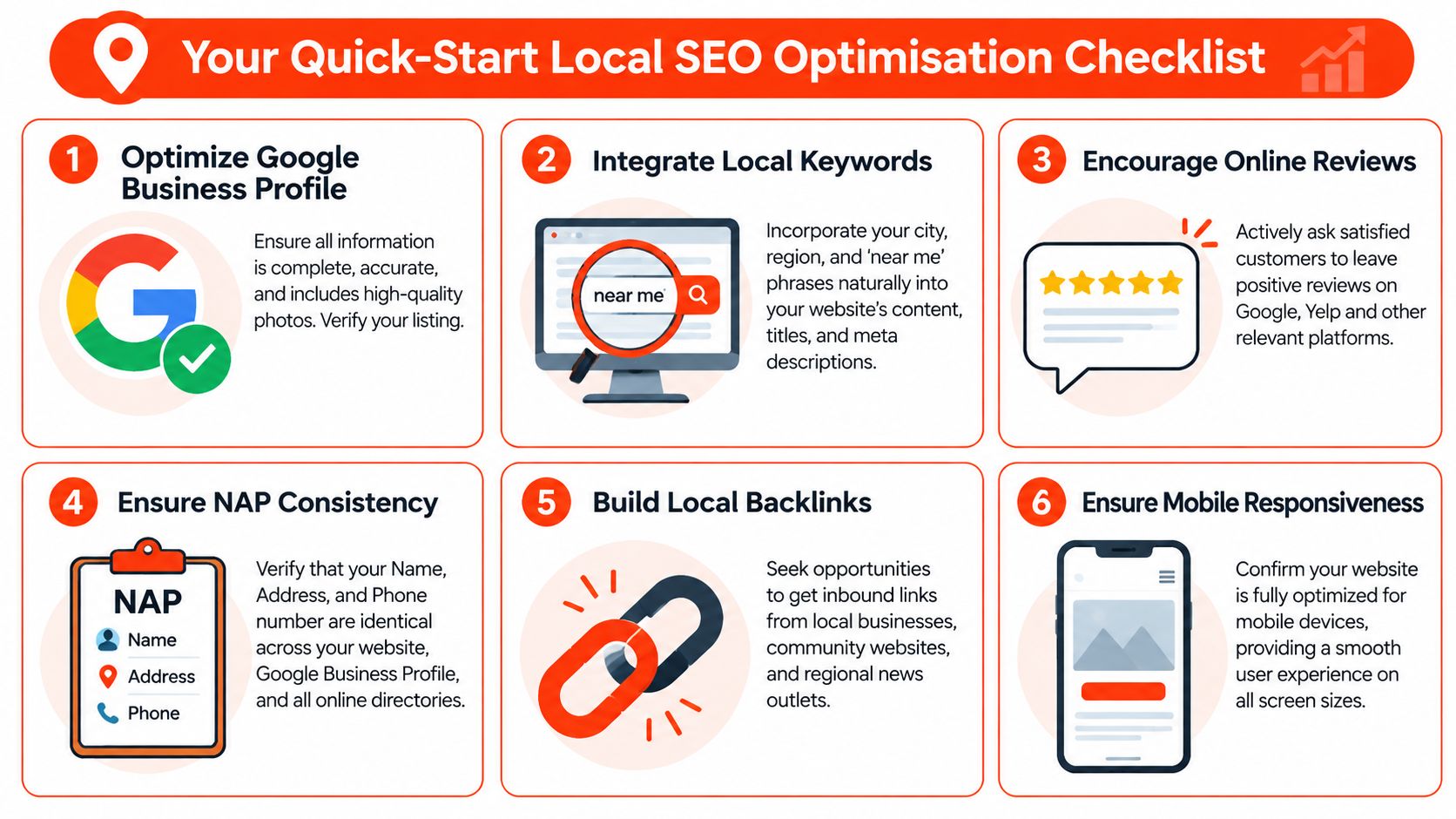
Your Quick-Start Local SEO Optimisation Checklist
If your Local SEO is patchy, don’t start with everything at once. Start with the basics that remove confusion and make your business easier for Google and customers to trust.
The checklist
Finish your Google Business Profile properly. Fill every relevant field, choose the right business category, and keep hours accurate. Add photos that reflect your business, not stock images.
Put your NAP details on your website.e Your business name, address, and phone number should appear in the footer or header in the same format used on your profile and directory listings.
Add local intent to your core pages. Service pages should mention the areas you serve naturally. If you need help writing pages that sound local without sounding spammy, good guidance on SEO copywriting for business websites can save a lot of rewriting later.
Build your core UK citation.s Get listed consistently on relevant directories. Quality and consistency matter more than spraying your details everywhere.
Create a review routine.n e Dedote’s UK local SEO guidance says businesses should generate 2 to 4 new Google reviews per month and reply to every review within 48 hours. That’s a practical cadence most small businesses can maintain.
Publish one strong local page before making ten weak ones Start with your main service area and make it useful. Expand only when you can support each page with real local relevance.
Good Local SEO usually looks boring behind the scenes. Clean data, clear pages, active reviews, and no contradictions.
Next Steps: DIY or Get It Done Fast
There are three realistic ways to handle Local SEO.
You can do it yourself. That works if you’ve got time, patience, and enough control over your website to fix the technical basics properly. For a sole trader or early-stage business, DIY can be the right move, especially if you start with one profile, one service area, and one clean site structure.
You can hire an agency. That makes sense if local search is a major revenue channel and you want ongoing management. The trade-off is cost, slower turnaround, and the fact that some agencies still focus on outdated checklists without properly addressing AI visibility or technical schematics.
The third option is a done-for-you setup that gets the website foundation right from the beginning. For many small businesses, that’s the most sensible route because Local SEO rarely fails for one dramatic reason. It fails because different people handle the website, business profile, content, and maintenance at different times with no consistency.
If you need to move quickly, the technical base matters more than clever marketing talk. A fast website, clear local page structure, proper schema, mobile performance, and ongoing upkeep give your Local SEO a chance to work. Without that, every later optimisation is harder than it should be.
Launch your website fast with a domain, SSL, hosting & maintenance included. In an hour. 1stNet AI Ltd website team. We transform your online presence with a stunning website. Call us now at 0204 577 2255. Don’t miss this chance to boost your brand! All our work comes with a 30-day money-back guarantee. WE OFFER AN INTERACTIVE LIVE CHAT SYSTEM TO DESIGN YOUR WEBSITE.