
You’ve launched the site. The design looks polished, the logo is sharp, and the copy sounds professional enough. Then the quiet starts. Without steady enquiries, there’s no useful Google visibility. Ultimately, there’s no sense that the website is doing any real work.
That’s where most small business owners get stuck. They’ve paid for a website, but what they really needed was one that generates leads. If your pages read like a brochure and nobody can find them, they won’t help much. If they attract visitors but don’t give people a reason to contact you, they still won’t help much.
SEO copywriting sits in the middle of that problem. It helps your business show up when someone searches for what you do, and it helps the page turn that visit into action. That matters because over 92% of marketers globally plan on or are already using SEO optimisation for traditional and AI-powered search engines, according to the HubSpot State of Marketing Report 2026.
Table of Contents
Your Website Is Live, but Is Anyone Visiting
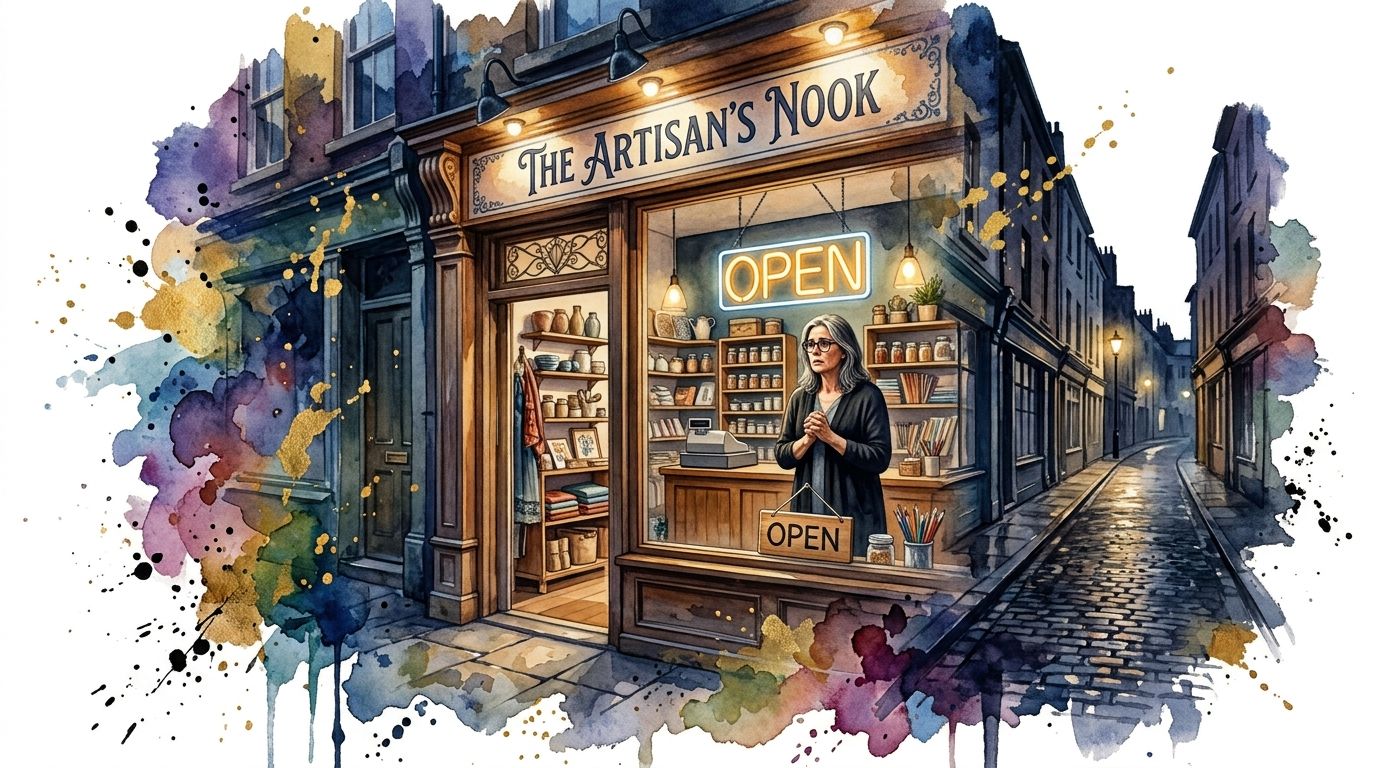
A lot of business websites feel like a lovely shop on a side street with no footfall. The branding is there. The services are there. The contact page works. But nobody arrives unless you manually send them the link.
That usually happens for one of two reasons. Either the site doesn’t target the phrases real customers search for, or it talks about the business in a vague way that sounds nice but doesn’t match buyer intent. A page called” Solutions for Modern Growth” may impress a designer. It won’t help much if your customer is searching for “accountant for small business in Leeds”.
What the website should do instead
Your website needs to answer practical questions fast. What do you offer? Who is it for? Where do you work? Why should someone trust you enough to get in touch?
SEO copywriting solves that by combining search relevance with persuasive writing. It doesn’t mean stuffing awkward phrases into paragraphs. It means building pages around the language customers already use, then making those pages clear enough that a real person feels confident contacting you.
Practical rule: If a stranger lands on your page and can’t tell within a few seconds what you do and whether you serve them, the page isn’t finished.
For a UK small business, this is less about chasing vanity rankings and instead more about making the site earn its keep. Ultimately, the right page can attract someone who is already looking for your service. The wrong page sits online doing almost nothing.
Why this matters to lead generation
A brochure website says, “Here we are.” An SEO-focused website says, “Here’s exactly how we help, and here’s the next step.” That difference is what turns traffic into enquiries.
If you’ve ever felt that SEO sounds like jargon wrapped around common sense, that instinct isn’t wrong. At its best, SEO copywriting is just clear commercial communication, written so search engines can understand and buyers can trust.
Understanding SEO Copywriting
SEO copywriting is writing web pages that rank in search and persuade people to act. It blends two disciplines that are often separated when they shouldn’t be.

A simple way to think about it is this. Ordinary copywriting is the shop assistant. It explains, reassures, and helps someone choose. SEO is the sign on the high street. It helps people find the shop in the first place. You need both.
Two jobs on one page
A good service page has to do two things at once:
- Get discovered: It needs to reflect what people search for.
- Get understood: explain the offer in plain English.
- Get action: It needs to move the reader towards a call to action, a form fill, or a purchase.
That’s why SEO copywriting isn’t the same as blog writing for its own sake. It also isn’t just a technical setup. You can have excellent site speed, clean code, and tidy indexing, but if the words on the page are generic, traffic won’t convert.
Later in the process, technical details still matter. Search engines need a clear page structure, a single H1, and a sensible topic focus. Before launch, teams should also turn off WordPress’s default”discourage search engines” setting and connect tools such as Google Analytics 4 and Google Search Console, as noted in this small business website launch checklist. But those steps only support the copy. They don’t replace it.
What it is not
SEO copywriting isn’t:
- Keyword stuffing: Repeating the same phrase until the page sounds robotic.
- Writing for algorithms only: A page that ranks but confuses buyers still underperforms.
- Pure brand language: Clever slogans without search intent often miss commercial traffic.
Here’s a useful test. If the page sounds polished but never clearly names the service, location, or buyer problem, it probably needs rewriting. If it names those things but reads as if a machine wrote it, it also needs rewriting.
Many business owners ask, “What is SEO copywriting, really?” The practical answer is simple. It’s the work of making your page easier to find and easier to say yes to.
A short explainer helps if you want to see the concept in motion.
The Core Principles for Writing That Ranks
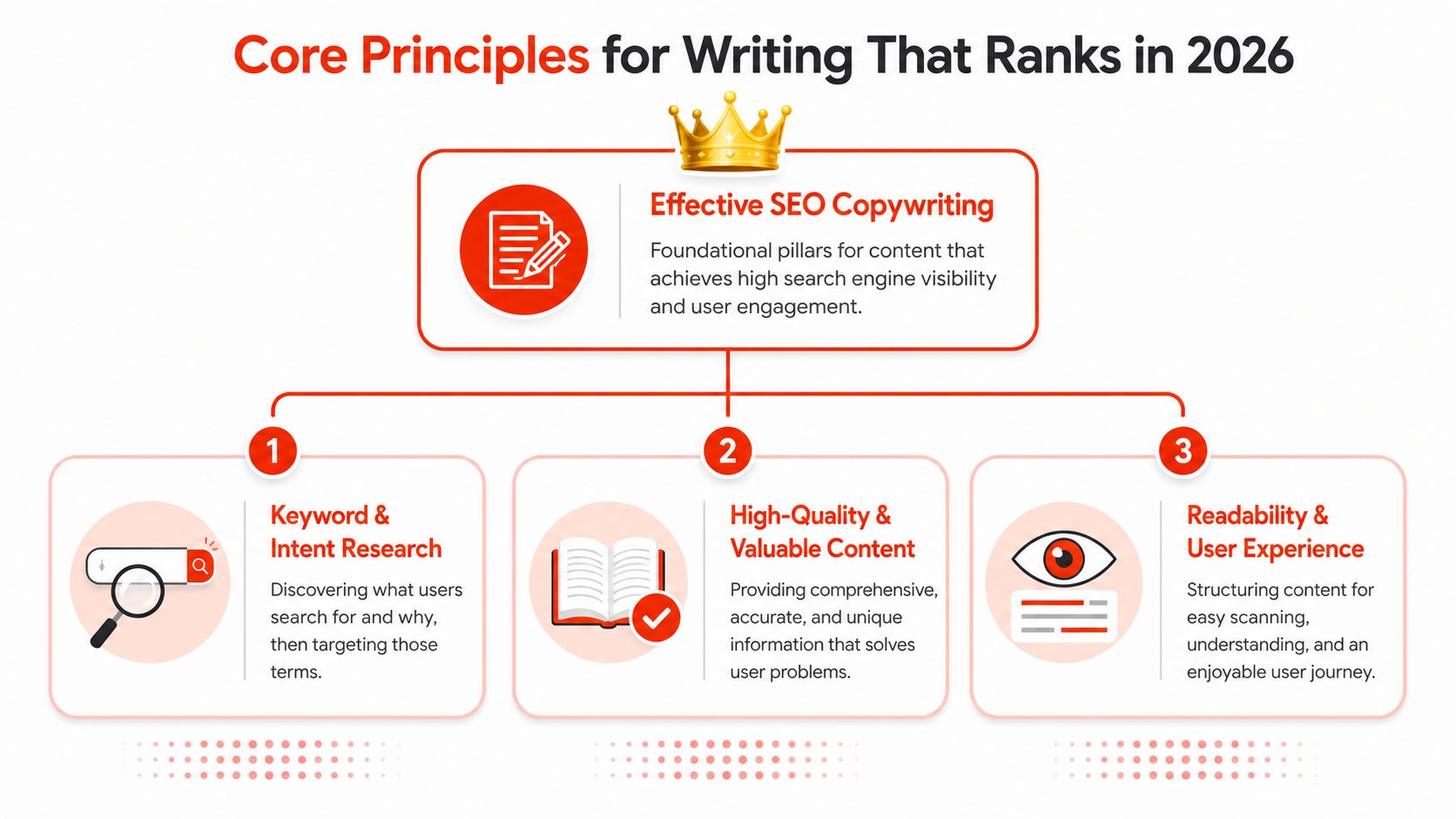
Most pages fail because they start with what the business wants to say, not what the buyer needs to know. Effective SEO copywriting works better when you build it around search intent, clarity, and structure.
Start with the search, not the sloga.n
Begin with the phrase a buyer would type when they’re close to a decision. That usually means a service, a problem, or a place. “Emergency plumber in Croydon” is stronger than “trusted property solutions”. One tells you exactly what the page is about. The other makes the reader work.
Intent matters as much as keywords. Someone searching “how to fix a leaking tap” may want advice. Someone searching “emergency plumber near me” probably wants to hire. Those users need different pages and different calls to action.
Buyers don’t search using your internal language. They search using their problem, the service they want, and often the place they need it.
Write for people first, then shape for search.h
Once you know the target phrase, write like you’re answering a real customer on the phone. Use plain language. Name the service early. Explain the process. Remove waffle.
Good SEO copy usually includes:
- Clear relevance: The page quickly confirms what service is offered.
- Useful detail: It answers the practical questions a buyer has before enquiring.
- Commercial clarity: It gives the reader an obvious next step.
If your homepage tries to rank for everything, it usually weakens itself. One main topic per page is a safer rule. A dedicated service page almost always gives you more room to match search intent better.
The same principle applies to decision-making speed. People judge fast, and first impressions often come from layout and wording together. As a result, pages built around fast clarity tend to outperform vague positioning. For example, the idea is similar to what’s explored in How Customers Decide in Seconds.
Structure for modern search behaviour
Search has changed. People still use Google, but they also rely on AI-generated summaries and answer engines. That changes how pages should be written.
According to White Hat SEO’s guidance on SEO copywriting, in 2026, SEO copywriting requires structuring content with 40–60-word direct “answer-first” responses under question-style H2S to qualify for AI Overviews and answer engines like ChatGPT, which now sit between users and Google rankings for UK B2B content.
That doesn’t mean every page should sound mechanical. It means key questions should get direct answers before the deeper explanation. A strong page often follows this pattern:
- Question-led subheading
- Direct answer near the top
- Supporting detail below
- Relevant next step
This works because it helps both skim readers and search systems. The page becomes easier to extract, scan, and trust.
On-Page SEO Copywriting for Your Website
Putting theory into practice: If you’re looking at a page and wondering what to change, start with the parts search engines and users notice first.
The parts of the page that matter most
Think of the page as a shopfront with layers.
| Page element | What it does |
|---|---|
| Title tag | Tells searchers and Google what the page is about |
| Meta description | Gives a short reason to click |
| H1 heading | Confirms the page topic once someone lands |
| Opening paragraph | Reassures the reader they’re in the right place |
| Subheadings | Help people scan and help structure the topic |
| Body copy | Answers objections and leads towards contact |
For UK business content, title tags must stay between 50 and 60 characters, and the primary keyword should appear within the first 150 words of the opening paragraph, according to StudioHawk’s SEO copywriting best practices. That’s a technical rule, but the reason is straightforward. People and crawlers both need fast confirmation that the page matches the search.
What good optimisation looks like on the page
Start with the title tag. Put the main service phrase near the beginning if you can do it naturally. Don’t waste space on vague branding language. Searchers care about the service first.
Then write the H1 so it mirrors the page’s purpose. If the title tag is your search listing sign, the H1 is the first in-store banner. It should reinforce the same topic, not introduce a new one.
For the body copy, follow a practical sequence:
- Lead with relevance: Name the service and who it helps near the top.
- Address obvious concerns: explain the pricing approach, turnaround time, service area, or processes if they matter.
- Use subheadings well: Turn common buyer questions into useful sections.
- End with direction: Don’t leave the reader wondering what to do next.
A strong page doesn’t bury the offer under brand story. It also doesn’t dump a wall of keywords into a single paragraph. You’re aiming for natural language with commercial intent.
Working rule: If you remove the business name from the page, the remaining copy should still make it obvious what service is being sold.
Design and copy also need to cooperate. A well-written page struggles when the layout is cluttered or the hierarchy is weak. If you want to see how structure and content should support each other, this guide to SEO-friendly web design is a useful companion.
One final point. Meta descriptions don’t directly close the sale, but they do shape the click. Write them like a concise promise. Tell the searcher what they’ll get on the page, and make that promise match the actual content.
Simple Before and After Examples
A weak service page usually isn’t a sign that the business is bad. It’s bad because the copy tries to sound impressive instead of useful.
After
Title tag: Small Business Website Design in Manchester
Meta description: Get a professional small business website designed for lead generation, clear messaging, and easy updates. Speak to a local team today.
H1: Website Design for Small Businesses in Manchester
Opening copy:
Need a website that helps your business win more enquiries? We design small business websites in Manchester that clearly explain your services, support local search visibility, and guide visitors to call or message you.
Subheading: What’s included in your website design service
Body copy:
Your site should do more than look good. Instead, it should make it easy for customers to understand what you offer, trust your business, and take the next step. To achieve this, each page needs clear headings, focused service content, and strong calls to action.
This version works better because it lines up with a real search, confirms the service immediately, and speaks to a commercial outcome. As a result, it also gives the page a clear next step. The visitor can keep reading while already knowing what the offer is.
Before
Title tag: Strategic Solutions for Growing Businesses
H1: Welcome to Our Services
Opening copy:
We are a passionate team dedicated to delivering customised solutions that enable modern businesses to reach their full potential. Our comprehensive approach supports growth, visibility, and long-term success across a range of sectors.
This version has familiar problems. It never names the actual service. As a result, it doesn’t match a likely search query. Consequently, it gives the visitor no immediate reason to believe they’re in the right place.
Your SEO Copywriting Checklist
A page shouldn’t be judged solely by its ranking. It should also be judged by whether it helps the right visitor convert. That’s where many small business sites lose value.
According to Trafficly’s UK guide to SEO copywriting services, 68% of top-ranking pages for local service keywords fail to include clear conversion triggers, such as UK-specific pricing tables or trust badges, leading visitors to bounce before contacting. That’s the gap most owners feel without always knowing how to describe it. The traffic arrives, but the page doesn’t do enough to turn interest into action.
SEO and conversion copy checklist
| Check | Item | Why it Matters |
|---|---|---|
| ☐ | Main keyword appears in the title tag | Confirms topical relevance in search results |
| ☐The title | The tag is concise and readable. | Helps prevent truncation and improves clarity |
| ☐ | H1 clearly names the service. | Reassures visitors they’ve landed on the right page |
| ☐ | The opening paragraph states the offer quickly. | Reduces confusion and keeps attention |
| ☐ | One main topic is covered on the page | Stops the message from becoming diluted |
| ☐ | Subheadings answer buyer questions. | Improves scanning and supports intent |
| ☐ | Copy uses plain English instead of jargon | Makes the page easier to trust |
| ☐ | The service area is named where relevant. | Helps local relevance and buyer confidence |
| ☐ | Trust signals are visible. | Buyers need reassurance before contacting. |
| ☐ | Pricing guidance or process clarity is present | Reduces hesitation and uncertainty |
| ☐ | Call to action is easy to find | Gives the visitor a clear next step |
| ☐ | Form, phone, or enquiry method feels low-friction | Makes contacting you easier |
A useful audit habit is to check the page in two passes.
- First pass for ranking: Can a search engine tell what this page is about?
- Second pass for conversion: Can a buyer tell why they should contact this business?
A page that ranks for the right search but hides the next step is only doing half its job.
If you’re unsure whether a page is weak because of SEO or weak because of copy, this checklist usually exposes the answer quickly.
Measuring Success and Avoiding Common Mistakes
Success isn’t “we published some optimised pages”. Success is that the right people arrive, and more of them enquire.
What to measure
Use Google Search Console to see which queries trigger impressions and clicks. Use Google Analytics 4 to see what organic visitors do after landing. Then tie that back to business outcomes. Are visitors reaching your contact page, clicking your phone number, or submitting forms from service pages?
The professional value of this work is easy to miss until it’s done badly. In the UK, the median average salary for an SEO specialist was approximately £39,719 between 2025 and 2026, reflecting the demand for this skill, according to Reboot Online’s SEO statistics. That figure is a reminder that effective SEO copywriting isn’t just “writing with keywords”. It’s specialist commercial work.
Mistakes that waste good traffic
The most common problems are familiar:
- Writing for the business instead of the buyer
- Targeting broad phrases with no commercial intent
- Stuffing keywords until the page sounds unnatural
- Ignoring calls to action
- Publishing thin pages that never answer real questions
Another mistake is treating AI visibility as separate from SEO copywriting. It isn’t. Clear structure, direct answers, and clean topic focus help across both. If AI search visibility is on your radar, this article on getting your business featured in ChatGPT, Google Gemini and AI search results adds useful context.
Good SEO copywriting does two jobs at once. It helps search systems understand the page and helps a buyer decide whether contacting you is worth their time.
If you want a site that does more than put it online, 1stNet AI Ltd offers a fully managed solution for UK businesses looking to move quickly. Launch your website fast with a domain, SSL, hosting & maintenance included. In an hour. 1stNet.AI website team. We transform your online presence with a stunning website. Call us now at 0204 577 2255. Don’t miss this chance to enhance your brand! All our work comes with a 30-day money-back guarantee. WE OFFER AN INTERACTIVE LIVE CHAT SYSTEM TO DESIGN YOUR WEBSITE.