
Your website has gone live. It looks sharp, the pages load properly, the contact form works, and you finally have something professional to send prospects to. Then the obvious problem hits. No one is visiting it.
That’s where many UK small businesses stall. They’ve solved the build problem, but not the attention problem. A website on its own doesn’t create demand. It only converts demand once people arrive.
Guest posting is one of the clearest answers to that gap. Not the spammy version built on weak blogs and mass outreach, but the practical version. You publish useful articles on websites your audience already reads, earn visibility in the right places, and send qualified readers back to your own site. In a search environment shaped by AI summaries, stricter quality filters, and tougher competition, that kind of targeted exposure matters more than ever.
Launch your website fast with a domain, SSL,
hosting & maintenance included. In an hour.
1stNet.AI website team. We transform your online presence with a stunning website.
Call us now at 0204 577 2255. Don’t miss this chance to enhance your brand!
All our work comes with a 30-day money-back guarantee.
WE OFFER AN INTERACTIVE LIVE CHAT SYSTEM TO DESIGN YOUR WEBSITE.
Table of Contents
- The ‘What Next’ Problem for Every New Website
- Building Tangible Brand Authority Beyond Backlinks
- Driving High-Intent Traffic That Actually Converts
- A Practical Framework for Your UK Guest Posting Campaign
- Measuring Success and Maximising Your Website’s ROI
- Turning Guest Posting Into a Sustainable Growth Engine
The ‘What Next’ Problem for Every New Website
A familiar pattern plays out after Launch. A local service business invests in a proper site, rewrites its core pages, adds testimonials, fixes mobile layout issues, and expects enquiries to follow. Instead, the analytics barely move.
That frustration makes sense. In the UK, a standard business website typically takes 10 to 14 weeks from planning to launch. In comparison, simple brochure sites usually take 6 to 8 weeks, while e-commerce builds often take 12 to 14 weeks due to payment setup and security requirements, according to Baslon Digital’s UK website build timelines. By the time a business reaches Launch day, it’s already spent serious time and attention. It’s easy to assume the hard part is over.
It isn’t. Launch is the starting line.
A new website needs distribution. If your pages aren’t yet ranking and your brand isn’t yet known, waiting passively for traffic is slow and unreliable. Guest posting solves that by putting your expertise in front of existing audiences. Instead of hoping Google discovers you quickly, you place yourself where relevant readers are already paying attention.
A strong website is the engine. Guest posting is one of the most reliable ways to feed it qualified traffic early.
This matters even more now that discovery isn’t limited to a list of blue links. Search behaviour is shifting across AI-powered results, summaries, and recommendation layers. If you want your brand mentioned in more places and understood in context, your content has to travel. That’s one reason many businesses are now paying closer attention to how to get their business featured in ChatGPT, Google Gemini and AI search results.
The real mistake after Launch
Most owners focus on finishing the site and treat promotion as a later task. That’s backwards.
A better sequence looks like this:
- Launch the site properly: Make sure the service pages, contact paths, and trust elements are in place.
- Choose the right publications: Look for websites read by your potential buyers, not random sites selling placements.
- Publish useful expertise: Answer questions your customers already ask before they enquire.
- Send readers to relevant pages: Don’t dump everyone on the homepage if a service page is a better fit.
That’s the practical context for the benefits of guest posting for business growth. It’s not just an SEO tactic. It’s the first serious traffic strategy many new websites need.
Building Tangible Brand Authority Beyond Backlinks
Authority is the primary asset guest posting builds. The link matters, but the stronger effect often comes earlier. People see your business featured in a publication they already know, and that borrowed trust changes how they judge you.

A small business rarely starts with public authority. It has to earn it. Publishing on respected industry sites helps you do that in full view of potential clients. When a prospect finds your name attached to a thoughtful article on a credible website, they don’t see an unknown company trying to promote itself. They see a business that belongs in the conversation.
Why borrowed trust matters
Many owners undervalue guest posting. They reduce it to a backlink exercise and miss the commercial effect.
Brand authority grows when your business appears in the right editorial environments:
- Industry relevance: A placement in a publication tied to your trade tells buyers you understand their problems.
- Third-party credibility: Someone else gave you space because your contribution was worth publishing.
- Message control: You decide which topic, angle, and expertise your brand becomes associated with.
- Sales support: Prospects often research a company before they call. Guest articles strengthen what they find.
That authority also supports how search engines assess trust signals. A business that’s cited, visible, and clearly associated with useful niche content is in a stronger position than one that only publishes on its own website.
Later in the buying process, this can make your own site work harder. A visitor who has already seen your name in a recognised publication tends to arrive warmer and less sceptical.
What weak placements do instead
Not all guest posting helps. Some of it damages trust rather than building it.
The current quality line is much stricter. GuestPost.uk’s review of whether guest posts are still effective in 2026 states that guest posting remains essential in 2026 only when targeting high-traffic, editorially vetted sites with genuine organic reach. It also notes that with Google’s 2025–2026 algorithm updates prioritising AI-search-friendly content, low-quality placements on link farms now actively harm rankings.
That changes the job. You’re not buying mentions. You’re earning credible placements.
Practical rule: If a site publishes anything from anyone, it won’t transfer much authority to your brand.
A good guest post should read like a real contribution, not rented space. Editors should care about quality. The publication should have a visible audience. The article should fit the site’s subject matter and tone. If those conditions aren’t there, skip it.
This walkthrough gives a useful visual sense of how authority content should be approached in practice:
Driving High-Intent Traffic That Actually Converts
Traffic only matters if it leads to enquiries, sales, or some measurable commercial step. That’s why guest posting outperforms many broader visibility tactics. It sends people who were already reading about a relevant topic and made an active choice to click through.
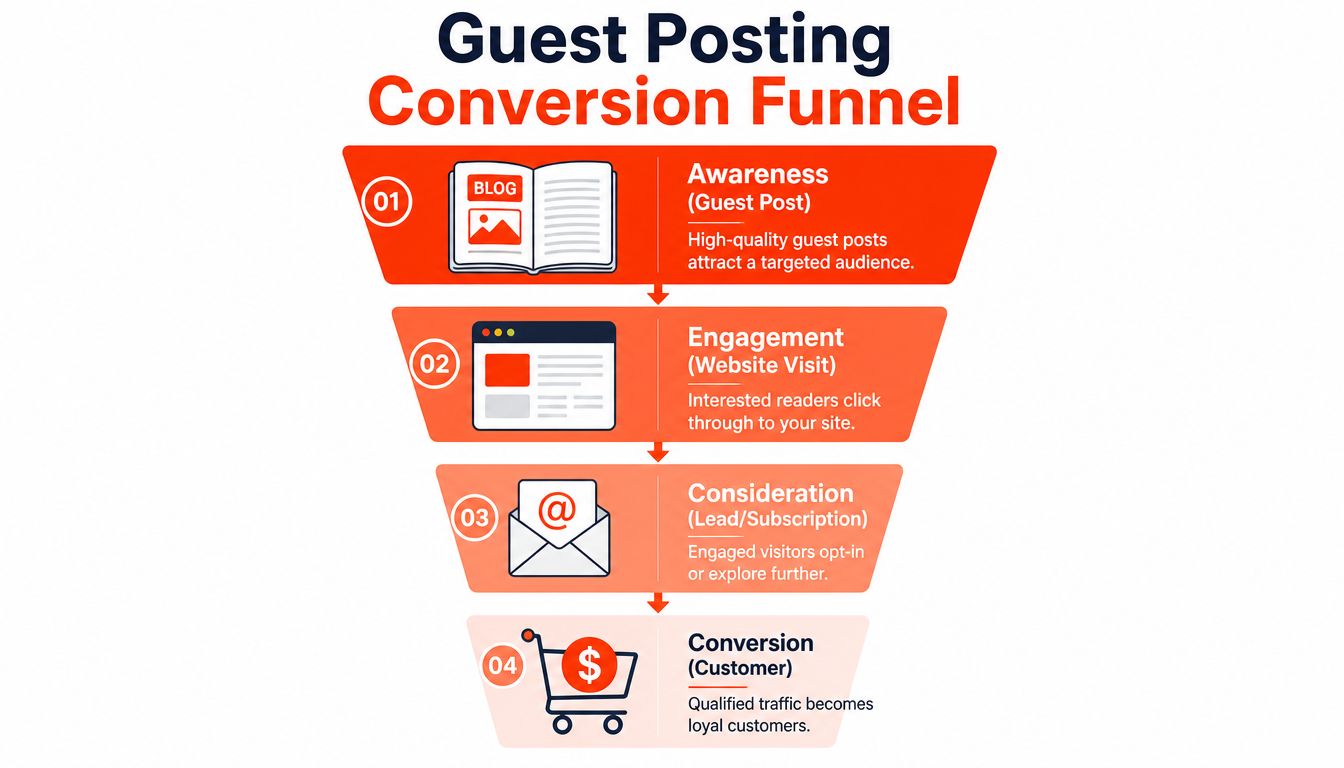
Someone landing from a well-placed guest article is different from a casual visitor who typed a broad search and clicked the first result that looked acceptable. The guest post reader has already engaged with your thinking. They’ve seen your name in context. They often arrive with a clearer problem and stronger intent.
Why referral visitors behave differently
The quality gap starts before the click.
A relevant guest article pre-frames your expertise. If you write about redesign mistakes for trade businesses, local SEO for clinics, or content structure for law firms, the reader arrives expecting a specific solution. That’s a much stronger starting point than attracting a generic visit from an unfocused keyword.
This is why the benefits of guest posting for business growth aren’t just about reach. They’re about fit.
A useful way to think about it is simple:
| Traffic source | Visitor mindset | Typical value |
|---|---|---|
| Generic search visit | Comparing options, often broadly | Useful, but mixed intent |
| Relevant guest post referral | Already interested in your topic and approach | Higher likelihood of enquiry or action |
That commercial difference shows up in the numbers. For UK businesses, Sanmo’s analysis of guest posting ROI shows that referral traffic from quality guest posts converts at 3% to 7%, compared with 1% to 3% for standard organic traffic. The same source states that a quality guest post can generate 150 to 500 targeted visitors per article within 30 to 60 days, and businesses using analytics report direct revenue attribution of £1,500 to £8,000 per single guest post within the first six months.
What makes the traffic profitable
The referral click itself isn’t the whole story. Profitability depends on how closely the article, anchor, and destination page align.
That means matching these three parts:
- Topic match: The guest article should answer a problem your service solves.
- Link match: The click should promise a logical next step, not a vague homepage visit.
- Page match: The destination page should continue the same conversation with clear proof and a direct action.
Readers don’t convert because they clicked. They convert because the click led them to the exact page they expected.
If your guest content effectively introduces your expertise, the next improvement is on-page messaging. Businesses that want stronger conversion from content-led traffic usually benefit from tightening their service page language, call-to-action structure, and alignment with search intent. That’s the same discipline behind SEO copywriting for service pages and content that converts.
A Practical Framework for Your UK Guest Posting Campaign
Most businesses don’t need a complicated outreach system. They need a disciplined routine they can repeat without wasting time on poor sites or weak topics.
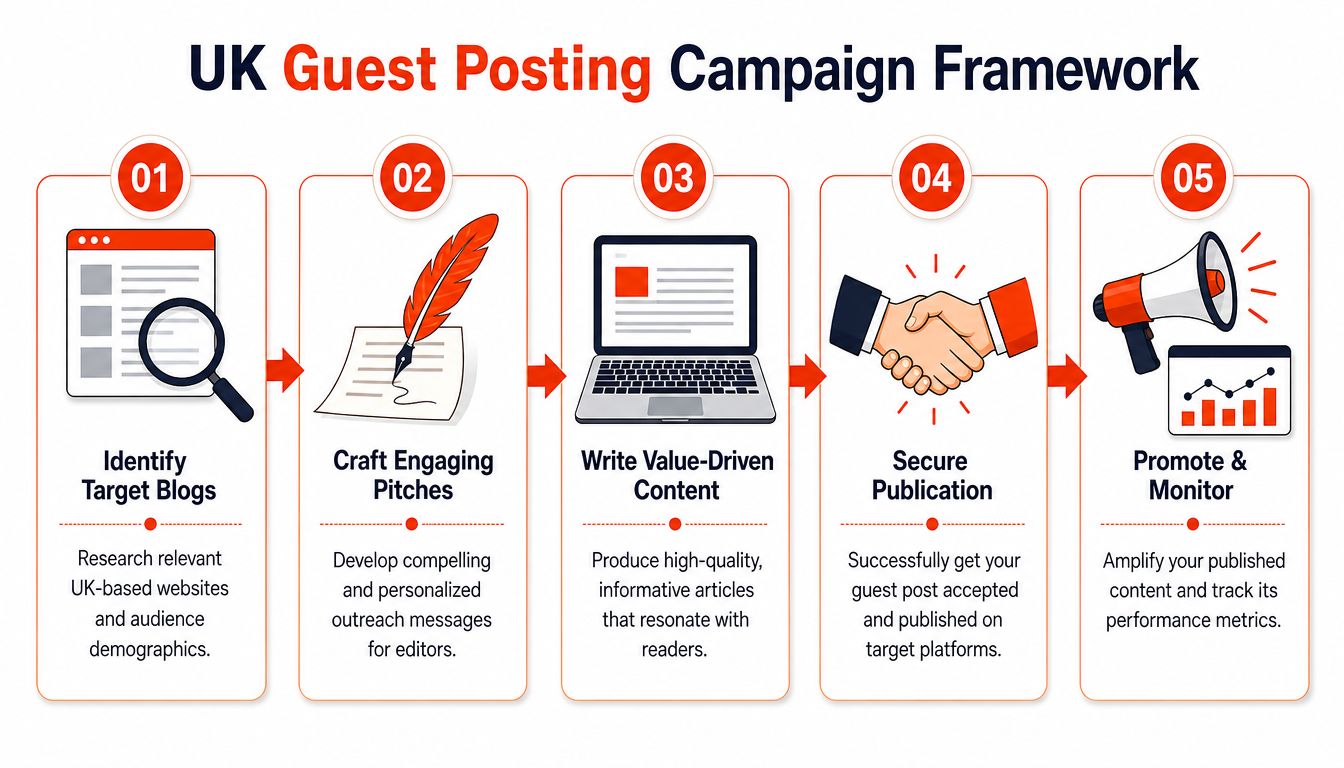
Choose publications your buyers already trust
Start with relevance, not vanity. A local accountant should look at UK small business publications, trade association blogs, regional business sites, and niche service publications. A web designer should look at SME marketing sites, startup resources, and business growth blogs with a real editorial standard.
Build a shortlist and check basic quality signals:
- Editorial fit: Does the site publish original articles that match your industry?
- Audience fit: Would a potential buyer of your service read it?
- Content standard: Are articles edited well, current, and useful?
- Link environment: Do outbound links look selective, or does every article feel promotional?
A high authority score means little if the readership is irrelevant. For many UK businesses, local relevance is more valuable than a broad site with no connection to your market.
Pitch like a contributor, not a marketer
Editors ignore vague outreach. They respond to specific ideas that fit their readers.
A workable pitch usually includes:
- A clear subject line tied to the site’s audience.
- A short introduction explaining who you help and why you’re relevant.
- Two or three article ideas with practical angles.
- A sentence on what the reader will gain from the piece.
- A link to one strong writing sample, if you have one.
Keep the tone professional and plain. Don’t open with link requests. Don’t promise” high-quality content” as if that phrase means anything. Show the quality in the idea itself.
Editors publish contributors who make their publication better, not businesses trying to sneak in promotion.
Publish consistently and validate the result.
Consistency is where many campaigns either compound or collapse. One good post can help. A reliable stream of good posts builds presence.
According to Link Building Journal’s UK benchmark for guest posting and links, a key metric for building authority is publishing 5 to 10 guest posts per month on sites with a Domain Rating of 30 or higher within a specific niche. The same source says Google must index those pages within 14 days or the links provide zero SEO value.
That gives you a practical operating standard:
- Aim for steady volume: Not a burst of random placements.
- Stay inside your niche: Relevance beats scattergun outreach.
- Check indexation quickly: A published article that isn’t indexed won’t pull its weight.
- Review monthly: Look at referring domains and overall quality, not just the count.
The businesses that get results from guest posting usually treat it like editorial business development. They identify useful publications, contribute strong ideas, and repeat the process without cutting corners.
Measuring Success and Maximising Your Website’s ROI
Guest posting only becomes a growth channel when you can connect the placement to business outcomes. If you only count links or pageviews, you’ll miss the full picture.

The website itself also changes the result. A good guest article can earn the click, but it can’t rescue a slow, unclear, or poorly structured page. That’s why off-site promotion and on-site conversion have to be managed together.
Track business outcomes, not vanity metrics
Start with the basics in your analytics stack. Look at referral traffic by publication, then go one level deeper and check what those users do.
Useful measures include:
- Qualified enquiry volume: Which placements generate contact form submissions or calls?
- Landing page performance: Whether visitors stay, read, and move to the next step.
- Assisted conversions: Whether a guest post introduced the visitor before they returned later to enquire.
- Page-level conversion behaviour: Which service pages turn referral traffic into leads?
A website should be treated as an investment, not a brochure. UK small businesses generally invest £2,000 to £5,000 for a professional brochure-style site and £5,000 to £15,000 for e-commerce, with most SMEs recovering those costs within 6 to 12 months through increased enquiries, according to CloudSwitched’s guide to small business web design costs in the UK. Separate reporting from Weblane’s small business website statistics indicates that professional small business websites typically pay for themselves within 6 to 12 months in most sectors, driven solely by increased enquiries.
That matters because guest posting accelerates the traffic side of that payback model.
Make sure the destination page can convert.
If you’re investing time in placements, the receiving page needs to do its job. Review the page with a buyer’s eye.
Ask direct questions:
| Checkpoint | What to look for |
|---|---|
| Message clarity | Does the page explain what you do in seconds? |
| Trust signals | Are reviews, case examples, or credentials visible? |
| Call to action | Is the next step obvious and easy? |
| Mobile usability | Can a visitor enquire quickly on a phone? |
The best guest posting campaign in the world still underperforms if it sends qualified visitors to a page that creates friction.
If that’s the weak point, improve the site before increasing outreach volume. Strong SEO-friendly web design for lead generation gives referral traffic a better chance of turning into revenue.
Turning Guest Posting Into a Sustainable Growth Engine
Guest posting works best when you stop treating it like a quick SEO trick and start using it as a repeatable business development channel. Done well, it builds public expertise, earns trust in places your audience already reads, and sends visitors who are more likely to act.
That’s why it makes sense as the next move after Launch. A professional website gives you a place to convert interest into action. Guest posting gives you a way to create that interest in the right market—one without the other leaves value on the table.
There are trade-offs. Quality placements take work. Strong articles take thought. Editors reject weak pitches. Some sites look impressive but offer no real audience. Low-grade link sellers waste budget and can hurt your visibility. None of that means guest posting has lost value. It means standards are higher, and that’s good news for businesses willing to do it properly.
A sensible approach is to start narrow. Pick a small set of relevant UK publications. Write about the questions your prospects already ask. Link to pages that continue the same topic. Track the enquiries that follow. Then refine from evidence, not guesswork.
For many small businesses, that’s the point where marketing becomes more predictable. You’re no longer waiting for your website to get somehow discovered. You’re placing your expertise in front of the people most likely to need it.
Guest posting won’t replace every other channel. It doesn’t need to. Its job is to compound. Each credible article strengthens your brand, supports your website, and creates another path for buyers to find you.
If your business has a website but not the momentum yet, 1stNet AI Ltd can help you get the foundation right. The team builds fast, SEO-friendly websites for UK small businesses, including domain registration, SSL, hosting, maintenance, and support. They can quickly take a site live, offer a 30-day money-back guarantee, and provide an interactive live chat workflow that makes the build process easier for non-technical owners. Call 0204 577 2255 if you want a site that’s ready to turn hard-earned traffic into real enquiries.