

A cheap website quote often feels like a relief at first. Then the annual renewals start, the plugin breaks after an update, the contact form stops sending leads, and you find out the original price covered little more than the launch.
For a UK small business, the cost of a website is rarely just the build. The upfront figure matters, but the bigger question is what you will spend to keep the site live, secure, updated, and useful over the next three years. That is the total cost of ownership, and it is the number that usually decides whether a website was good value or a false economy.
If you are comparing quotes now, the market can feel needlessly confusing. One provider gives you a low setup fee, then leaves hosting, support, security, content edits, and maintenance outside the quote. Another charges more because those jobs are already included. A freelancer may be flexible. An agency may offer more process. A website builder may look cheap until your own time becomes part of the bill.
That is why small business owners get frustrated with website pricing. You are not buying a brochure. You are buying a business tool that needs to load properly on mobile, earn trust, collect enquiries, and keep working after launch without turning into a monthly headache.
A website works like a van. Buying it is one cost. Running it, insuring it, servicing it, and fixing problems is another.
Over three years, that difference becomes clear. A low one-off build can end up costing more once you add hosting, domain renewals, SSL, maintenance, bug fixes, content updates, and emergency support. A fully managed monthly service often looks dearer on day one, but it gives you predictable costs and fewer surprises, which matters if you need to budget properly.
This article looks at website cost through that practical lens. The aim is simple. Help you compare the actual three-year cost of each option so you can choose based on value, support, and financial predictability, not just the cheapest number on the first quote.
Table of Contents
- How Much Does a Website Really Cost in 2026
- Breaking Down Your Bill One-Time vs Recurring Costs
- What Determines Your Final Website Price
- UK Website Price Ranges by Type and Complexity
- Choosing Your Path DIY vs Freelancer vs Agency vs Managed Service
- Actionable Tips to Control Your Website Budget
- Beyond Cost Investing in Value and Speed
How Much Does a Website Really Cost in 2026
A local business owner usually starts with a simple question: “What should a website cost?” Then the quotes arrive, and the question gets harder, not easier.
One quote covers design only. Another includes hosting but not updates. A third sounds cheap until you notice it doesn’t mention content entry, SSL, or support after launch. That’s why headline prices often create more confusion than clarity.
For a professional UK brochure-style website, the market range is broad. A basic brochure-style website designed by a professional typically ranges from £500 to £3,00. At the same time,e small businesses or e-commerce sites commonly fall between £2,000 and £5,000 according to Finsbury Media’s UK website design cost guide.
The first quote does not include the full cost.
That build price is the entry ticket, not the full bill. It tells you what it takes to create the site. It doesn’t automatically tell you what it takes to run it properly for the next three years.
A lot of frustration comes from that gap. Business owners think they’re comparing like-for-like, but they aren’t. One supplier may price the website as a finished business asset. Another may price only the initial assembly, leaving the owner to sort hosting, renewals, plugin licences, backups, edits, and security later.
Practical rule: If a quote looks much lower than the rest, ask what happens after launch. That’s usually where the missing cost is hiding.
Why the cost of website ownership feels confusing
Websites combine creative work, technical setup, and ongoing operations. That mix makes pricing look inconsistent, even when there are sensible reasons behind it.
A five-page site for a local trades firm isn’t priced like a booking-led service business or an online shop. The more your site has to do, the more planning, testing, and maintenance it needs. That’s normal.
The better question isn’t just “what does a website cost?” It’s “What will this website cost me to build, run, and maintain without headaches?” Once you ask it that way, cheap quotes become easier to read.
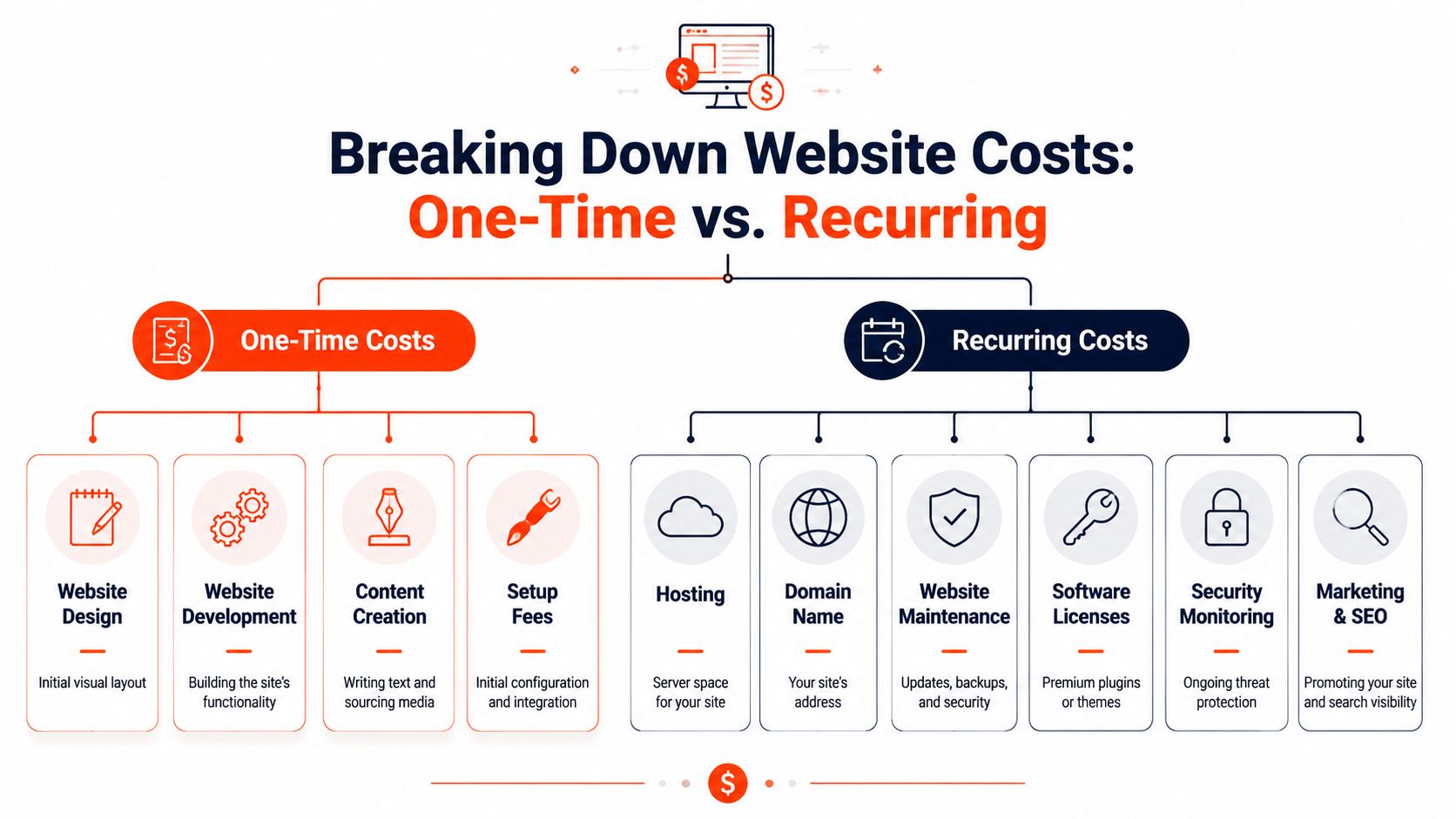
Breaking Down Your Bill: One-Time vs Recurring Costs
Buying a website is a bit like buying a car. The purchase price matters, but so do the fuel, insurance, servicing, and MOT. If someone only tells you the sticker price, they haven’t told you what ownership feels like.
The upfront build cost
The one-time part usually includes the visible work:
- Design work for the layout, page structure, branding application, and mobile presentation.
- Development to build the site, configure forms, create templates, and make the pages function properly.
- Content setup to load text, images, service pages, and contact details into the website.
- Launch configuration for essentials such as analytics, forms, redirects, and the basics around your domain name setup.
This is the part most commonly considered when discussing the cost of website projects. It’s important, but it’s still only stage one.
The recurring costs people forget
The second category is the one that catches people out. A website that stays live and secure has recurring operating costs, even when nothing dramatic changes on the surface.
According to HDWEBSOFT’s breakdown of web development costs, annual infrastructure costs for domain registration and hosting range from $100 to $5,000; SSL certificates cost $0–$500; and third-party services such as payment gateways and CDNs incur recurring operational costs.
That matters because these aren’t vanity extras. They’re the plumbing.
| Cost type | What it does | Why does it keep recurring |
|---|---|---|
| Hosting | Keeps the website online | Server resources are rented, not bought, once |
| Domain renewal | Retains your web address | Domains expire if not renewed |
| SSL | Secures traffic | Certificates require renewal or managed provision |
| Maintenance | Applies updates and fixes | Software changes and threats don’t stop |
| Third-party tools | Supports payments, forms, email, and bookings | Most are billed monthly or annually |
A website can look finished on launch day and still be underfunded for ownership.
The practical point is simple. If your supplier doesn’t clearly show these costs, you’re not seeing the full financial picture. You’re looking at the first invoice.
What Determines Your Final Website Price
Two websites can both be called “small business sites” and still land in very different price brackets. The reason is complexity. Not fluff. Not branding language. Actual build complexity.
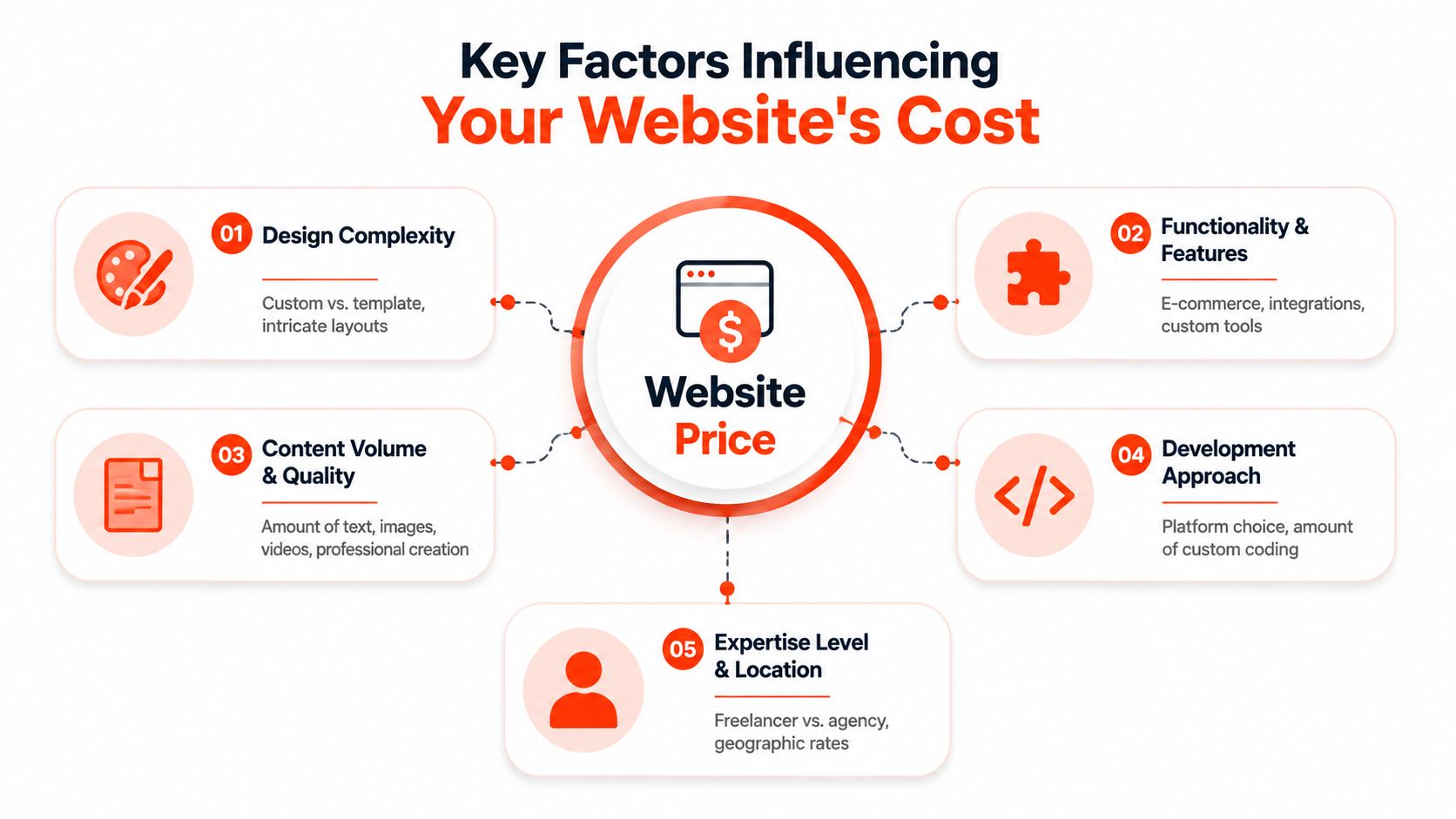
According to D2I Technology’s UK cost guide, a basic informational site costs £1,500 to £5,000, a complex website with custom features costs £5,000 to £20,000, and advanced e-commerce solutions can exceed £30,000 due to technical integrations.
Design choices change labour.
A template-led build is usually cheaper because the layout system already exists. The designer adapts it to your brand, content, and pages.
A bespoke design costs more because someone has to think through every screen, every section, every mobile behaviour, and how all of it fits your sales process. Custom design isn’t just” nicer visuals”. It’s more decision-making, more revision control, and more development time.
That doesn’t mean bespoke is always the right answer. For many small firms, a well-implemented clean template is a better commercial decision than paying for originality they don’t need.
Features and integrations push the quote up
A lot of website budgets jump at this point.
If your site only needs service pages, an about page, and a contact form, the build is fairly contained. If you want bookings, gated content, a product catalogue, account areas, payment collection, CRM syncing, or stock management, the quote rises because the testing burden rises too.
A useful way to think about it is this:
- Simple pages are like fitted shelves.
- Integrated features are like adding plumbing and electrics.
- Custom workflows are like moving walls in a house.
Each step adds coordination and risk.
Content is part of the build.
Many owners underestimate content. They assume the cost of website design includes polished copy, image selection, service messaging, and page-by-page structure by default.
Sometimes it does. Often it doesn’t.
If the supplier has to write your service pages, source imagery, edit existing text, or structure a blog, the price goes up because content creation is labour-intensive. If you provide clear, usable content early, you can often keep the project leaner and faster.
The biggest quote increases usually come from hidden complexity, not from the homepage looking nicer.
UK Website Price Ranges by Type and Complexity
Abstract pricing advice only gets you so far. It’s easier to budget when you can place your project into a realistic category.
Typical projects and where they sit
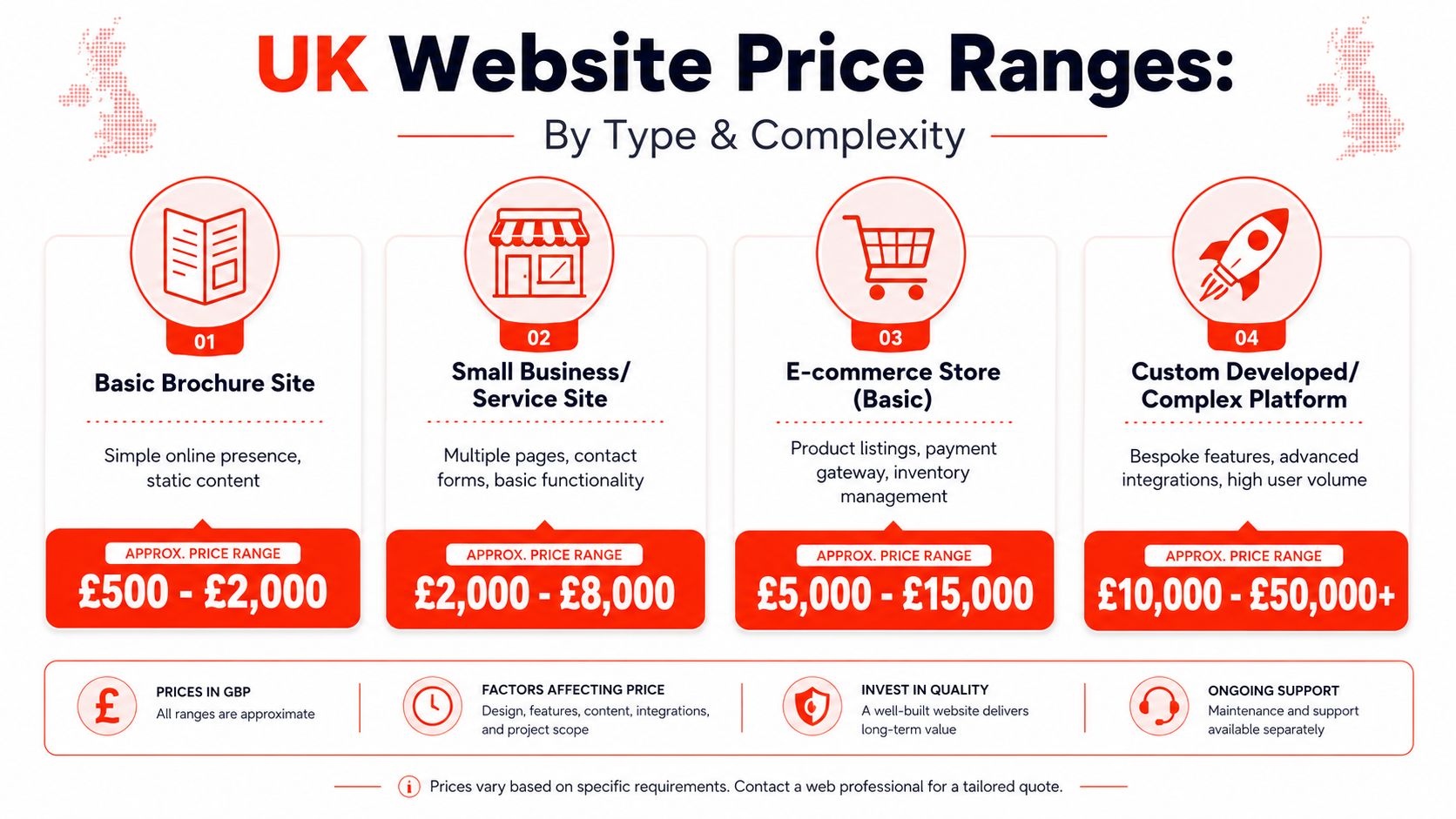
The UK market gives a fairly clear set of reference points. A professional small business website with 5 to 15 pages, mobile responsiveness, and basic SEO typically costs between £2,000 and £6,000 from a regional agency. At the same time, simpler 5-page sites range from £500 to £2,500 according to Red Eagle’s 2026 UK website pricing overview.
That gives you a practical way to sort projects:
| Website type | Typical use case | Common range |
|---|---|---|
| Simple brochure site | Local trades, consultants, sole traders | £500 to £2,500 |
| Professional small business site | Service firms needing 5 to 15 pages and basic SEO | £2,000 to £6,000 |
| Small e-commerce setup | Shop with a limited product range and payment handling | Higher than brochure builds, depending on platform and checkout setup |
| Custom platform | Bespoke workflows, integrations, and advanced functionality | Enters a different budget category entirely |
If you’re planning to take payments online, the build also needs proper checkout logic, product handling, and gateway setup. That’s where details such as website payment gateway options become part of the budget conversation, not an afterthought.
Where small firms usually overspend
Overspending doesn’t always come from buying too much quality. It often comes from buying the wrong project shape.
A local accountant may not need a bespoke animation-heavy build. A plumber may not need a content-heavy site with dozens of pages on day one. A retailer, on the other hand, shouldn’t try to force an online shop into a brochure-site budget.
Three sensible budgeting questions help:
- What must the site do now? Enquiries, bookings, sales, credibility, recruitment?
- What can wait until phase two? Reviews area, blog expansion, advanced automation?
- What needs to be managed for you? Hosting, updates, security, edits?
That filtering keeps the cost of website projects tied to business use, not wish lists.
Choosing Your Path: DIY vs Freelancer vs Agency vs Managed Service
A lot of small business owners hit the same wall. The quote for the website build looks manageable, but then the questions start. Who updates it?
If a plugin breaks, who fixes it? And who renews the SSL certificate, resolves hosting issues, or restores the site after a bad update?
That is the difference between buying a website and owning one for three years.
What each route really means
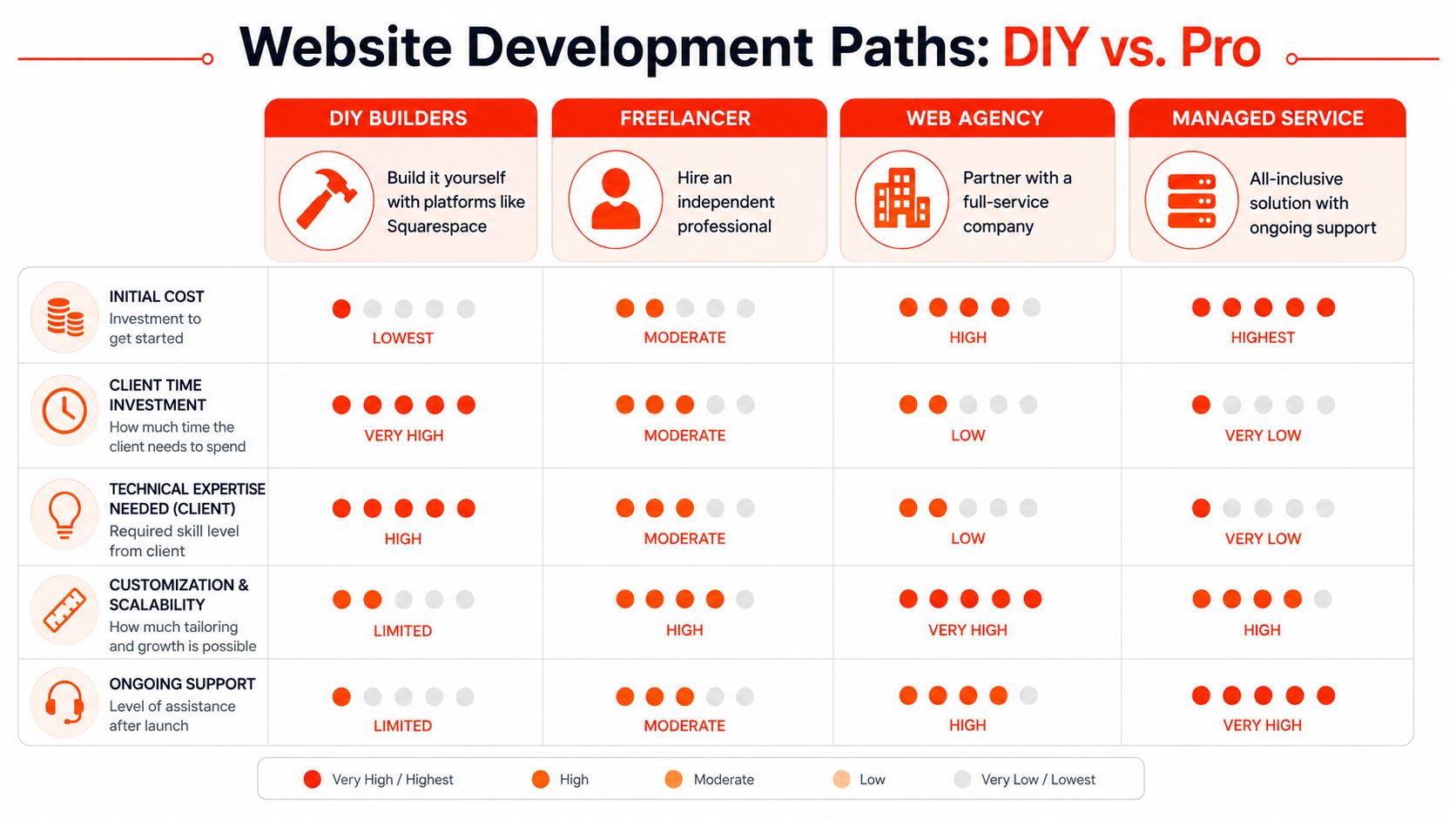
DIY builders keep upfront spending low, but they shift the work onto you. You are choosing layouts, loading content, checking forms, handling updates, and working out why something stopped working on a Sunday evening. For an owner with time and patience, that can be fine. For an owner already wearing six hats, the hidden cost is time.
Freelancers often suit smaller projects with a clear brief and limited functionality. You usually get direct communication and a more flexible process. The trade-off is continuity. If your freelancer is busy, away, or no longer offering support, the website still needs attention.
Agencies bring a wider team and are often a better fit for larger builds, custom features, or businesses that need strategy as well as design. They can also introduce additional processes, handovers, and cost layers. That is not a criticism. It is how agency delivery works.
Managed services package the build and the ongoing ownership costs together. That usually includes hosting, security, updates, maintenance, support, and a defined process for changes. For owners who want a website that stays looked after without coordinating three or four suppliers, that structure is often easier to budget for.
Some providers package it under a single agreement. 1stNet AI Ltd is an example of a managed provider that combines build, hosting, SSL, maintenance, and support into a single service. That model also tends to work well when paired with SEO-friendly web design for small business websites, because build quality and ongoing management affect rankings as much as launch-day design.
A short comparison helps:
| Option | Best for | Main trade-off |
|---|---|---|
| DIY | Lowest upfront spend, hands-on owners | Your time and technical responsibility |
| Freelancer | Leaner custom work | Support continuity can vary |
| Agency | Larger or more complex projects | Higher and less predictable total spend |
| Managed service | Owners who want one provider and a fixed ownership structure | Less suited to people who want to self-manage everything |
The video below gives useful context on how businesses think through these options.
Why does the three-year cost matter more than the launch cost
The smarter comparison is total cost of ownership over three years, not the number on the first invoice.
A cheap one-off build can become expensive fast. Hosting gets renewed separately. Maintenance gets skipped. WordPress, plugins, or themes drift out of date. Then one day, the contact form stops sending, the site goes down, or a malware warning appears in search results. The repair bill arrives long after the original project felt “done”.
I see this mistake regularly. Owners buy the website as if it were a brochure printed once and left alone. In practice, a website works more like a company van. Buying it is only part of the cost. It still needs servicing, insurance, and someone responsible for keeping it roadworthy.
That is why managed monthly pricing appeals to many small firms. You swap the low upfront figure and uncertain repair costs for a fixed operating cost that is easier to plan around. You also know who to call when something needs to be changed.
A managed arrangement will not suit every business. Some owners want full control and are happy to handle the moving parts themselves. But for firms that value predictable spend, support continuity, and fewer technical surprises, the three-year TCO is often lower, or at least far more predictable, than the cheap-build-first route.
Actionable Tips to Control Your Website Budget
Controlling the cost of website ownership isn’t about squeezing every supplier. It’s about reducing waste before the project starts.
Budget control starts before design starts.
The cheapest revision is the one you never create. Most website overspend comes from unclear scope, late content, and feature creep.
A few habits help immediately:
- Start with the minimum useful version. If your business only needs credibility, service pages, and enquiries today, launch that first.
- Prepare your content early. Logos, service descriptions, prices, team bios, and photos should be ready before design reviews begin.
- Write a proper brief. List the pages you need, the actions users should take, and any tools the site must connect with.
- Separate must-haves from nice-to-haves. Booking system, shop, member area, and custom calculators aren’t all equal.
That discipline protects you from buying complexity by accident.
Choose pricing you can live with
Website budgets fail when owners only plan for the launch month. Ongoing support has to be part of the decision from day one.
According to We Are Tenet’s UK website design cost guide, monthly website maintenance and support services in the UK generally range from £500 to £3,000, with extensive retainers reaching up to £1,500 per month. That range is wide enough to show why fixed, transparent maintenance terms matter.
Use this checklist when reviewing proposals:
- Ask what’s included after launch. Updates, backups, support time, edits, and security checks should be named clearly.
- Check renewal responsibility. Domain, hosting, SSL, plugin licences, and platform fees shouldn’t be vague.
- Limit approval loops. Too many review rounds burn time and money.
- Favour transparent workflows. An interactive live chat design process can reduce long email chains and avoid revision drift.
If the pricing model is hard to understand before you sign, it won’t get clearer later.
Beyond Cost: Investing in Value and Speed
A small business owner signs off on a cheap website build, feels good about the one-off price, then spends the next three years paying for fixes, renewals, edits, plugin licences, hosting problems, and delays every time something breaks. That is the cost of website ownership.
The better question is not “What does the build cost?” It is “What will this website cost me to own, run, and support over three years?”
That Total Cost of Ownership view usually changes the decision. A lower upfront quote can become the more expensive option once you factor in maintenance, software renewals, support time, and the value of your own time spent chasing different suppliers. For many UK small businesses, financial predictability matters as much as the launch price. So does speed. A site that goes live quickly, stays updated, and gets support when needed is often worth more than a cheaper build that creates ongoing admin.
This is why managed, all-inclusive services appeal to owners who are tired of jargon and surprise charges. Instead of buying the site in pieces, you pay for a single service that handles the parts that usually cause trouble later: hosting, security, updates, maintenance, and support. It works like servicing included in a car plan. The monthly cost is not always the lowest on paper, but it is often easier to budget for and live with.
If you want a simpler route, 1stNet AI Ltd offers an all-in-one option for UK small businesses that want a fast launch without juggling separate suppliers. You can get a website with a domain, SSL, hosting, and maintenance included, with a quick launch process, ongoing support, and a 30-day money-back guarantee. If you’d like to speak to the team directly, call 0204 577 2255.