A domain name is the human-friendly address people use to find your business online, instead of remembering a string of technical server details. In the UK, that choice matters more than many owners realise, because .uk reached 10.4 million registrations by 2024 and has become one of the world’s most widely used top-level domains, underscoring its centrality to British online identity (history and registration scale of .uk).
If you’re setting up a website right now, you’re probably seeing words like hosting, SSL, DNS, registrar, renewal, SEO, and AI search, all thrown at you at once. That’s usually when small business owners start to feel that getting online is more complicated than it should be.
It doesn’t have to be.
The simplest way to understand what a domain name is is this. It’s your business’s memorable nameplate on the Internet, much like the sign above a shop door. Your customers remember it, type it into their browser, see it on your business card, and trust it when they see it in your email address.
For a UK business, your domain isn’t just a technical purchase. It’s often your most important digital asset. It shapes how local customers recognise you, how professional your business looks, and increasingly, how easy it is for search engines and AI-generated answers to understand that you serve the UK market.
Many owners hit the same wall. They want a website for their plumbing company, beauty salon, accountancy practice, café, or local shop, but the minute they start researching, they get buried under technical terms.
What usually clears the fog is realising that the first decision is surprisingly simple. Your domain name is your online address. If someone wants to find your business, that’s the name they’ll look for and remember.
Take a local example. If a customer hears about “Green Oak Kitchens” and later searches for a web address, greenoakkitchens.co.uk feels clear, direct, and credible. It also works neatly for email addresses such as hello@greenoakkitchens.co.uk. That one choice influences branding, trust, and discoverability long before anyone worries about plugins or servers.
Practical rule: If you wouldn’t feel confident saying the domain aloud over the phone, it probably needs simplifying.
A domain also becomes the foundation for everything else. Your website sits under it. Your email usually uses it. Your printed materials point to it. If you later invest in search visibility, social profiles, or online ads, they all work better when built around one strong, consistent name.
That’s why choosing it early saves headaches later. It gives your business a fixed online identity rather than a patchwork of mismatched names across different platforms.
For many small firms, the biggest shift comes when they stop viewing the domain as “tech stuff” and start seeing it as brand property. That’s when better decisions happen. If you’re building a site for a local company and want to see how it fits into the wider setup, it helps to look at a small-business website approach built for UK firms.
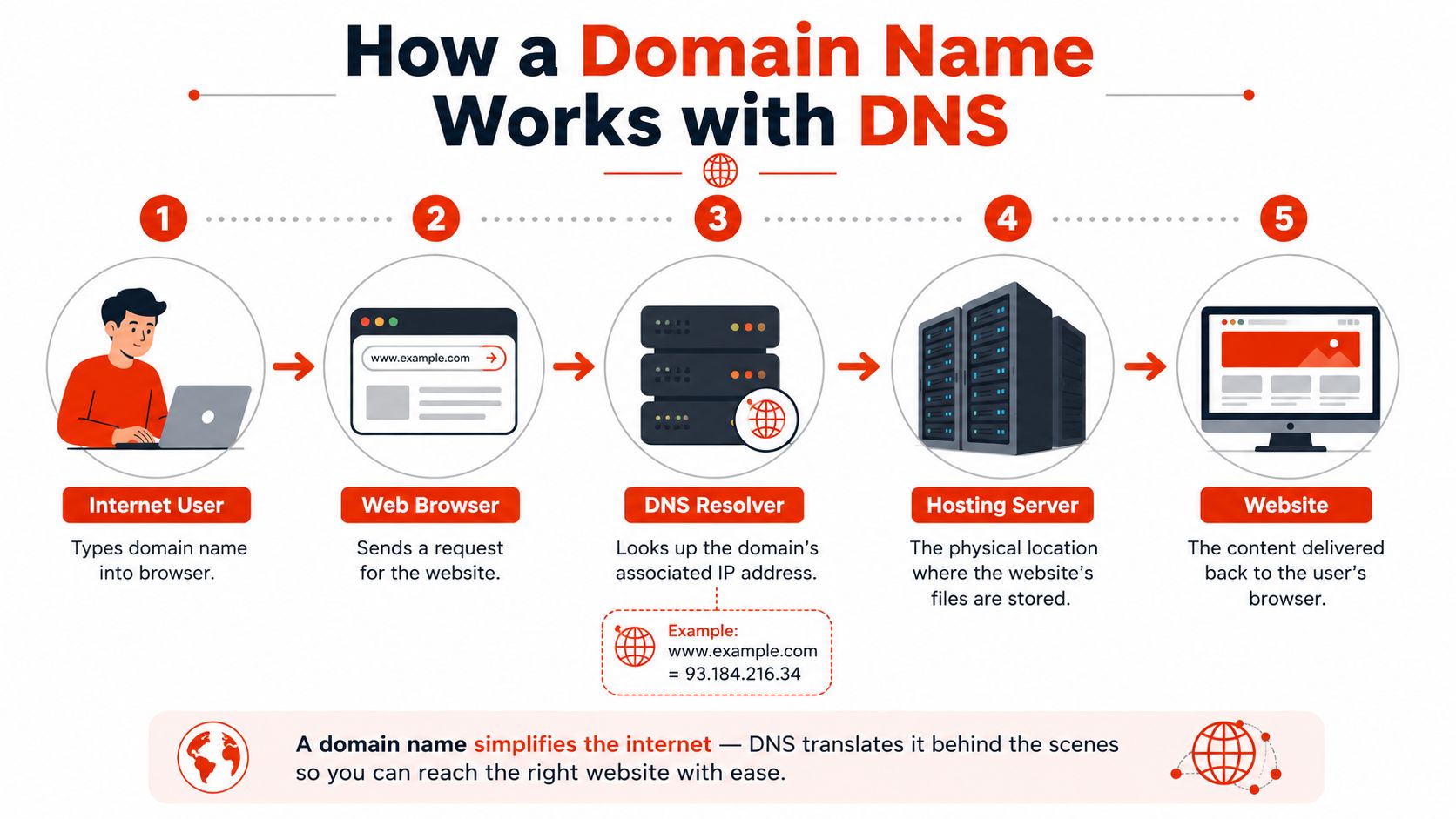
How a Domain Name Works with DNS
The street address and GPS analogy
The easiest way to define a domain name is that it works like a street address.
Your website lives on a server. That server has a technical location inside the Internet’s system. People could never realistically remember that location in the way they remember a business name. So instead, you use a domain name such as yourbusiness.co.uk. It acts like the address on the front of the building.
The Internet then uses the Domain Name System (DNS) to map the name to the correct location. If you like analogies, DNS is the Internet’s phonebook. Someone types your domain into a browser, DNS resolves it to the correct IP address, and the browser loads the right website.
That process feels instant to the customer, but it’s doing a very practical job. It turns a memorable business name into a destination the browser can reach.
You don’t need to manage the lookup process yourself day to day. But it helps to know why a domain matters so much. If the domain isn’t connected properly, customers can’t reach the site, even if the site itself is perfectly built.
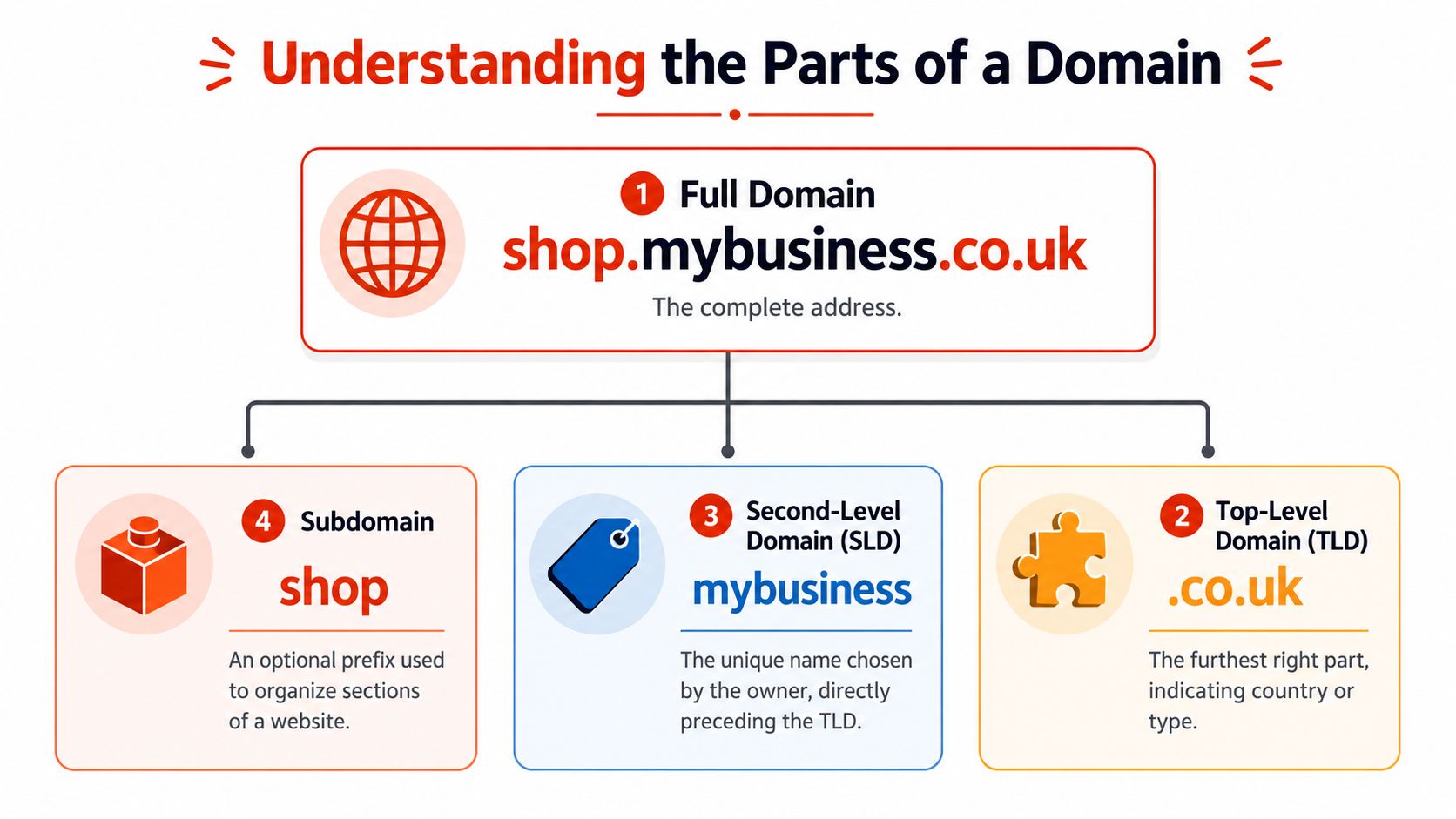
Understanding the Parts of a Domain
A domain has layers, a bit like a business address. One part tells people which business they are looking for, one part can direct them to a specific area, and one part signals the wider location or market.
Take shop.mybusiness.co.uk.
Here is how each part works:
Part
Example
What it means
Subdomain
shop
An optional section that sends visitors to a specific area of the site
Second-level domain
mybusiness
The main name your business registers and builds its brand around
Top-level domain
.co.uk
The ending that helps signal geography, audience, or purpose
The second-level domain is the name customers are most likely to remember. In this example, that is my business.
The top-level domain (TLD), usually shortened to TLD, is the rightmost part of a domain name, such as .uk, .co.uk, or .com. For a small business, this is not a minor detail. It shapes first impressions before anyone reads your homepage.
The subdomain sits on the left. Businesses often use it to organise separate areas, such as an e-commerce shop, support help pages, or a client login portal. That can be useful, but only if it makes the site clearer. If it adds extra words without helping the visitor, it usually makes the address harder to remember.
Why the ending matters in the UK
For a British business owner, the TLD is partly a branding choice and partly a trust signal. A .com can feel broad and international. A .uk or .co.uk usually feels more local and more familiar to UK customers.
British users have seen .uk and .co.uk for decades, so they tend to recognise them quickly as local web addresses. That familiarity has a practical effect. If someone in Birmingham or Newcastle is choosing between two similar businesses, a UK domain can reinforce the impression that your company serves the UK market.
That same signal can also help machines interpret your relevance. Search engines and AI-powered search tools consider many clues to determine who a business is for. Your content matters most, but your domain ending can support that picture. If your customers are mainly in the UK, a .uk domain strengthens the local context around your brand, which fits neatly with broader SEO optimisation for UK businesses.
A simple way to read the choice is this:
Choose .com if your business sells across countries and wants a more international feel.
Choose .uk or .co.uk if your customers are mainly in Britain and local credibility matters at first glance.
Use subdomains carefully if they make the site easier to use and easier to understand.
A UK-focused domain can reassure local customers and give AI search systems one more clue that your business belongs in UK results.
So the parts of a domain are not just technical labels. They influence memory, trust, and how clearly your business presents itself online.
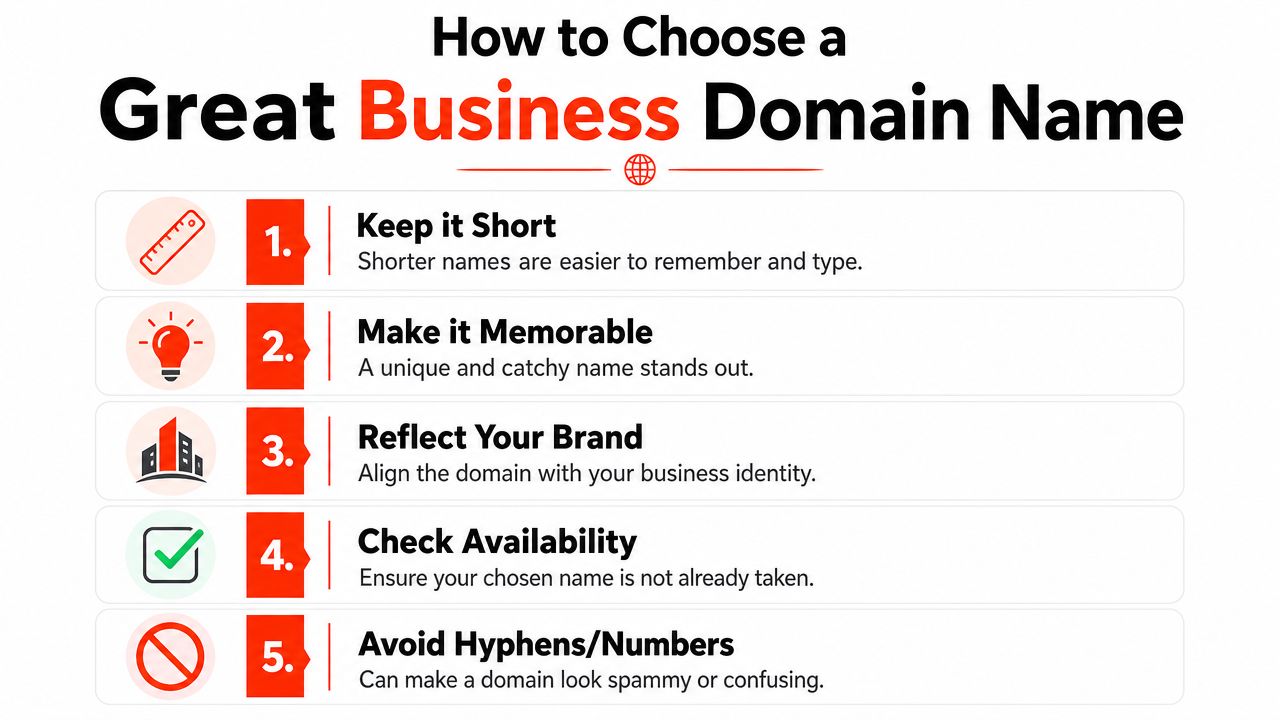
How to Choose a Great Business Domain Name
A good business domain is rarely the cleverest one in the room. It’s the one customers can remember, spell, and trust.
Start with the basics first. Short names are easier to type. Clear names are easier to repeat. Names that sound natural in conversation are easier to recommend. If someone says your business aloud and the listener instantly knows how to spell the domain, you’re on strong ground.
A simple checklist for better choices
Use this filter before you register anything:
Keep it short: Shorter names usually make better signage, better email addresses, and fewer typing mistakes.
Make it memorable: A name should stick after one hearing, not require explanation.
Reflect your brand: The domain should sound like your business, not a random keyword list.
Check availability early: Don’t build your branding around a name you can’t secure.
Avoid hyphens and numbers: People forget them, mishear them, or type the wrong version.
A useful self-test is to say the name to someone else once. If they can type it correctly without asking follow-up questions, that’s a good sign.
This short video gives a helpful overview before you decide:
Why .uk can be a strategic advantage
For UK businesses, the ending isn’t just cosmetic. It can influence both visibility and trust.
A 2026 UK study found that websites with country-code domains such as .uk are 32% more likely to appear in UK-specific AI-generated search summaries than global .com domains, with direct implications for local SME lead volume (UK study on ccTLDs and AI-generated search visibility).
That finding matters because search is changing. People still use traditional search results, but they’re also getting answers from AI overviews and AI-generated summaries. If your domain sends a stronger local signal, you may be easier for those systems to classify as relevant to UK users.
Customer perception matters as much. A UK-specific domain often looks more aligned with a local service business than a generic global extension. If local search performance is part of your growth plan, it’s worth looking at SEO optimisation for small business websites.
Your domain is one of the earliest signals your business sends. It tells customers who you are, and it tells search systems where you belong.
Registering and Managing Your Domain
What happens when you register
Once you’ve chosen your name, you register it through a domain registrar. That’s the company authorised to handle domain bookings and renewals. You select the name, choose the registration period, and connect it to your website and email later.
For .uk domains, registration follows strict DNS label rules and requires verification of registrant details. Guidance on UK registration also notes that the National Cyber Security Centre recommends multi-factor authentication on registrar portals to reduce the risk of domain hijacking (UK domain registration rules and security guidance).
That last point is easy to overlook. Your registrar account is control central for your online identity. If someone gains access to it, they may be able to disrupt your website, email, or both.
How to avoid the common mistakes
Most domain problems aren’t dramatic technical failures. They’re admin slips.
Here are the ones that catch businesses out most often:
Out-of-date contact details: If the email address on the account is old, you may miss renewal notices or security alerts.
No multi-factor authentication: A password on its own is weaker than many owners realise.
No clear ownership record: If a freelancer, former employee, or third party controls the account, your business can end up locked out.
Forgetting renewals: Domains need ongoing management, not one-time setup.
Scattered suppliers: Running domain, SSL, hosting, and maintenance in separate places can slow support and make it more confusing.
A transfer is possible if you later want to switch providers, so you’re not trapped with your first choice forever. But life is much easier when the domain is registered under your business details, secured properly, and included in a managed setup from the start.
A domain gives your business an address, but an address alone doesn’t create a working website. You also need hosting, which stores the website files, and SSL, which secures the connection so visitors see the padlock and can trust the site.
That’s where many owners get stuck. They buy the domain from one supplier, hosting from another, SSL from somewhere else, then try to connect all the moving parts while also approving the design and writing content. It’s manageable if you’re technical. It’s exhausting if you want a good business website up and running quickly.
As of early 2025, the .uk domain family had over 10 million registrations, making it the sixth-largest TLD globally. That scale shows just how many UK businesses are trying to establish an online presence, and why simplified all-in-one services appeal to owners who don’t want extra complexity (UK domain family scale in early 2025).
Why bundled website setup is easier
An all-in-one setup turns separate tasks into one joined-up process. Instead of coordinating different providers, you sort the name, website, security, hosting, and maintenance together.
That reduces friction in practical ways:
One team handles setup: Fewer handoffs mean fewer misunderstandings.
Support is simpler: You don’t waste time figuring out which supplier owns the problem.
Renewals are easier to track: Fewer accounts usually mean fewer missed admin tasks.
Security is more consistent: Domain control, SSL, and hosting are less likely to fall out of sync.
Here’s what that kind of website delivery can look like in practice:
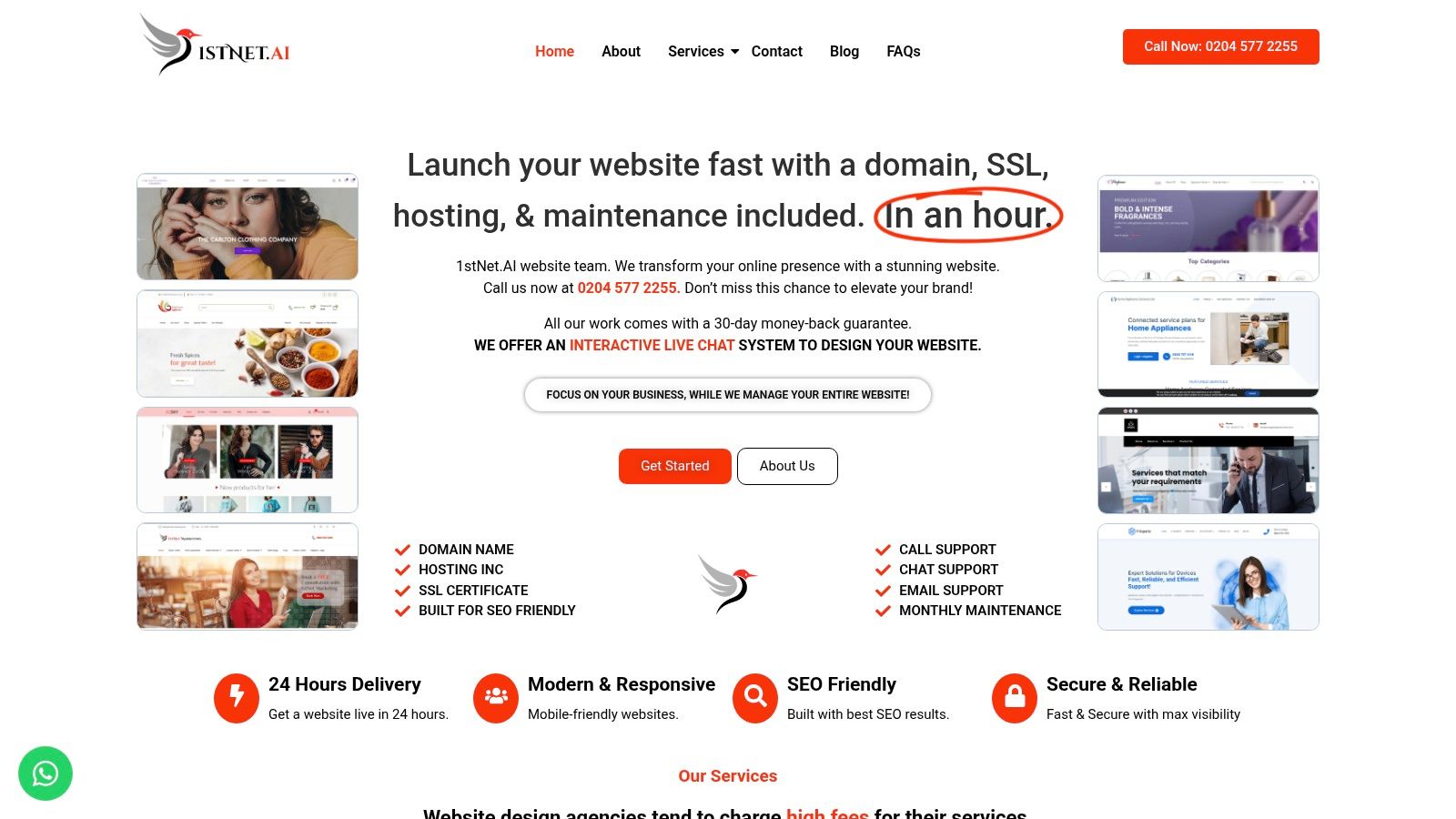
Launch your website in an hour with a domain, SSL, hosting, and maintenance included. 1stNet.AI website team. We transform your online presence with a stunning website. Call us now at 0204 577 2255. Don’t miss this chance to boost your brand!
All our work comes with a 30-day money-back guarantee. WE OFFER AN INTERACTIVE LIVE CHAT SYSTEM TO DESIGN YOUR WEBSITE.
If you want a done-for-you website from 1stNet AI Ltd, the team handles the full setup for UK businesses, including domain registration, SSL, hosting, maintenance, and launch support, so you can get online without juggling multiple suppliers.