

You've left a secure role, won a couple of clients through your network, and suddenly a bank asks for a business plan. Your expertise is solid, but your pricing, pipeline, capacity and forecast exist mostly in your head. That's the point at which many capable UK consultants realise they've built a job, not yet a dependable business.
A useful business plan for consulting fixes that gap. It gives lenders a credible view of repayment capacity, gives prospects a clear reason to buy, and gives you rules for deciding which work to accept. The strongest plans now cover two areas older templates often miss, AI-search visibility and funding-readiness.
Table of Contents
- Why Most UK Consultants Start Without a Real Plan
- The Executive Summary That Lenders and Clients Actually Read
- Defining Your Services and Ideal Client
- Mapping the UK Consulting Market and Your Niche
- Pricing Models and a 12-Month Revenue Forecast
- Operations, Compliance and a 90-Day Launch Timeline
- Your One-Page Plan Checklist and First Steps
Why Most UK Consultants Start Without a Real Plan
Priya, an operations consultant in London, left a corporate role with a strong reputation and two paying clients from her professional network. She delivered good work, received positive introductions and assumed the rest would follow. Then her bank asked for a written plan to support a £15,000 bounce-back loan top-up, and she found she couldn't clearly explain her target market, monthly sales assumptions or capacity.
That situation is common because consultants usually understand the client problem better than they understand commercial planning. They know operations, HR, technology, sustainability or finance. They don't necessarily know how many engagements they need, how long each one takes, which lead source deserves attention or what minimum price protects their time.
A fragile pipeline creates a second problem. A consultant may be busy for several months, then face a quiet period with no documented acquisition process. Referrals help, but “most work will come from my network” isn't a forecast. It's an assumption that needs testing.
A plan is a decision tool
A practical plan should answer questions you can use every week:
- Pricing: What will you charge for each offer, and what work is excluded?
- Capacity: How much client delivery can you handle without damaging quality?
- Pipeline: Which channels produce qualified conversations, and how quickly?
- Cash: When will invoices be issued, paid and converted into available cash?
- Focus: Which projects will you reject because they don't fit your positioning?
The plan doesn't need corporate decoration. It needs a clear link between a defined buyer, a specific problem, a service offer, a sales activity and a financial outcome.
Practical rule: If a number in your forecast can't be traced to a unit, price or operating assumption, it's not evidence. It's optimism.
Start with a concise working document. Update the assumptions when clients respond, proposals convert or delivery takes longer than expected. A plan that helps you make decisions is more valuable than a polished document nobody revisits.
The Executive Summary That Lenders and Clients Actually Read
The UK provides a large but fragmented buyer base. At the start of 2024, the country had 5.5 million SMEs, representing 99.8% of the business population. That base included 4.1 million non-employer businesses, 1.2 million micro businesses, 220,000 small businesses and 37,800 medium-sized businesses. SMEs employed 16.6 million people, equal to 60% of UK employment, and generated an estimated £2.8 trillion in turnover, about 52% of the UK total, according to the UK Government's UK Business Data Survey.
Those figures don't justify a vague “we serve UK SMEs” statement. They prove the opposite. Your summary must show exactly which part of that market you can reach and serve profitably.
Five points readers scan first
Keep the executive summary to about 250 words. Lead with the commercial case, not your career history.
- Problem statement: Identify the expensive, urgent issue. “Manufacturers struggle with sustainability reporting” is broad. “East Midlands manufacturers lose tender opportunities because they can't present consistent carbon data” is more useful.
- Solution: Describe the service and the result. Explain what you do, how the engagement works and what decision it helps the client make.
- Specific client: Name the sector, location, organisational profile and buying trigger.
- Opportunity: Define the reachable segment, not an inflated national market. Explain why buyers have reason to act now.
- Ask: State the funding required, its use and the evidence supporting repayment or growth.
A sustainability consultancy targeting East Midlands manufacturers might write: “We help owner-managed manufacturers prepare tender-ready sustainability evidence through a fixed diagnostic, reporting framework and implementation support. We sell to firms whose customers increasingly request environmental documentation but lack internal capacity. We'll acquire clients through manufacturing associations, referral partners and answer-first search content. Funding will support marketing, software and working capital while the consultancy builds recurring advisory work.”
Mission and commercial relevance
Your mission should connect expertise to buyer value. “To make responsible manufacturing commercially practical” is stronger than a biography, but it still needs a delivery model, target client and financial logic beside it.
| Section Element | UK Lender Priority | Client Priority |
|---|---|---|
| Problem statement | Evidence that demand is real and urgent | Recognition of a problem they already feel |
| Solution | Clear route from activity to revenue | Specific outcomes and manageable scope |
| Ideal client | A segment that can be reached efficiently | Proof that you understand their situation |
| Opportunity | Defensible market logic | Confidence that you specialise in their context |
| Financial ask | Amount, purpose and repayment logic | Commercial stability and delivery capacity |
Don't claim every SME is your customer. A lender sees risk when the market is enormous but the acquisition plan is undefined. A prospect sees the same weakness when your summary could describe any consultancy.
Defining Your Services and Ideal Client
A consultant with too many services forces buyers to decode the business. Cap the initial portfolio at three offers or fewer, then attach each offer to a client outcome. The outcome might involve cost reduction, revenue improvement, audit preparation, compliance readiness or a faster management decision.
Use distinct buying stages. A diagnostic can open the relationship, an implementation project can deliver the main result and a retainer can maintain progress. That structure makes proposals easier to compare and forecasts easier to build.
Build the ideal client profile
A useful profile has four dimensions:
- Firm size: Use a range that matches the complexity you can handle and the budget you need.
- Sector: Choose an industry where you understand the language, risks and decision process.
- Geography: Define whether you serve a local area, a UK-wide segment or a remote market.
- Trigger event: Identify the moment that creates urgency, such as funding, rapid hiring, a failed audit, a new contract or operational disruption.
Consider an HR consultancy serving professional services firms in the South East. Its profile could focus on firms with 20 to 75 seats, a growing headcount, inconsistent performance management and no dedicated HR lead. The trigger might be a hiring push, a new office or a need to formalise policies before winning a larger client.
That profile is commercially useful because the consultant can find relevant firms, recognise buying signals and create content around specific questions. It also prevents proposals from drifting into unpaid general advice.
Write a positioning statement
Use this formula:
I help [specific client] solve [specific costly problem] through [distinct method], so they can achieve [measurable or observable outcome].
Avoid “we partner with you to deliver excellence”. It says nothing about the buyer, problem or result. A sharper version is: “We help South East professional services firms with 20 to 75 employees reduce people-management friction through practical HR systems, so partners can hire and manage teams without adding a full-time HR department.”
Your website should reflect the same specificity. The guidance on how to write website content is useful when turning the positioning statement into service pages, proof points and calls to action. Every page should make it obvious who the service is for, what changes after purchase and what the buyer should do next.
Mapping the UK Consulting Market and Your Niche
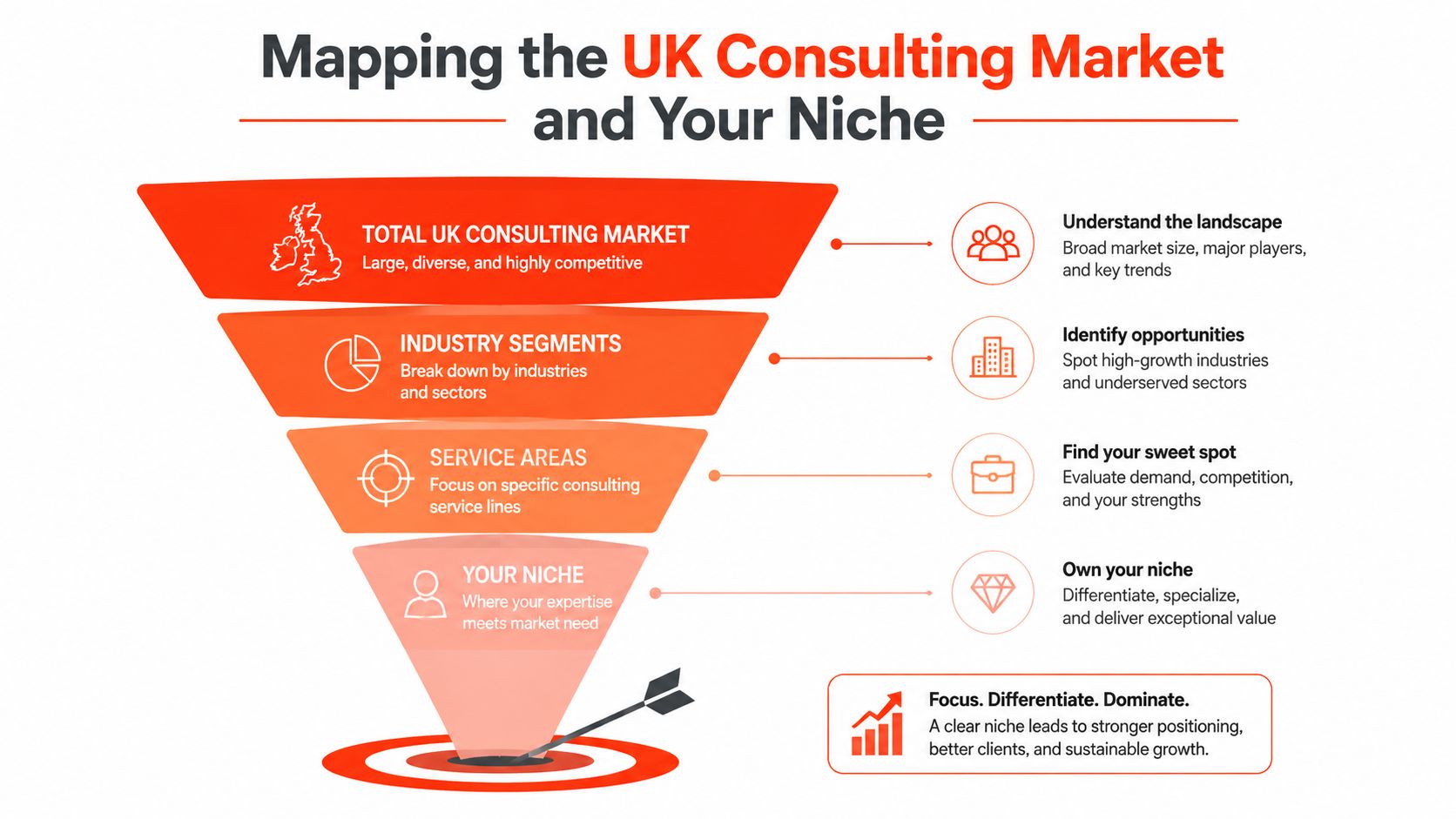
Large-market language won't rescue a weak niche. A plan might describe UK consulting as a market worth roughly £70bn, but the more decision-useful fact is that the UK contains 5.5 million SMEs and many different buying situations. The verified market evidence places UK management consulting at about £83.0bn in 2026, with 188,000 businesses operating in the sector, while the Management Consultancies Association forecasts sector growth of 5.7% over the next 12 months and 7.4% in 2027 in its UK consulting forecast.
Don't present competing market estimates as if they were one precise truth. Use them to establish context, then build a bottom-up market model.
Size the opportunity from the bottom up
Your total addressable market is the broad group that could theoretically buy the service. Your serviceable available market is the portion matching your sector, geography and capability. Your serviceable obtainable market is the number of clients you can realistically reach and deliver to through your chosen channels.
For a funding-readiness consultancy, the demand signal is particularly relevant. A British Business Bank survey cited in the sector evidence found that 67% of UK SMEs planning growth-funding applications needed external support for their business plan, and 44% wanted consulting firms specifically. Cite the British Business Bank funding-support evidence, rather than turning that finding into a generic claim about all SMEs.
Your niche should pass three tests:
- Pain: Can you solve a problem tied to money, risk, time or access to an important opportunity?
- Reach: Can you identify and contact the buyer without relying on chance referrals?
- Competition: Can your expertise be distinguished in Google results and AI-generated answers?
Make AI visibility part of go-to-market
UK-focused analysis reports that AI Overviews appeared in roughly one-third of UK Google searches by mid-2026, while only 23.2% of searches led to the open web in the analysed set, according to the UK business AI-search analysis. Treat these figures as a reason to plan for citations and answer visibility, not as a traffic forecast.
Create service pages, FAQs, case-study evidence and clear author credentials that answer the questions your niche asks before a funding application. Keep your business name, services and location consistent across your website and business profiles. A practical local SEO guide can support the local discovery layer, while structured content helps answer engines understand your expertise.
Choose one niche and two acquisition channels. Build a quarterly content cadence around funding-readiness, lender questions, planning errors and sector-specific evidence. The objective is not just clicks. It's becoming a citable answer when a buyer asks an AI system which consultant can help.
Pricing Models and a 12-Month Revenue Forecast
Pricing is not a formatting choice in your plan. It determines capacity, cash flow and the kind of buyer you attract. Choose the model that fits the buying decision, then forecast from units multiplied by price.
| Pricing Model | UK Worked Example | Best For |
|---|---|---|
| Hourly | £150 per hour for a 40-hour month | Specialist advice with uncertain scope |
| Project-based | £4,500 for a defined payroll project | Clear deliverables and a fixed decision |
| Retainer | £1,800 per month for ongoing HR support | Recurring advisory access |
| Value-based | 10% of verified savings created | Outcomes that can be measured and agreed |
Hourly pricing is simple, but it can punish efficiency. If you solve the issue faster, your income falls unless the market recognises the value of the result. Project pricing gives both sides a defined commitment, but your scope must be precise. Retainers smooth revenue, although clients need a clear explanation of access, deliverables and unused capacity. Value-based pricing can align incentives, but the baseline, measurement method and payment trigger must appear in the agreement.
Build the forecast in units
Create separate revenue lines for diagnostics, implementation projects, retainers and any performance-linked work. Model delivery capacity at 40% in months 1 to 3, 60% in months 4 to 6 and 80% in months 7 to 12, then show how many units fit inside those capacity assumptions.
Do not combine everything into one annual income figure. A lender should be able to see what happens if one project slips, a retainer starts later or the conversion rate changes. Your sales schedule should also show proposal dates, expected decisions, invoice dates and payment assumptions.
Check the commercial traps
Consultants often price as though every pound invoiced becomes available income. That ignores tax, software, insurance, subcontracting, holidays, marketing and late payment. It also ignores whether VAT registration applies to the business, so get current advice before publishing prices or signing contracts.
Break-even is straightforward:
Monthly fixed operating costs divided by contribution per engagement equals the engagements needed to cover those costs.
If fixed costs are £2,000 and each engagement contributes £1,000 after direct delivery costs, break-even requires two engagements. Replace those illustrative values with your actual costs and contribution. Show the calculation plainly, then test a slower sales month and a delayed payment. Lenders trust a forecast that acknowledges pressure.
Operations, Compliance and a 90-Day Launch Timeline
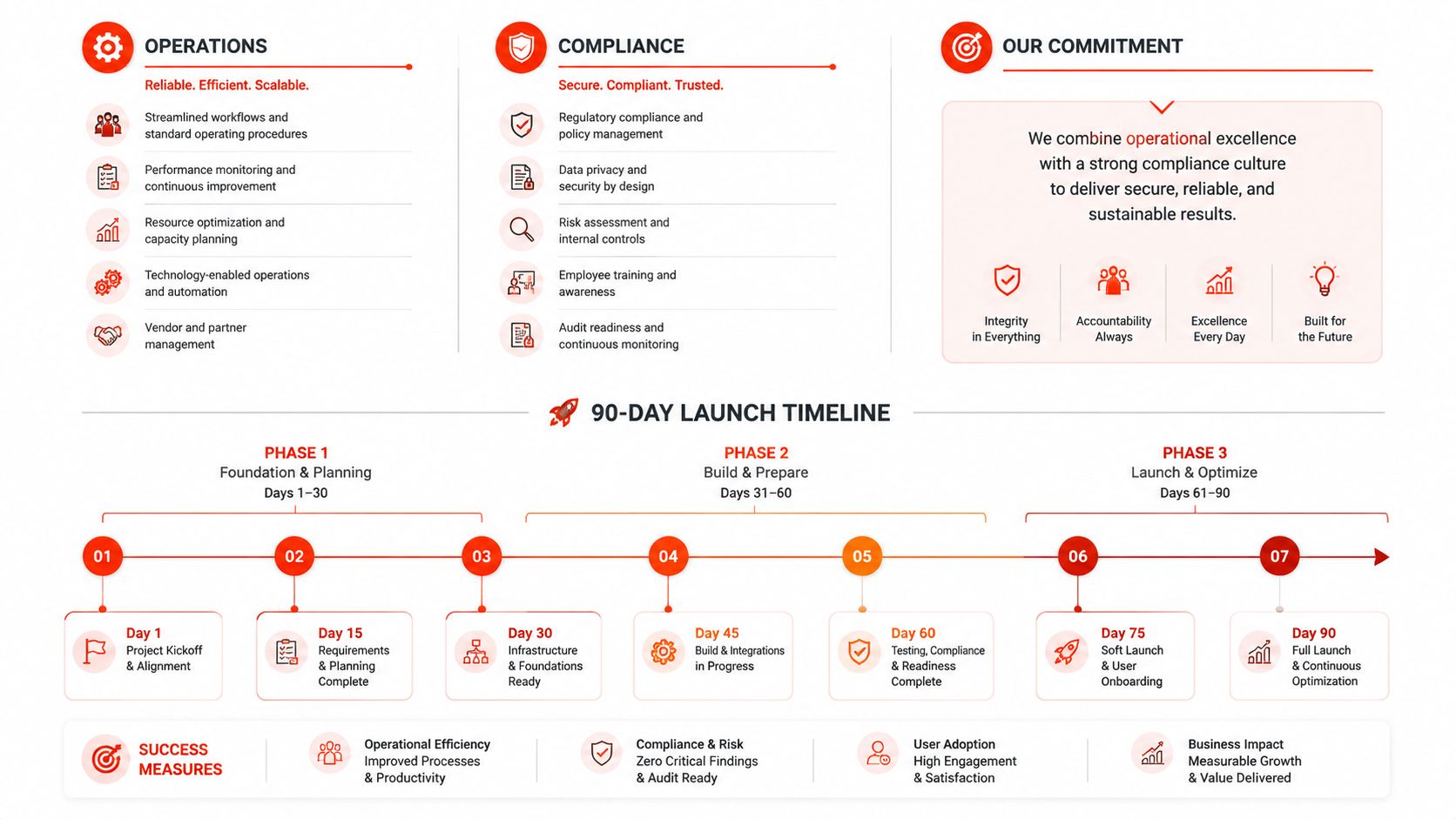
A lender doesn't expect a solo consultant to mimic a large firm. They do expect the business to operate legally, collect money reliably and protect client information. Decide whether you'll trade as a sole trader or limited company, complete relevant Companies House registration where required, separate business banking and arrange suitable professional indemnity insurance.
Your client agreement should define scope, deliverables, fees, payment dates, intellectual property, confidentiality, cancellation and what happens when work starts before a cancellation period ends. For distance service contracts, UK consumer law provides a 14-day cancellation period, beginning the day after the contract is made. The Consumer Contracts Regulations explain the statutory mechanics, and Citizens Advice cancellation guidance confirms that this is the minimum period for eligible consumer service contracts.
A 30-day money-back guarantee is a separate commercial promise. If you offer one, write its conditions clearly and don't present it as the statutory right. Monthly maintenance, hosting or support may also involve subscription-style rules, including initial and renewal cooling-off periods under the Digital Markets, Competition and Consumers Act.
Use a practical launch sequence
- Weeks 1 to 2: Set up the legal structure, bank account, insurance and agreement. Link each cost to the start-up budget.
- Weeks 3 to 4: Finalise the brand, website, lead magnet and accounting stack. Treat the website as a sales asset, not a decorative project.
- Weeks 5 to 6: Build a prospect list of 50 relevant organisations, conduct three case-study interviews and optimise LinkedIn and AI-search presentation.
- Weeks 7 to 9: Hold five discovery calls, issue two proposals and sell one paid pilot. Record each stage in the pipeline.
- Weeks 10 to 13: Convert the pilot into a retainer where appropriate, publish two long-form pieces and establish a monthly financial and pipeline review.
Review data protection responsibilities before collecting prospect and client information. The UK data protection regulations guide can help you identify the operational questions to take to an accountant or legal adviser.
Your One-Page Plan Checklist and First Steps
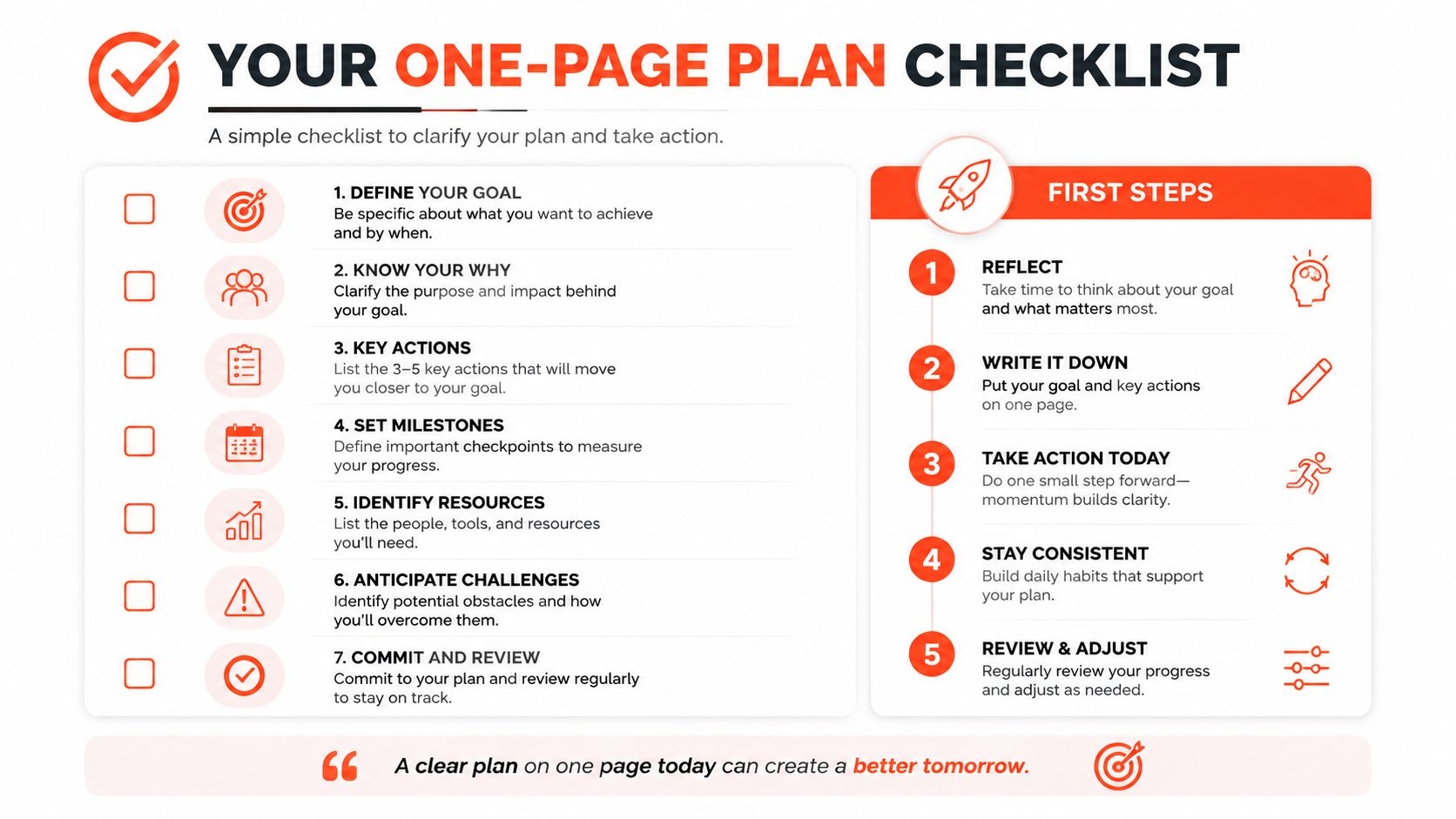
A one-page plan forces priorities into view. Put each item in a row, assign an owner and record the evidence that proves the assumption. Lenders, clients and partners don't need identical information, so mark the audience that matters for each line.
| Plan Item | What to Complete | Who Needs to See It |
|---|---|---|
| Executive summary | Problem, solution, client, opportunity and ask | Lender and partner |
| Ideal client profile | Firm size, sector, geography and trigger | Client and marketing partner |
| Service portfolio | Three offers or fewer, each tied to an outcome | Client and lender |
| Pricing model | Chosen model, scope rules and payment terms | Client and lender |
| 12-month forecast | Units, prices, capacity, costs and cash timing | Lender |
| Compliance basics | Structure, insurance, data handling and agreement | Client and partner |
| 90-day calendar | Weekly actions tied to forecast lines | Lender and founder |
Three moves for this week
First, block two uninterrupted hours and draft the executive summary from work you've already done. Don't wait for perfect wording. If you can't state the buyer, problem, offer and funding requirement plainly, you haven't made the underlying decisions yet.
Second, audit your Google Business Profile and website copy for AI-search clarity. Use the positioning statement from the services section, then check whether a buyer or answer engine can identify your niche, location, expertise, proof and next action without guessing.
Third, book a no-obligation call with one UK business finance broker and ask them to pressure-test the plan's funding readiness. Bring the forecast, assumptions and proposed use of funds. A broker's questions will expose gaps faster than another round of design edits.
The finished document doesn't need to look impressive. It needs to hold together under questioning. A usable plan beats a polished plan, and this week's target is a credible draft that makes the next commercial decision easier.
Launch your consulting website fast with 1stNet AI Ltd, including a domain, SSL, hosting and maintenance, with an accelerated build process that can take your site live within 24 hours. Visit 1stNet AI Ltd to discuss a website structured for clear positioning, funding-ready credibility and AI-search visibility, or call 0204 577 2255 to speak with the website team. All work comes with a 30-day money-back guarantee, and the interactive live chat system lets you shape the design in real time.