

A small business owner gets three website prices in the same week. One looks cheap enough to start today, one feels expensive, and one comes as a tidy monthly package that seems easier to justify. A month later, the cheap quote needs paid plugins, the monthly plan excludes changes, and nobody is quite sure who handles security, backups, or search visibility.
That is why the average cost of website design for small business UK is hard to pin down with one number.
A professional small business website in the UK often sits in the low thousands, while freelancer builds and DIY platforms can start much lower. The problem is that the entry price rarely reflects the full cost of running the site properly over time. If you compare setup fees alone, you can end up choosing the option that costs more in year one and creates more admin for you every month after that.
A website is not just a design file or a homepage. It is design, build, content, hosting, domain setup, SSL, maintenance, security, software updates, performance, support, and someone taking responsibility when something breaks.
For that reason, the sensible way to judge website pricing is by total cost of ownership. That means looking at the build cost, ongoing fees, time spent managing suppliers, and the commercial impact of getting corners cut. DIY and piecemeal setups can look affordable at the start, but the hidden extras and lost time often wipe out the saving. An all-inclusive service usually costs more upfront than doing everything yourself, but it gives small businesses clearer budgeting, fewer surprises, and one provider accountable for the result.
Table of Contents
- Untangling UK Website Prices Why Is There No Simple Answer
- The 2026 UK Website Cost Spectrum by Provider Type
- Key Factors That Drive Your Website Cost Up or Down
- What a Quote Should Include and Common Hidden Costs
- Sample Budgets for Real UK Small Businesses
- The All-in-One Alternative How Bundled Services Save Money and Time
- How to Choose Your Provider and Avoid Common Pitfalls
Untangling UK Website Prices: Why Is There No Simple Answer
If you’ve had one quote that looked manageable and another that felt wildly out of reach, that doesn’t automatically mean someone is overcharging. It usually means each provider has defined the job differently.
A website can be a simple brochure site with a few pages and a contact form. It can also serve as a lead-generation tool, with service pages, copywriting, SEO setup, blog structure, tracking, and post-launch support. Both get called “a website”, but they’re not the same purchase.
What business owners are actually comparing
One quote may cover design only. Another may include development, mobile responsiveness, content upload, basic SEO setup, hosting, SSL, and maintenance. A lower price can still be poor value if you end up buying the missing parts one by one.
That’s why pricing looks messy in the UK market. The final figure depends on three things:
- Who builds it? A freelancer, regional agency, London agency, or DIY platform all price work differently.
- What the site needs to do. A service site is different from an online shop.
- What’s included after launch. Hosting, updates, and support matter just as much as the build.
Practical rule: Don’t ask only “How much is the website?” Ask “What will I still need to pay for after it goes live?”
The average range is useful, but only as a starting point
For a standard small-business website, the market sits in a broad yet workable range. Professional UK builds often cluster in the mid-range, while cheaper options usually involve compromises in scope, support, or long-term upkeep.
If your business needs credibility online, a dependable lead funnel, and a site that doesn’t become your weekend job, the cheapest sticker price isn’t always the most economical option. That’s the key lens for judging the average cost of website design for small businesses in the UK. Initial price matters, but ownership costs matter more.
The 2026 UK Website Cost Spectrum by Provider Type
The clearest way to make sense of pricing is to break the market into provider types. Once you do that, the quote range starts to feel less random.
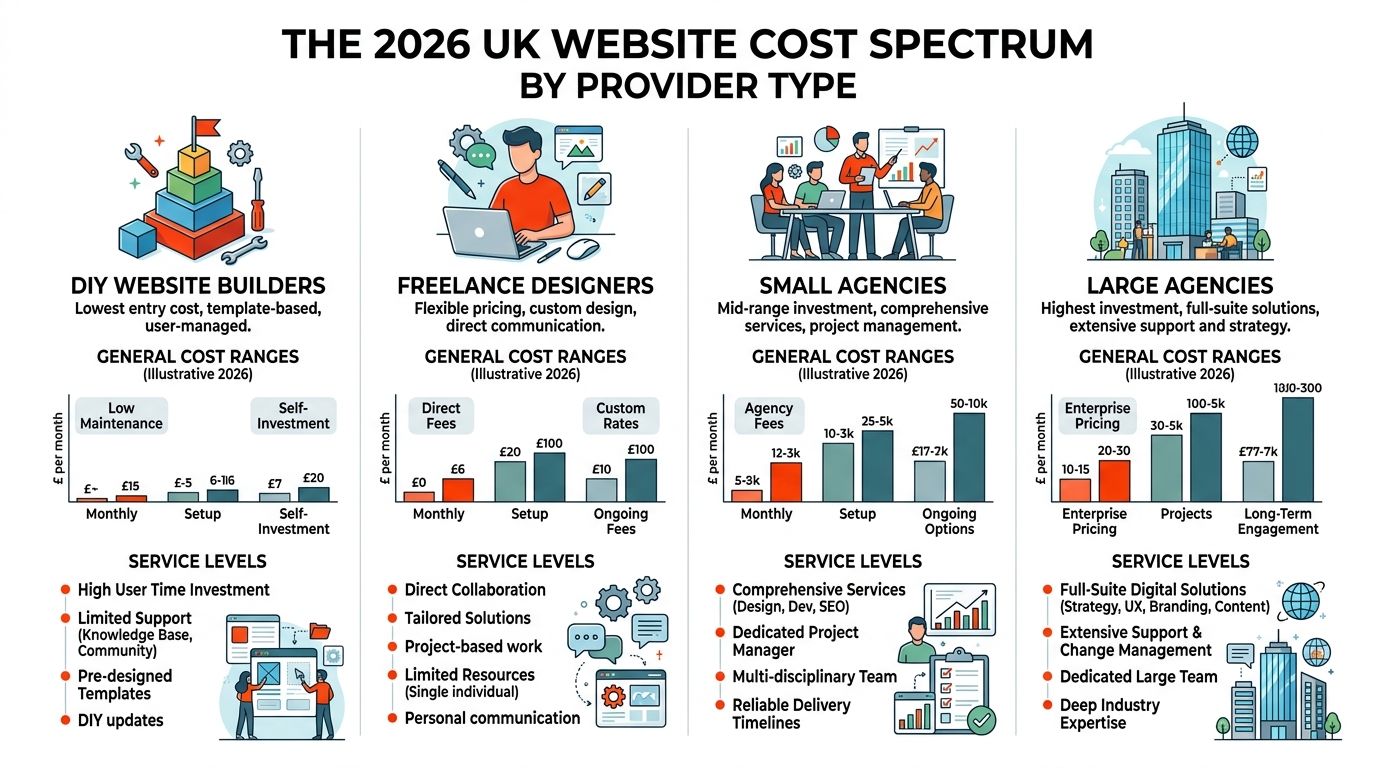
UK Website Design Cost by Provider Type 2026 Estimate
| Provider Type | Typical Upfront Cost | Best For |
|---|---|---|
| DIY website builders | £100 to £300 per year advertised | Very small budgets, owners with time to manage setup and upkeep |
| Freelance designers | £500 to £3,000 | Simpler custom sites, direct communication, lean budgets |
| Regional UK agencies | £2,000 to £6,000 | Small businesses wanting a professionally managed build |
| London-based agencies | 30% to 50% above regional pricing, often £8,000 to £12,000 for similar projects | Businesses wanting a larger team or agency structure |
According to Redeagle’s UK website cost guide, in 2026, a professional small business website built by a regional agency typically costs £2,000 to £6,000, London agencies charge 30% to 50% more, and freelancers usually charge around £500 to £3,000.
DIY builders look cheap because they price the entry point
Platforms like Wix and Squarespace attract owners who need to get online quickly and keep spending low. That approach can work when the site is basic, and you’re comfortable managing the details yourself.
The problem is that DIY pricing usually highlights the starting plan rather than the actual working setup. Once a business wants stronger templates, add-ons, forms, SEO tools, or outside help to fix limitations, the low-cost story becomes less straightforward.
Freelancers can be excellent, but scope control matters
A good freelancer often gives a small business the best balance of flexibility and personal service. You usually speak directly to the person doing the work, which can speed up the process and make it less layered.
That said, a freelancer’s quote needs scrutiny. Some include only the build. Others bundle setup, edits, and support. If the proposal is thin, ask what happens after launch, who handles maintenance, and how quickly issues get fixed.
A lower quote is only cheaper if it includes what your business actually needs.
Agencies bring process, but overhead affects pricing
Regional agencies often sit in the sweet spot for businesses that want a professional result without London pricing. They usually have enough structure to manage the job properly, while staying closer to SME budgets.
London agencies can be the right choice for complex projects, but many small businesses don’t need that level of overhead. Paying more makes sense when you need deeper strategy, wider service coverage, or custom functionality. It doesn’t make sense to buy layers your business won’t use.
Key Factors That Drive Your Website Cost Up or Down
Two websites can look similar from the outside and cost very different amounts to build. The difference usually comes down to scope, not markup.
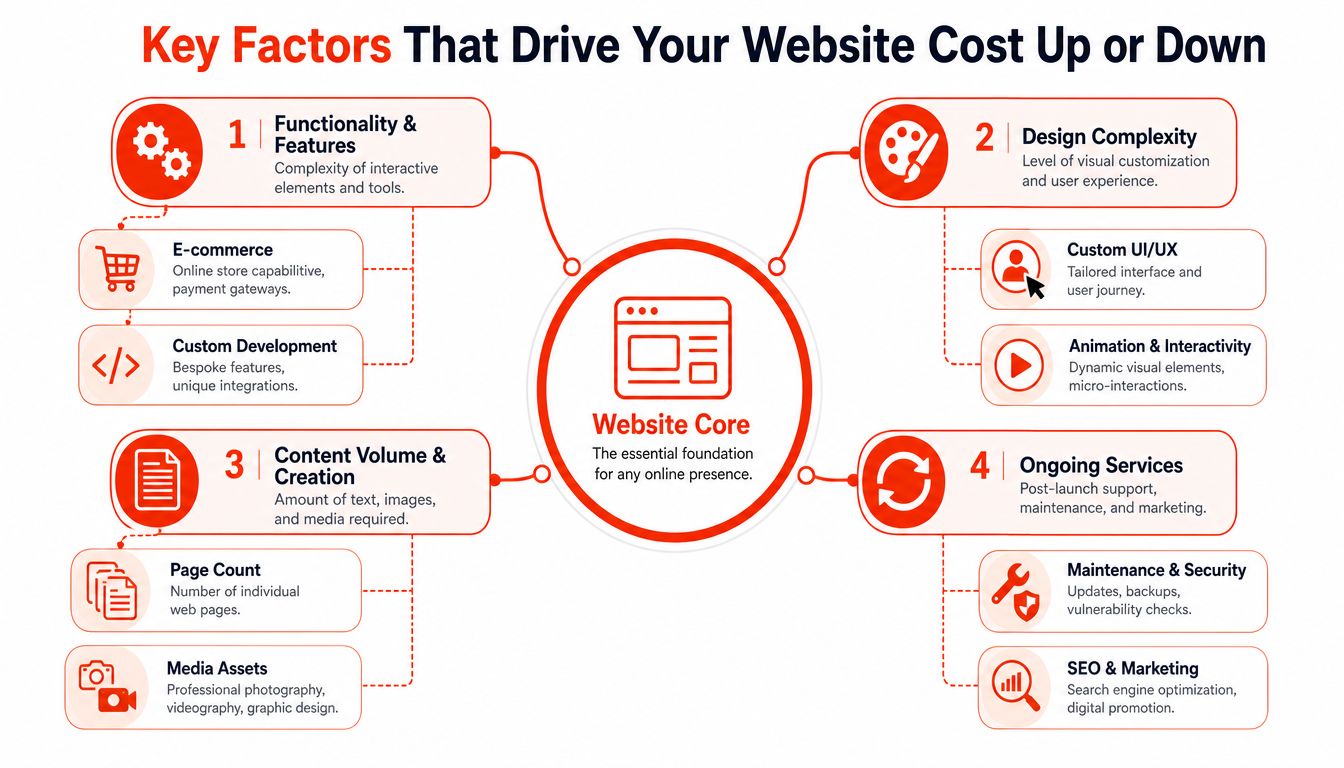
A useful way to think about it is this. You’re not buying pages. You’re buying requirements. A five-page site with strong content, custom layouts, and lead-focused structure can take far more work than a larger site built from a standard template.
Scope changes everything
The biggest cost driver is usually functionality. Expert Market’s UK pricing breakdown notes that a small business website with no online shop typically costs £1,200 to £5,500. In contrast, small-to-medium online shops range from £2,000 to £15,500 because of payment gateways and inventory management.
That gap tells you something important. Adding e-commerce is not a cosmetic upgrade. It changes the build, testing, user journey, and support needs.
Here are the main levers that push prices up or down:
- Functionality. Contact forms are simple. Online payments, booking flows, gated areas, and custom tools are not.
- Design complexity. Template-led work is faster than fully custom layouts.
- Content load. If someone has to organise, write, edit, and upload the content, the job expands quickly.
- SEO depth. Basic on-page setup is one thing. A structured search-focused build is another.
Design and content aren’t separate from cost.
Business owners often focus on layout and forget content. But copy, images, service messaging, and page structure take real time. If your provider is also handling that side, expect the quote to reflect it.
Many projects drift at this stage. The original brief sounds simple, but then the team realises there’s no final logo file, no clear service descriptions, no usable photography, and no agreed page structure. Build time increases because the website is now doing both discovery and production work.
If you’re weighing providers, it helps to compare what’s included in their hosting plans, too. A well-managed setup affects performance, reliability, and admin time, which is why small firms often review guides on the best web hosting for small businesses before deciding how much they want a provider to handle for them.
A short explainer can help you see how professionals frame these decisions in practice.
If the quote doesn’t spell out content responsibility, revisions, and feature limits, expect the project to become more expensive than it first appears.
A simple brief can still produce a better result
You don’t need a complicated specification. You do need a clear one.
Write down what the site must do on day one. List the pages you need, whether you need online payments, whether you’re supplying the copy, and whether someone must maintain the site after launch. That alone improves quotes dramatically, because providers aren’t guessing where the hidden work sits.
What a Quote Should Include and Common Hidden Costs
A website quote should tell you what you’re buying, what you’re not buying, and what you’ll keep paying for after launch. Many don’t.
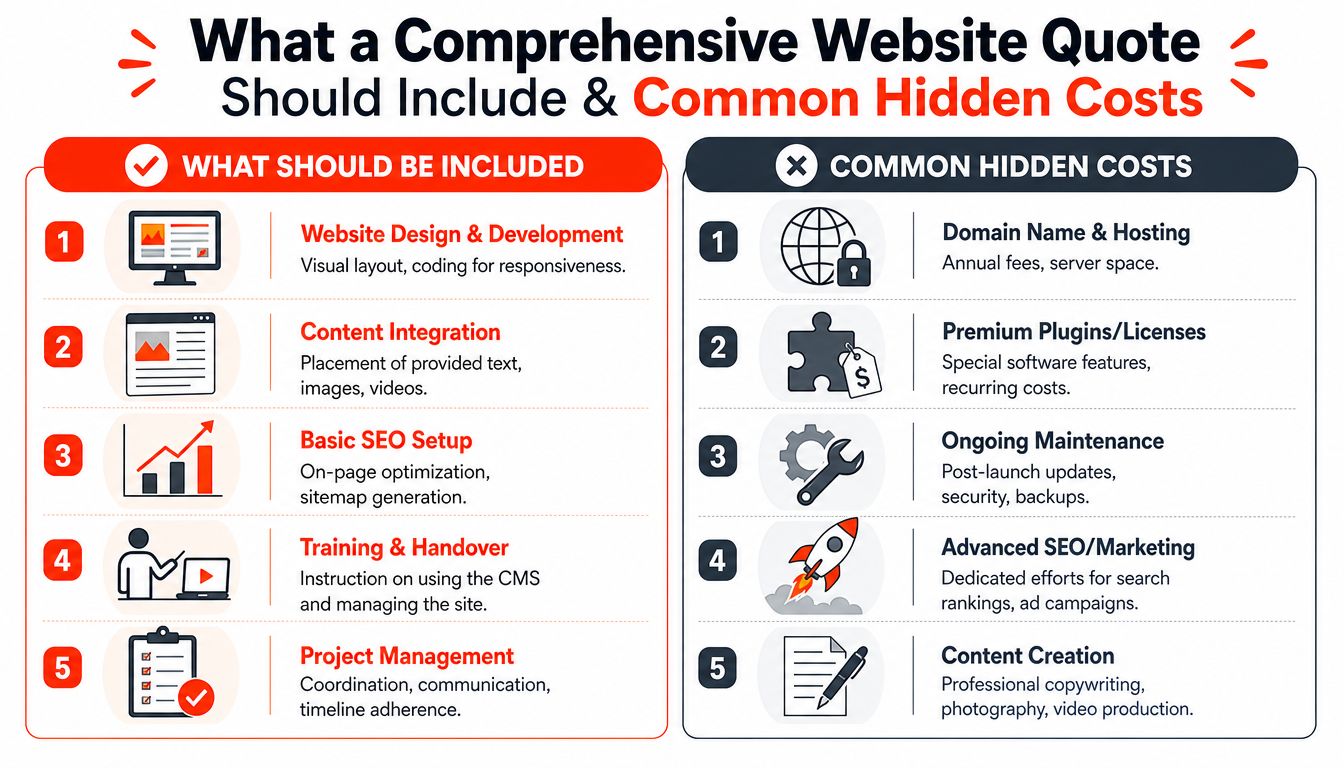
Cheap-looking proposals often stay cheap by excluding the work that business owners assume is standard. That’s where disappointment starts. You think you’ve bought a finished website, but you’ve actually bought a partial build.
What should already be in a proper quote?
For a standard business site, a transparent quote should usually make room for the essentials below:
- Design and build. The visual layout, responsive setup, and page construction.
- Content integration. Uploading the text, images, and basic media needed for launch.
- Basic SEO setup. Titles, structure, and the on-page groundwork a site needs to be discoverable.
- Training or handover. Enough support to make ordinary updates without panic.
- Project management. Someone owns deadlines, revisions, and communication.
A good proposal also makes ongoing costs visible. If you’re trying to understand those recurring expenses, it helps to compare them against a dedicated guide to website maintenance costs.
DIY hidden costs are where budgets go sideways
This is the part many owners only discover after they’ve committed time and money. Hollis Web’s UK pricing analysis says the average cost discussion often misses the 60% to 75% premium that DIY builders add to their advertised prices. It also notes that while platforms like Wix may appear to cost £100 to £300 per year, the total can rise to £ 1,500 to £3,000 once you add professional templates and plugins.
That doesn’t mean DIY never works. It means DIY is often mispriced in the owner’s head. The advertised plan is one part of the cost. The missing part is everything you add to make the site behave like a real business asset.
Hidden costs to watch for
| Cost area | Why does it catch people out |
|---|---|
| Domain and hosting | Often billed separately, even when assumed to be included |
| SSL and security | Can appear as add-ons or part of maintenance plans |
| Premium plugins | Small recurring charges stack up quickly |
| Content creation | Many providers expect you to supply polished copy and media |
| Ongoing support | Post-launch edits and fixes may sit outside the original scope |
Most website overspend doesn’t come from one big surprise. It comes from a string of small exclusions.
That’s why total ownership matters more than entry price. If you buy the build from one provider, host from another, handle maintenance elsewhere, and provide ad hoc content support, your budget becomes harder to predict. Your accountability becomes harder to pin down.
Sample Budgets for Real UK Small Businesses
Abstract price ranges are useful, but they become clearer when attached to actual business situations. Most owners don’t need “a website”. They need a site that supports a specific commercial goal.
According to DotGO’s UK pricing overview, professionally designed small business websites generally fall in the £1,500-£5,000 range, and nearly half of UK SMEs report total website spending between £2,500 and £10,000. That makes the budget scenarios below realistic rather than theoretical.
A local trades business
A local electrician, plumber, or roofing firm usually needs credibility first. The site has to answer practical questions fast. What do you do, where do you work, how do people contact you, and do you look trustworthy on mobile?
This type of business often suits the lower to middle part of the professional market. A lean freelancer or efficient small provider can work well if the scope stays focused. The danger is overcomplicating the brief with features that don’t help enquiries.
A sensible build usually prioritises:
- Core pages. Home, services, about, contact, and service area information.
- Trust signals. Reviews, accreditations, and clean contact details.
- Simple lead capture. Phone-first layout and a reliable contact form.
A growing consultancy or service firm
A consultancy, accountancy practice, or specialist B2B service usually needs more substance. Prospects often compare providers before contacting them, so the site has to explain its expertise and present a more organised structure clearly.
That often pushes the build into a fuller professional bracket. More pages, stronger copy, blog capability, and service positioning take time; consequently, a business benefits from investing in clarity rather than just aesthetics..
A startup e-commerce brand
An online shop is a different category of work. Even a small store involves product setup, payment handling, and a more detailed customer journey.
For a startup selling a focused product line, the smart move is often to keep the first version disciplined. Launch with a manageable catalogue, clear policies, and a smooth checkout. Don’t spend the early budget on decorative complexity that won’t help sales.
Start with the version your business can maintain confidently. Expansion is easier than untangling an overbuilt first launch.
The common thread across all three examples is simple. Businesses get better value when they match budget to commercial purpose, not ego. A website should earn its keep by helping people trust you, understand your offer, and take the next step.
The All-in-One Alternative: How Bundled Services Save Money and Time
A common small business scenario goes like this. The site was built cheaply, the domain is with one supplier, hosting is with another, and nobody is quite sure who handles updates. The monthly costs look modest at first, but the actual price shows up later in delays, fix fees, and time spent chasing answers.
An all-inclusive service model changes the cost structure by treating the website as an ongoing business asset rather than a one-off design purchase. The value is not limited to a lower admin burden. It comes from clearer accountability, fewer supplier gaps, and a more predictable total cost of ownership.
Why bundled service changes the economics
Dot IT Media’s UK cost analysis notes that professionally built small business websites often include core items such as hosting, SSL, and domain setup, all of which add cost if bought separately. That matters because the cheapest-looking quote often excludes the parts required to keep the site live, secure, and usable after launch.
In practice, piecemeal buying tends to spread costs across different invoices and renewal dates. That makes budgeting harder. It also creates a familiar problem. If the site is slow, broken, or vulnerable, each supplier can point the finger at someone else.
Bundled delivery reduces that friction by putting the build, hosting, maintenance, and support in one place.
What works better in practice
For many small firms, a managed package is less about convenience and more about control. One provider sets up the site, hosts it, keeps software updated, and handles routine fixes. That usually means fewer surprises and less downtime caused by missed renewals or conflicting advice.
The best bundled services also support the website’s commercial side. A business does not only need pages that look good. It needs a site that loads properly, works on mobile devices, can be maintained without drama, and follows sound, SEO-friendly web design principles from the start.
A practical bundled model usually includes:
- Design and technical setup together. Fewer handoffs and clearer responsibility.
- Hosting, SSL, and maintenance in one plan. Ongoing costs are easier to track.
- A defined support process. Changes and fixes do not turn into a supplier chase.
- A launch process with limits and scope. Faster delivery without vague promises.
Predictability is often the biggest saving.
Small business owners often focus on the build price because that is the easiest number to compare. The ongoing effort matters as much. If a lower upfront quote leads to extra maintenance fees, emergency fixes, plugin conflicts, or hours spent coordinating suppliers, the cheaper option stops being cheaper.
That is why bundled services can save money over the life of the site. They reduce administrative drag, make monthly or annual costs easier to forecast, and give the owner a single point of responsibility when something needs attention.
For a busy business owner, that predictability has real value. It protects time, reduces the risk of costly gaps, and makes the website easier to keep working properly after launch.
How to Choose Your Provider and Avoid Common Pitfalls
The right provider isn’t always the cheapest or the biggest. The right provider is the one whose proposal clearly matches your business needs, includes the essentials, and remains supportable after launch.
If you’re choosing between options, ask sharper questions. That changes the buying process immediately.
Questions worth asking before you sign
- What exactly is included in the quoted price? Ask about design, content upload, mobile setup, basic SEO, hosting, maintenance, and post-launch edits.
- Who owns what after launch? Make sure you understand access, control, and what happens if you want to move providers later.
- What support looks like in reality. Ask how changes are requested and how problems are handled.
- What the site is being built to do. A provider who talks only about visuals, not enquiries, trust, or discoverability, may not be thinking commercially.
If search visibility matters, review whether the provider’s approach aligns with proven SEO-friendly web design rather than just attractive mock-ups.
Red flags that usually lead to trouble
Some warning signs are easy to miss when you’re under pressure to get online quickly.
| Red flag | Why it matters |
|---|---|
| Vague proposals | If the scope is fuzzy, costs usually expand later |
| No mention of maintenance | Someone will have to handle updates and security |
| Overfocus on the homepage | Businesses need a usable site, not just a pretty front page |
| Poor explanation of ongoing fees | Hidden recurring costs tend to follow |
| Pressure to decide fast without detail | Good providers explain, they don’t rush |
Clear scope beats clever sales talk every time.
The best buying decision usually comes from a simple mindset. Judge the whole system, not just the build. If the site is affordable to launch but awkward to maintain, expensive to host, and unsupported when problems appear, it wasn’t really affordable.
If you want a faster, more predictable route, 1stNet AI Ltd offers an all-in-one managed approach for UK small businesses. You get website design and development, domain registration, SSL, hosting, maintenance, and ongoing support in one place, with an accelerated build process that can take a site live quickly. There’s also a 30-day money-back guarantee and an interactive live chat workflow to help shape the design in real time. If you’d like to speak to the team directly, call 0204 577 2255.