

You've rewritten your service page, checked the spelling, added better photographs, and waited for Google to notice. Yet a competitor still appears in the local results while your business sits well below the most visible listings. Your website may be clear to a person, but search engines and AI systems still need help identifying exactly what each fact means.
That translation problem is where structured data fits. It adds machine-readable labels to information such as your business name, location, products, services, authorship, opening hours, and reviews. In 2026, being well written still matters, but being cleanly extractable matters too.
Table of Contents
- Why Your Website Feels Invisible to Search Engines
- What Structured Data Actually Means in Plain English
- Schema.org Types That Matter for UK Businesses
- Reading a Real JSON-LD Snippet Without Panic
- What Structured Data Does Not Guarantee
- Implementing and Testing Schema on Your Site
- Structured Data in the Age of AI Search
Why Your Website Feels Invisible to Search Engines
A visitor can usually understand a small-business website quickly. They can see that a page belongs to a plumber, identify the service area, read the phone number, and work out whether the business handles emergency repairs. A search engine has to interpret those same details from page structure, wording, links, business profiles, and other signals.
That difference creates a translation gap. Humans use context naturally, while machines need consistent clues about what a piece of text represents. A phone number might be a business contact number, a customer-service line, or an unrelated number printed in an article. A price might describe a product, a starting service fee, or an old promotion.
The label behind the information
Structured data acts like a label attached to the information on the page. It can tell a search system, “This is the business name,” “This is the postal address,” “This is a product price,” or “This person wrote the article.”
Without those labels, the information is still available in the visible copy. However, a search engine has to infer more of the meaning for itself. With accurate labels, the relationship between the page and its facts becomes easier to process.
Practical rule: Structured data should describe the page visitors can actually see. It shouldn't introduce hidden offers, locations, ratings, or services that aren't present in the visible content.
Why this matters for local visibility
Local businesses depend on consistent identity information. Your business name, address, phone number, service area, and opening hours should agree across your website and relevant business listings. Local SEO guidance from 1stNet AI discusses how structured data can help search engines confirm what a business is, where it operates, and which services belong to each page.
That doesn't guarantee a place in the map pack. It does give search systems a clearer description to interpret alongside your content, links, reviews, and business profile.
The same principle applies beyond local search. A retailer needs machines to distinguish a product name from its description, price, stock status, and identifier. A publisher needs them to recognise an article, its author, date, and publisher. In each case, structured data makes the page easier to classify and reuse.
What Structured Data Actually Means in Plain English
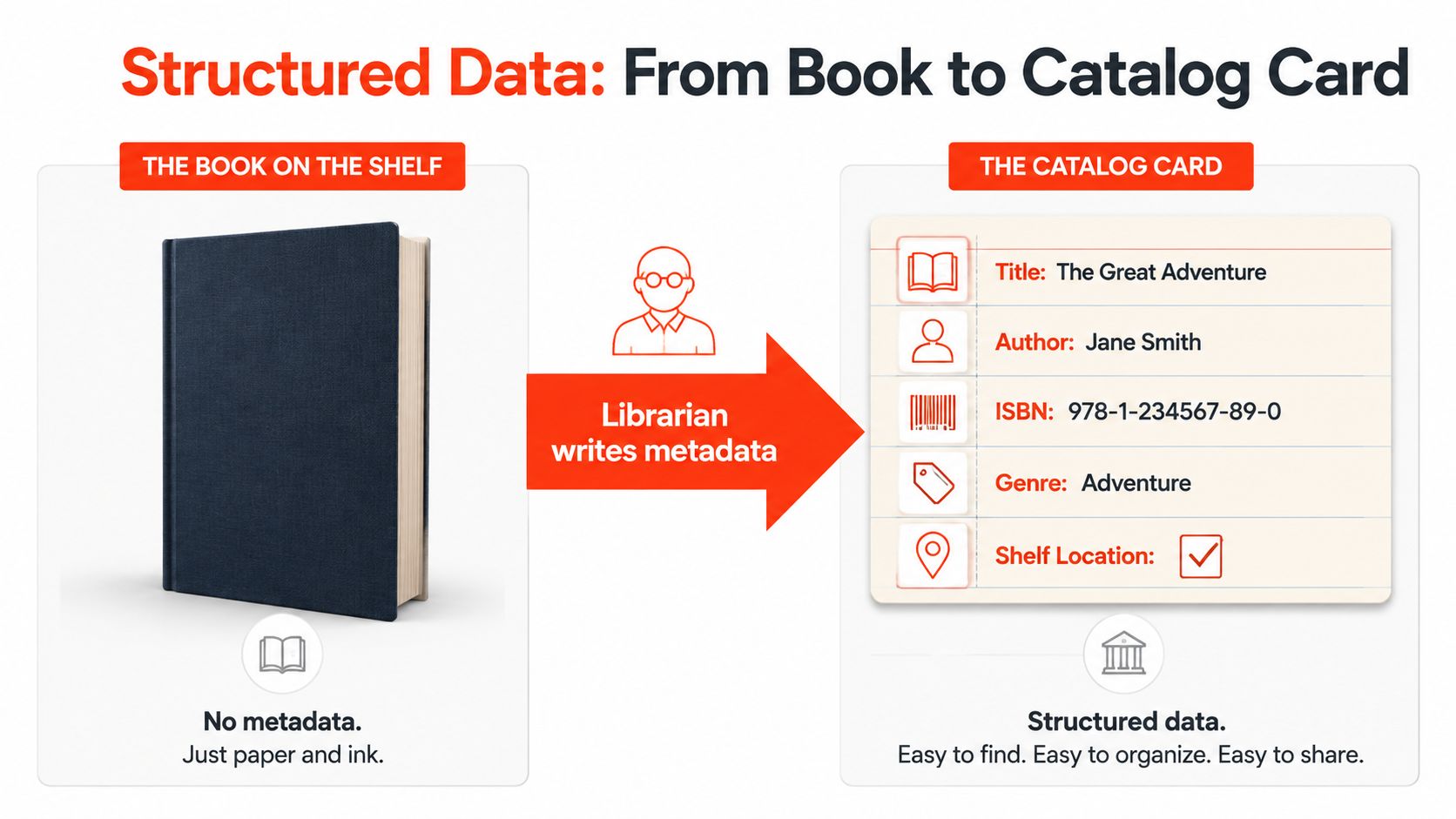
Think about a library. A book on a shelf contains useful information, but a librarian searching only by looking at every cover would work slowly. A catalogue card makes the book easier to find because it records defined fields such as title, author, ISBN, genre, and shelf location.
That catalogue card is a useful analogy for structured data. The book is your visible webpage. The card is a machine-readable description that identifies the important entities and their properties.
Three ways information can be organised
Structured data follows a defined arrangement. A product record might have a name field, brand field, price field, availability field, and identifier field. Each field has a recognised purpose, so software can process it consistently.
Semi-structured data has some organisation, but the meaning isn't fully standardised. A blog post might include a heading, publication date, categories, and tags. Those elements help readers and software, but they may not completely describe the relationships between the article, author, publisher, and website.
Unstructured data has no consistent machine-readable pattern. A PDF brochure, photograph of a menu, scanned document, or image containing text may still be useful to people, but software has to interpret the content before it can reliably classify individual facts.
Schema.org and JSON-LD
Schema.org is a shared vocabulary for describing things on the web. It provides types such as LocalBusiness, Product, Article, and Organization, along with properties that describe each type.
JSON-LD is a format used to express that information. Google recommends JSON-LD for structured data because it can usually be added without changing the visible HTML elements that visitors interact with. The markup is commonly placed in a script element in the page head or body.
The important distinction is simple: structured data doesn't normally change what visitors see. It changes how machines understand the content that visitors already see. It isn't a replacement for useful copy, clear navigation, accessible design, or a trustworthy business profile. It is a machine-readable layer that helps connect those elements.
Schema.org Types That Matter for UK Businesses
Small businesses don't need every available schema.org type. They need the types that accurately describe their important pages and support the search surfaces where customers look.
A local tradesperson will usually start with Organization and LocalBusiness. An online retailer will focus on Product. A publisher may use Article or NewsArticle, while most structured websites can benefit from BreadcrumbList when the visible page hierarchy supports it.
Choosing types by business purpose
Organization describes the wider business entity. It can connect the company name, logo, website, contact details, and related profiles. LocalBusiness adds location-focused information for a business that serves customers from a defined place or area. Accurate name, address, and phone details can support clearer interpretation of local identity, but they don't replace a properly managed Google Business Profile.
Product is useful for ecommerce pages where customers can see the product name, description, price, availability, brand, and identifier. It can make product information easier for search systems to process for shopping-related experiences, although eligibility doesn't guarantee a product feature.
Article and NewsArticle describe editorial content. They can clarify the headline, author, publisher, image, and publication details, which may help search systems understand the page as a piece of journalism or expert content rather than a commercial landing page.
BreadcrumbList describes the visible trail that shows where a page sits within a website. It can support clearer breadcrumb presentation in search results and helps machines understand site hierarchy.
FAQ markup needs more caution in 2026. Google removed FAQ rich results for most sites on 7 May 2026, while FAQPage markup remains valid. Google also scheduled removal of the FAQ report in Search Console in June 2026 and API support in August 2026, as explained in this analysis of FAQ schema's changing role. Use FAQ markup when the page contains visible questions and answers, not because an old checklist promises a prominent result.
A practical comparison
| Schema Type | pageElement | searchOrAiSurface |
|---|---|---|
| Organization | Business identity, logo, contact details | Entity understanding and business identification |
| LocalBusiness | Name, address, phone, opening hours, service area | Local search and map-related interpretation |
| Product | Product name, price, availability, brand, SKU | Product results and shopping comparisons |
| Article | Headline, author, publisher, dates, image | Editorial understanding and answer extraction |
| NewsArticle | News headline, author, publisher, dates | News-focused search and source attribution |
| BreadcrumbList | Visible navigation path | Breadcrumb presentation and site hierarchy |
| FAQPage | Visible questions and answers | Machine-readable answers, with limited rich-result expectations |
Prioritise the schema that matches your most valuable page template. A local plumber shouldn't begin with product markup, and an online shop shouldn't describe every commercial page as an article.
Reading a Real JSON-LD Snippet Without Panic
JSON-LD looks more intimidating than it is. Curly brackets contain an object, quotation marks identify text values, and commas separate one property from the next. The following example describes a fictional Bristol plumbing business.
{ “@context”: “https://schema.org”, “@type”: “LocalBusiness”, “name”: “Bristol ClearFlow Plumbing”, “url”: “https://example.com”, “telephone”: “+44 117 000 0000”, “address”: { “@type”: “PostalAddress”, “streetAddress”: “12 Example Street”, “addressLocality”: “Bristol”, “postalCode”: “BS1 1AA”, “addressCountry”: “GB” }, “openingHoursSpecification”: { “@type”: “OpeningHoursSpecification”, “dayOfWeek”: [ “Monday”, “Tuesday”, “Wednesday”, “Thursday”, “Friday” ], “opens”: “08:00”, “closes”: “18:00” } }@context identifies the vocabulary. @type says what the main object is, in this case a LocalBusiness. The name, url, and telephone properties describe the business, while the nested address object identifies a postal address and its postalCode.
openingHoursSpecification contains another object. It explains which days the business is open and the opening and closing times. The values must match the visible and current information on the page. If the business is closed on a listed day, the markup is inaccurate.
A product example
This second block describes a hand-thrown mug sold on an ecommerce page.
{ “@context”: “https://schema.org”, “@type”: “Product”, “name”: “Hand-Thrown Stoneware Mug”, “description”: “A handmade stoneware mug with a speckled glaze.”, “sku”: “MUG-001”, “offers”: { “@type”: “Offer”, “priceCurrency”: “GBP”, “price”: “28.00”, “availability”: “https://schema.org/InStock”, “url”: “https://example.com/hand-thrown-stoneware-mug” } }The Product type anchors the record. name, description, and sku identify the item, while the nested Offer object contains the currency, price, availability, and product URL. The visible product page should show the same offer details.
You can inspect these patterns yourself. Right-click a webpage and choose View Source, then search for application/ld+json. On some sites, use Inspect and search the document structure for the same script type. You might find one object or a connected graph, but the basic pattern remains recognisable.
What Structured Data Does Not Guarantee
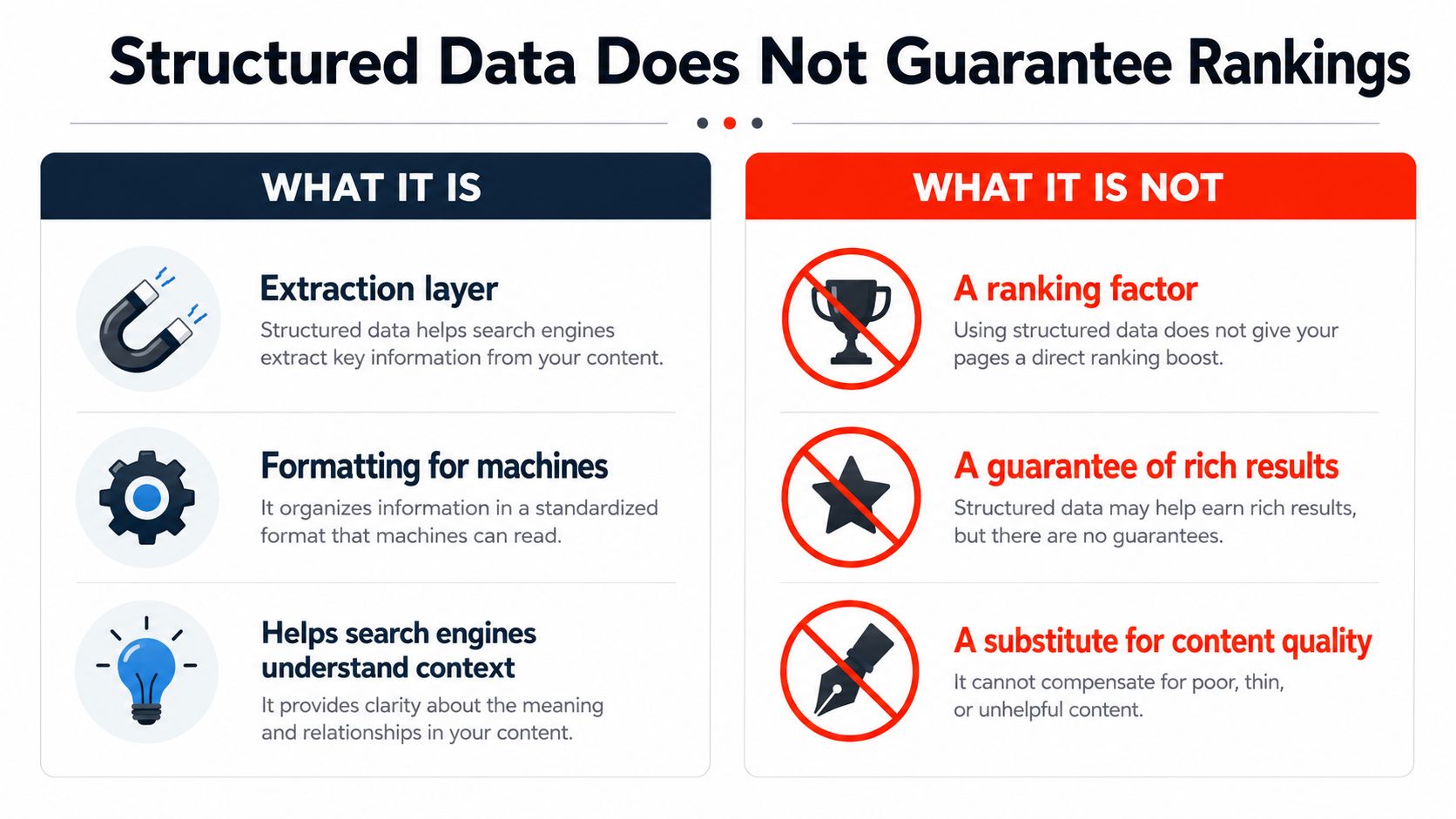
The promise that “adding schema makes your site rank higher” is too simplistic. Structured data is primarily an extraction and formatting layer for machines. It helps Google understand the entities and relationships represented on a page, but it doesn't automatically make weak content authoritative or move a page above stronger competitors.
Google's structured data introduction recommends JSON-LD, requires markup to describe the page it appears on, and explains that structured data doesn't guarantee a rich result. Passing a validation test confirms that the markup is readable and eligible rules may be met. It doesn't promise that Google will display the enhancement.
The distinction matters because search presentation depends on more than markup. Google can consider the content, page quality, relevance, technical accessibility, search context, and other systems before deciding what to show. Structured data can improve eligibility for supported rich results and clarify entities for machine processing, but eligibility isn't inclusion.
Claims to treat carefully
Ignore a vendor who promises any of the following without qualification:
- Guaranteed rankings: Markup alone can't guarantee a first-page position.
- Guaranteed rich results: A valid implementation can still produce no visible enhancement.
- Hidden information advantages: Markup shouldn't contain facts that visitors can't see.
- Automatic AI citations: Structured data can improve clarity, but an answer engine decides what it uses.
- One schema for every page: The type must reflect the page's actual subject and purpose.
Google also warns that misleading or inaccurate markup can create structured data issues and may lead to manual action. A smaller, accurate implementation is safer than a large collection of copied properties that don't match the page.
Implementing and Testing Schema on Your Site
A sensible implementation starts with one important page template, not a site-wide paste of code. Choose a local service page, a product template, or an article template, then map the visible facts before writing JSON-LD.
Add the markup at page level
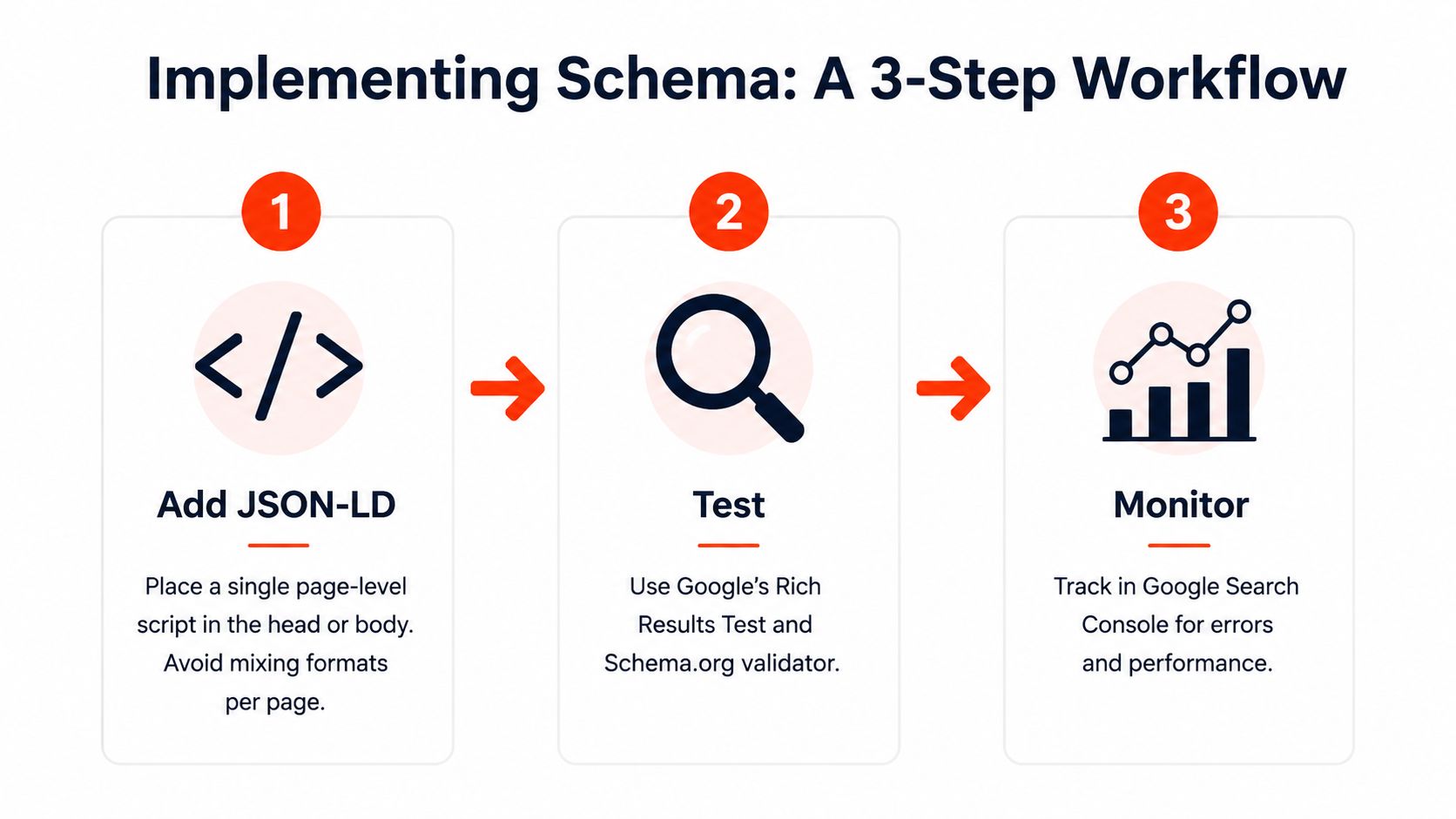
Place a page-level <script type="application/ld+json"> in the head or body. JSON-LD doesn't need to be woven through every visible element, which makes it easier to maintain. Keep the representation consistent and don't create conflicting versions of the same entity through several formats on one page.
WordPress users can begin with a reputable SEO or schema plugin, but should check the generated output rather than assuming the plugin has chosen the right type. Shopify themes and apps often generate product markup, while Wix provides built-in SEO controls and structured-data options. Hand-edit a template when the plugin output is incomplete, duplicates existing markup, or describes the wrong business or product.
Test before publishing
Use Google's Rich Results Test to check eligibility for Google-supported search features. Use the Schema Markup Validator to inspect schema.org syntax and broader vocabulary issues.
A practical workflow looks like this:
- Map the visible facts: Record the exact business name, address, phone number, price, availability, author, dates, or other properties shown on the page.
- Choose the narrowest accurate type: Select
LocalBusiness,Product,Article, or another type because it fits the page, not because it sounds commercially attractive. - Add JSON-LD: Insert the script into the relevant page template.
- Run both validators: Fix syntax errors, missing required fields, and mismatched values.
- Re-test template changes: A theme, plugin, product feed, or content update can alter the output.
Test the live URL, not only the draft. A staging page may contain different rendered content, scripts, canonical settings, or access rules.
Measure what changed
Google recommends using Search Console's URL Inspection tool and Performance report to compare search visibility before and after deployment. Look for changes in impressions, clicks, queries, and supported enhancement data, while remembering that correlation doesn't prove markup caused every change.
Use the Enhancements reports to find issues on live pages, then inspect representative URLs individually. A green test is useful, but in 2026 it still doesn't mean a rich result will appear.
For wider technical housekeeping, an XML sitemap creation service can help ensure important URLs are discoverable, although a sitemap and structured data solve different problems. The sitemap helps search engines find URLs. Structured data helps them interpret the content on those URLs.
Structured Data in the Age of AI Search
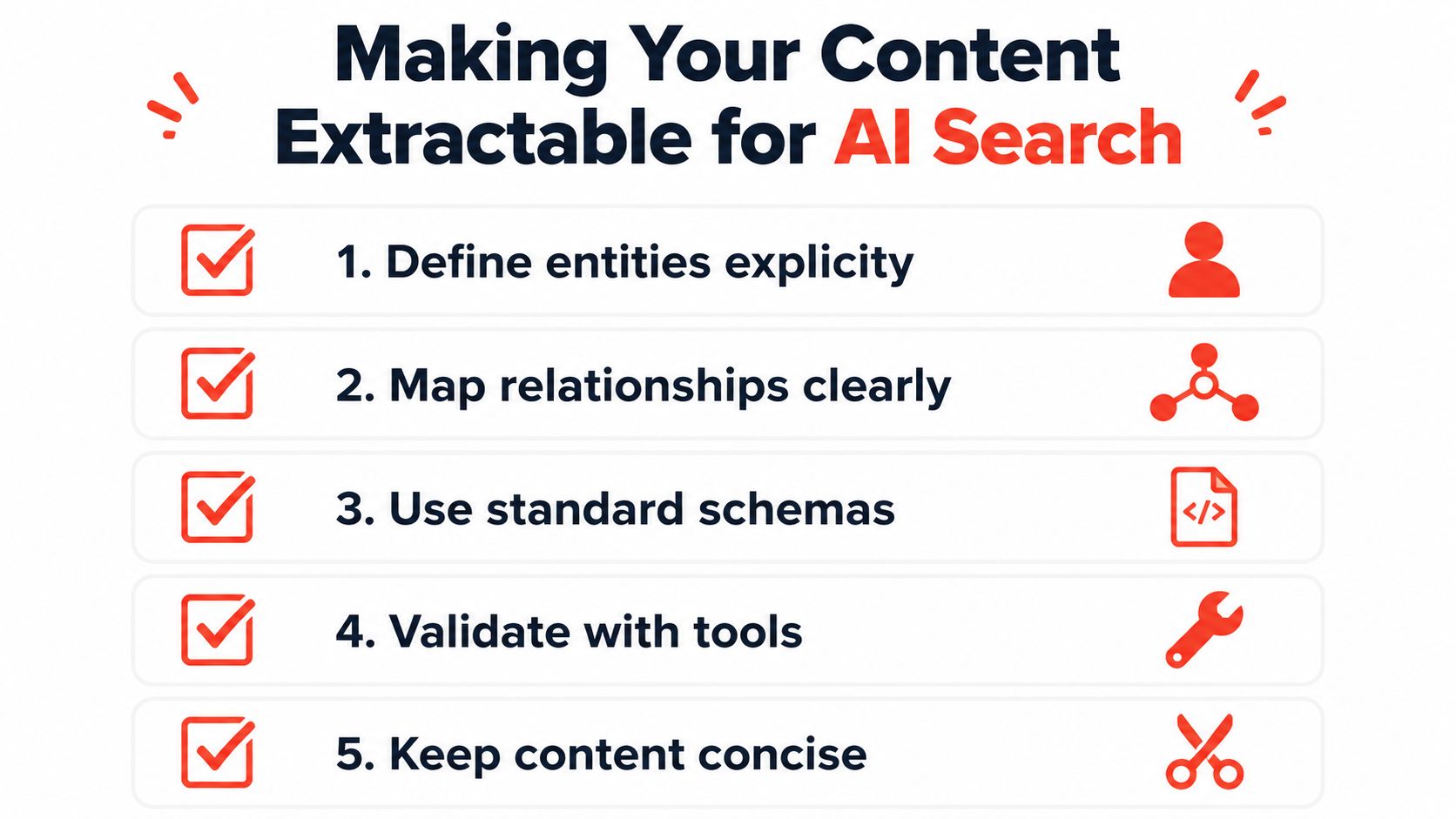
AI search makes structured data more useful as a clarity layer, but not as a magic visibility switch. Answer systems need to identify entities, connect facts, and decide whether a source is relevant enough to summarise or cite. Clear page content and accurate structured data give those systems a cleaner representation to work with.
For a UK business, the use cases are concrete:
- Organization can clarify the company behind the website and connect its identity across pages.
- LocalBusiness can reinforce the relationship between the business, its address, phone number, opening hours, and service area.
- Product can expose a clearer relationship between an item, its price, stock status, brand, and identifier.
- Article can identify the headline, author, publisher, and publication information.
- FAQPage can organise visible questions and answers, even though most sites shouldn't expect the former FAQ rich-result treatment.
An answer engine may still ignore the markup, choose a different source, or provide no business recommendation. That uncertainty is why measurement should focus on eligibility, indexing, query impressions, and the accuracy of extracted information rather than promised inclusion. This guide to AI search visibility provides related guidance for businesses preparing their content for answer-focused search.
A useful week-one checklist
- Claim your Google Business Profile: Keep the public business identity accurate and current.
- Deploy Organization and LocalBusiness markup: Use the type that matches the business and page.
- Add Product or Service information to commercial templates: Mark up only details visitors can verify.
- Validate the live pages: Check both Google eligibility and schema.org syntax.
- Monitor Search Console monthly: Review URL Inspection, enhancement issues, and Performance data.
The UK government has treated structured data as more than an SEO trick for years. Its publishing guidance has instructed public-sector publishers to use the schema.org Dataset schema for CSV files, spreadsheets, and other published data since at least 2020, with recommended properties including creator, dateCreated, description, encodingFormat, identifier, license, name, supersededBy, and temporalCoverage. The guidance also recommends combining schema.org with persistent resolvable identifiers, showing how structured data supports discoverability and interoperability in a wider publishing system. Read the GOV.UK schema guidance for that public-sector context.
The related semantic web field has also appeared in the UK jobs market. In the six months to 14 November 2025, UK listings citing Semantic Web included four permanent vacancies, compared with one in the comparable period two years earlier. The quoted median annual salary was £80,000, based on two reported salaries, according to IT Jobs Watch's UK Semantic Web data. That's a niche signal, not proof of a broad employment trend, but it illustrates that machine-readable data connects web publishing with wider data and interoperability work.
1stNet AI Ltd offers website design and development with domain registration, SSL, hosting, maintenance, SEO-friendly implementation, and AI visibility optimisation for UK businesses. Launch your website fast with a domain, SSL, hosting and maintenance included, with an accelerated option to go live within an hour, interactive live chat support, and a 30-day money-back guarantee. Call 1stNet AI Ltd on 0204 577 2255, or visit 1stNet AI Ltd to discuss your website and structured-data requirements.