You’re staring at a registrar search box, the name you wanted is half gone, and the cheap offer in front of you looks tidy enough to click. That’s where most UK business owners get it wrong. A domain isn’t a checkout chore; it’s the bit of your business address customers type, trust, and remember, and it’s tied to hosting, SSL, renewals, and the mess you’ll inherit if you choose badly.
A decent domain decision saves time later. A sloppy one becomes an admin, a legal risk, and a source of brand confusion. If you want the straight version of how to get a domain name, treat it like a business asset, not a receipt.
You open a laptop, type in a few possible names, and one comes back available. That feels like a small win. It is not a small decision. The domain ends up on invoices, in search results, in email addresses, and in how customers remember you after they close the tab.
A UK business should treat a domain as part of its public identity. Nominet is the official registry for .uk names and lists more than 10 million registered .uk domains, demonstrating the namespace’s established and widespread use in the UK market. It also supports several second-level domains, including .co.uk, .org.uk, .me.uk, and .uk, so you can choose the format that best reflects how your business presents itself rather than forcing a clumsy label on the brand. Nominet’s registry overview and namespace scale
The domain is a business asset, not a receipt
Control matters more than the checkout screen. A domain is rented, not permanently owned, and the standard registration period is at least 1 year, with renewals thereafter, under ICANN’s registrar rules. That means the registrar relationship matters just as much as the name itself, because contact details, verification, renewal settings, and DNS access all affect whether you still control the address next year. ICANN registrar and renewal basics
Practical rule: if the registrar makes renewals, DNS, or ownership checks hard to find, walk away. That friction is how businesses lose domains they meant to keep.
For a small business, the best domain is the one customers can repeat without thinking. If your café has to spell it out every time, if your plumbing firm keeps correcting the hyphen, or if your online shop sounds too close to a competitor’s brand, you have created admin before you have created traffic. The point is a clean, defensible name that will not cause problems when you build the site around it.
Start with pronunciation. If you can’t say the domain once and expect someone to type it correctly, it’s the wrong name. That rule saves more pain than any design trend or keyword trick, because most customers hear your name before they ever see it.
Keep it short and typo-proof
Short wins. Long domains are a tax on every phone call, email signature, flyer, invoice, and social profile. A good domain should be easy to say aloud, simple to spell, and free of unnecessary punctuation. That means no hyphens, no numbers unless they’re part of the brand, and no awkward strings that need explanation. A UK plumber should pick something like BrightonPlumbing.co.uk only if it’s the cleanest, most defensible option, not because it matches a search phrase. A café should favour a name customers can remember after one conversation. An online retailer should avoid a domain that looks like a coupon code.
Run the trademark and lookalike checks
Do the boring legal work before you buy. Search for obvious trademark conflicts, check whether the name looks too similar to a competitor’s, and say it out loud as if you were on a radio interview. If you need to stop and explain the spelling, scrap it. Independent guidance on choosing a domain name also recommends checking for lookalike and confusingly similar names, as well as for trademark issues, before registration. Domain name checks for pronunciation, lookalikes, and trademark risk
If the domain fails the “radio interview” test, it’ll fail in real life too.
Choose brandable over awkwardly exact
A memorable, pronounceable name is usually better than an exact-match keyword domain that nobody can say cleanly. That’s the contrarian answer most beginners don’t hear enough. The domain should help you build a brand around it, not force you to defend a clumsy word salad every time you mention your business. If someone else already owns the obvious version, move on and choose the better business name, not the cheapest available compromise.
Picking the Right Extension for a UK Business
The suffix isn’t decoration. It tells people something about trust, geography, and intent. A UK business usually has more to gain from a UK extension than from chasing a fashionable global one, because local relevance is part of the signal you send before anyone clicks.
Compare the common choices
Extension
Trust signal
Best for
Typical annual cost
Availability pressure
.co.uk
Strong UK trust signal
Local businesses that want a familiar UK address
Qualitatively, usually in the standard low-cost registrar range
High
.uk
Strong and modern UK signal
Brands that want a shorter UK identity
Qualitatively, usually in the standard low-cost registrar range
High
.com
Broad international trust
Businesses trading outside the UK or wanting global recognition
Qualitatively, usually in the standard mid-range registrar range
Very high
.shop or .studio
Clear niche signal, but less familiar
Brand-led businesses that suit the extension
Qualitatively, often varies more by seller and promotion
Lower than .com, but uneven
The right default for most small UK firms is still .co.uk or .uk. They tell people immediately that you’re a UK business, and they avoid the awkwardness of pretending you’re a global brand when you’re really serving local customers. Nominet’s namespace includes multiple second-level formats, so you’re not forced into a one-size-fits-all choice. Nominet’s UK namespace options and scale
When .com is worth the hassle
Go for .com if you trade internationally, plan to, or your brand name already works best in that form. Don’t chase it just because people talk about it as the default. A clean .co.uk beats a stretched, unavailable, or expensive .com that you’ll spend years explaining.
When niche extensions make sense
A niche extension only earns its keep if it strengthens the brand story. A studio, maker, or specialist service can use one well if the audience already understands the category. If it looks clever but untrustworthy, skip it. The name should do the selling, not the suffix.
Checking Availability and Registering Without Mistakes
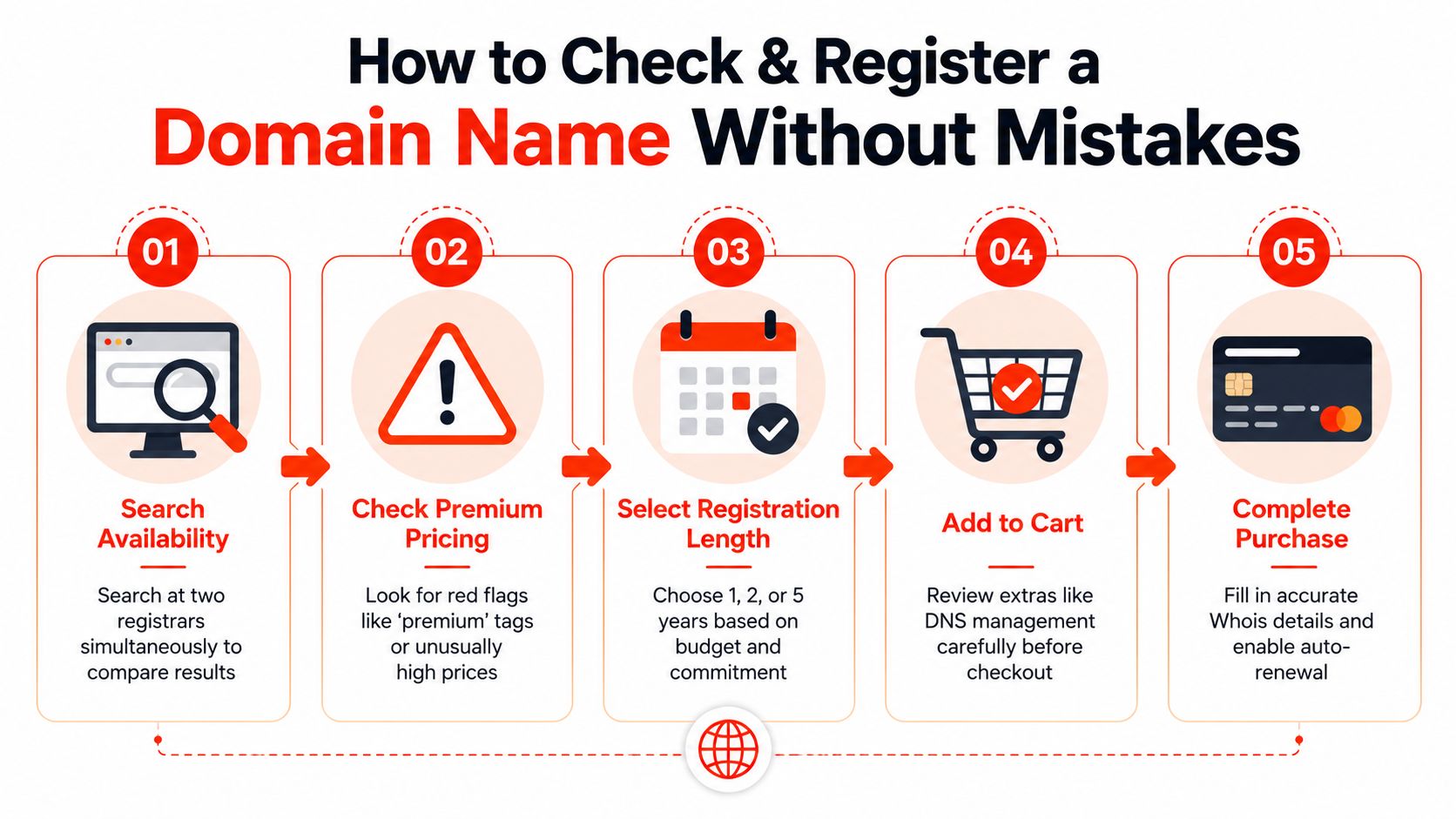
Search once, then panic when the exact name is gone, and buy the next thing that looks close enough. Don’t do that. Search at two registrars before you commit, because the same domain can look available in one place and come with premium pricing, awkward upsells, or hidden renewal pain in another.
Follow the purchase path properly.
Search availability carefully. Check the name with a registrar and a hosting provider to compare what’s on offer.
Watch for premium tags. If a domain is marked premium or priced far above the standard range, treat that as a warning, not a sign of quality.
Pick the registration term with your eyes open. One, two, or three years is common at checkout, and the longer term only makes sense if you’re committed to the name.
Choose a registrar that gives you control. DNS management, email forwarding, renewal controls, and clear ownership settings matter more than a flashy checkout page.
Verify the ownership email straight away. Delayed verification can trigger suspension or account issues, so treat it as part of the purchase, not an optional extra.
The operational mistake I see most often is people treating the domain like a one-off shopping basket item. It’s not. Renewals, contact details, verification, and DNS are part of ongoing control. If the registrar buries those settings, your future self will pay for it.
For the actual process flow, the register-then-verify sequence is the one to trust.
Best practice: don’t buy until you’ve confirmed the renewal price, privacy option, and DNS access. That’s the real decision, not the first checkout total.
Once the name is bought, make sure the registrar account is under a business email you control long term. If the ownership email goes missing, the domain can become a headache fast, even if you paid for it properly.
Domain Costs: The Two-to-Three-Year Picture
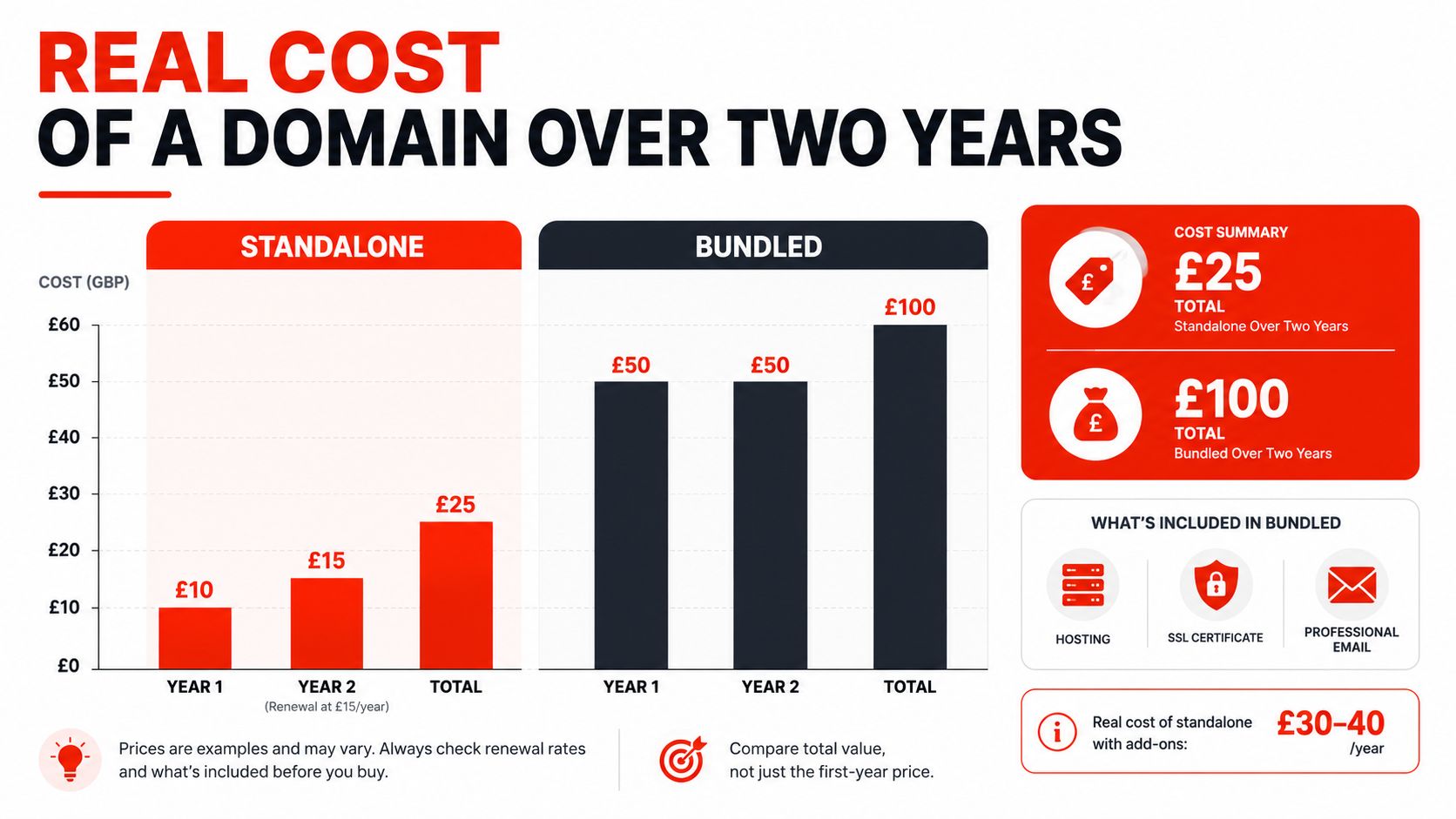
A cheap first year is often the most expensive way to buy a domain. That sounds backwards until you add the renewal, privacy, DNS features, and the bits you assumed were included when the checkout page looked friendly. By year two or three, the sticker price barely matters.
Standalone registration versus bundled support
Standalone domain sellers usually look cheap because they only show the domain line item. That is the trap. The right question is not what year one costs; it is what you will pay after renewals, admin, and the missing pieces are added back in. For UK small businesses, a bundled setup that includes hosting, SSL, and maintenance often cuts hidden work and vendor chasing, even if the first invoice is higher. That is the part many first-time buyers miss. Why the website cost needs to be viewed as a full package
The same logic applies to first-year promotions. Independent coverage of free domain offers warns that renewal prices can rise sharply and package deals can restrict extension choice, which is why the headline offer should not make the decision for you. A “free” domain is only free until the renewal period begins. Free domain offers and renewal trade-offs
Use this rule before you buy
If a quote looks cheap, ask three things before paying:
What is the renewal price? That is the number that matters.
What do I get for privacy and DNS management? If they cost extra, add them in.
How much admin will I have to do myself? If the answer is “quite a bit”, the cost is higher than the invoice.
Domain registration is rented year by year, so budget like a renter, not like an owner. Renewal cycles are part of the deal, and the contract matters more than the headline price at checkout. Domain registration and yearly renewals
The simple buying rule
Choose the option that stays boring after the first year. If the low sticker price comes with messy renewals, hidden extras, or support you cannot use, it is not cheap. It is delayed pain.
Connecting Your Domain to Hosting and SSL
A bought domain doesn’t do anything useful until it points at a live website. That’s the part people underestimate. DNS tells the internet where the domain should go, and SSL is what lets browsers show the padlock and treat the site as secure. Without both, you’ve got an address, not a functioning web presence.
Get the order right
Point the domain to hosting first, either through the registrar’s DNS controls or the hosting provider’s setup, then activate SSL so the site loads securely. If you need email forwarding, confirm that too before launch, because the domain has to support the way you plan to use it. The practical point is simple. The website, the secure connection, and the email settings need to be aligned before you send traffic anywhere.
What the settings actually do
DNS is the routing layer. It tells browsers and email systems where to look when someone types your domain. SSL is the trust layer. It encrypts the connection and provides users with the visual reassurance they expect, especially before they enter their contact details or make a purchase.
For small businesses, the cleanest setup is one where the registrar, hosting, and SSL are all part of the same managed workflow. That reduces the chance of broken handoffs and avoids the classic “the domain is bought, but nothing loads” problem. If you’re comparing providers, treat hosting as part of the domain decision, not an afterthought. Hosting choice and small business website setup
The two issues that waste the most time
SSL hasn’t been activated yet. That usually means the DNS change hasn’t fully settled, so don’t keep reinstalling anything.
The domain still shows a placeholder page. That’s almost always a pointing problem, not a website problem.
Keep it simple, point the domain once, test the padlock, then stop touching settings you don’t need.
Most business owners don’t need a DNS course. They need a site that works, a secure browser experience, and an email address that matches the brand. Get those three working and move on.
Common Pitfalls and a Fast-Track Recommendation
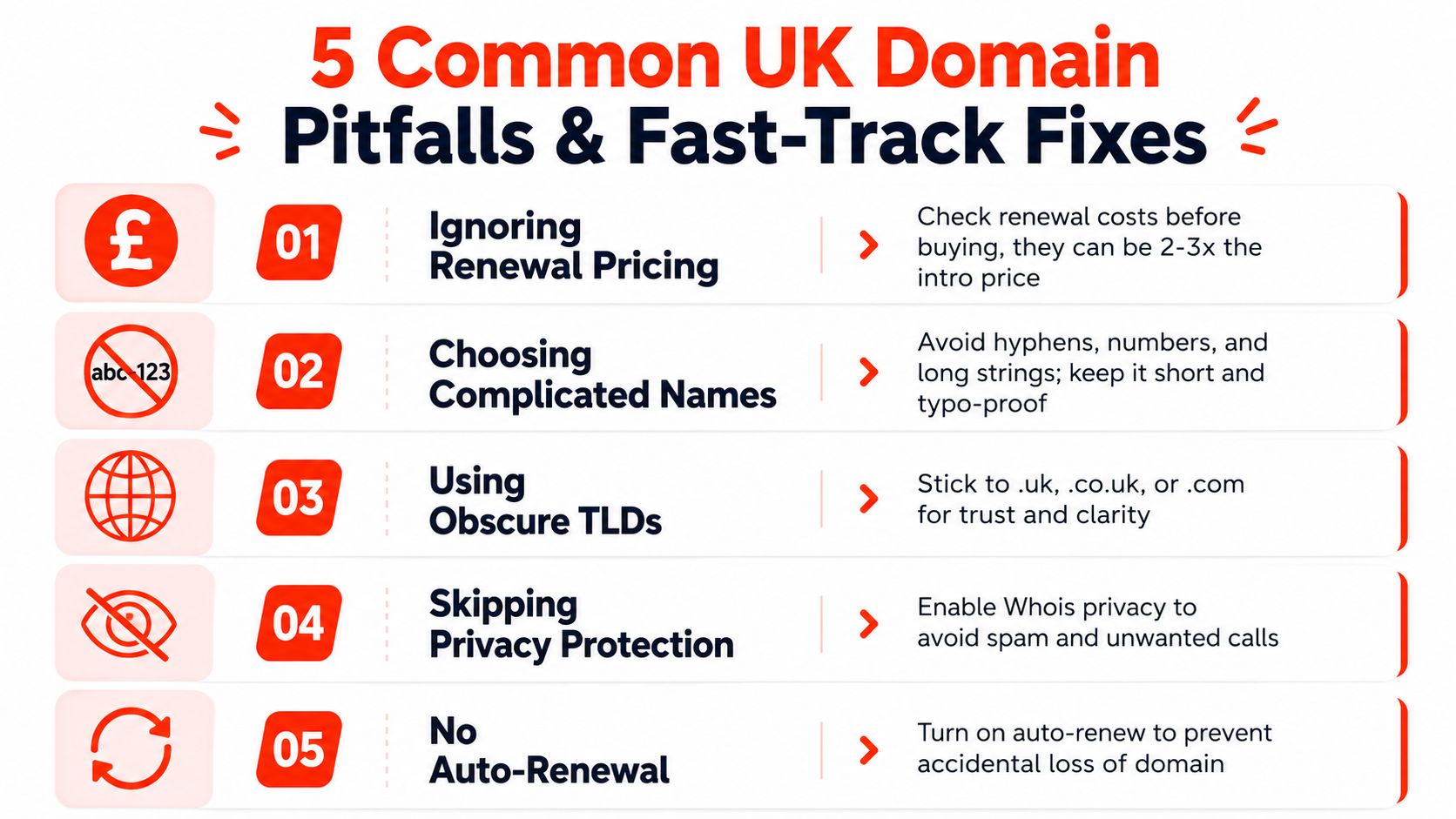
Most UK domain mistakes are painfully ordinary. People ignore renewal pricing, pick names that are hard to spell, choose obscure extensions because the obvious ones are taken, forget privacy, and leave auto-renew switched off. Every one of those problems is avoidable if you take five minutes to slow down before paying.
The five mistakes that cause the most grief
Ignoring renewal pricing. Check the long-term cost before you buy, not after the first invoice.
Choosing complicated names. Keep it short, avoid hyphens and numbers, and make it typo-proof.
Using obscure TLDs. Stick to .uk, .co.uk, or .com unless the brand story supports something else.
Skipping privacy protection. Enable WHOIS privacy where the extension supports it, so you don’t invite spam or sales calls.
Leaving auto-renewal off. Switch it on so you don’t lose the domain by accident.
The strongest operational advice is this. If you want the fastest, lowest-risk path to live, choose a managed bundle that includes the domain, SSL, hosting, and maintenance from a single UK provider. That cuts handoffs, reduces billing surprises, and removes the technical pieces most owners never wanted to manage in the first place. A separate domain seller and separate host can work, but it usually creates more admin than a small business needs.
Final check before you commit
The name is short and easy to say.
The extension fits the business.
The renewal price is acceptable.
The registrar gives you DNS and renewal control.
The ownership email is one you’ll keep.
Auto-renew is on.
Buy the domain once, set it up properly, and leave yourself a clean path to build on it. If you want a UK team to handle the domain, hosting, SSL, and launch without the usual vendor juggling, speak to 1stNet AI Ltd today and get the whole website stack moving in one go.