

You’re probably staring at three tabs right now. One host says cheap, another says managed, and a third throws in SSL, backups, and “optimised for WooCommerce” as if that settles it. It doesn’t, because ecommerce website hosting is where your checkout, your customer trust, and your day-to-day workload either stay under control or become a mess.
The mistake I see most often from UK small businesses is treating hosting like a utility bill. Pick the lowest price, bolt on SSL later, worry about maintenance when something breaks. That’s backwards. Hosting is part of your sales system, and if it’s weak, everything built on top of it feels brittle.
Table of Contents
- Why E-commerce Hosting Is a Business Decision, Not Just a Technical One
- Understanding the Main Types of E-Commerce Hosting
- Essential Security and Performance Features for UK Online Stores
- Comparing Hosting Costs and Resource Requirements
- The Hidden Costs and Maintenance Burden Most Guides Ignore
- Your E-commerce Hosting Evaluation Checklist
- When Managed Hosting Makes Sense for Growing UK Businesses
Why E-commerce Hosting Is a Business Decision, Not Just a Technical One
I’ve seen owners spend weeks on logo colours and homepage tweaks, then lose orders because the checkout slows to a crawl. That problem usually starts with hosting. It shows up exactly where customers decide whether to pay.
Hosting sits inside the sales process
Slow loading makes shoppers hesitate before they trust you. Missing SSL does the same before they enter card details. If the site drops during a promotion, you lose the traffic, the sale, and the confidence that comes with a working checkout. Encryption is a basic commercial requirement, and the NCSC’s security guidance on using HTTPS makes that clear.
The UK market makes this harder to ignore. The Office for National Statistics reported that Internet sales value accounted for 17.5% of total retail sales in Great Britain in December 2024 (ONS retail sales data). When that much trade depends on online checkout, hosting becomes part of revenue protection, not background plumbing.
Practical rule: if a hosting choice makes support, security, or checkout slower to manage, it already costs more than the monthly fee.
Cheap hosting can be the expensive option
The low entry price is attractive. Shared hosting is still a common starting point, and global reporting from Wix web hosting statistics shows it remains a big part of the market. That does not mean it suits a store with real orders, real customers, and demand spikes that matter.
The hidden cost is operational. Once you add plugins, payment tools, backups, security checks, and compliance tasks, the “cheap” plan turns into a coordination job. You are no longer just buying hosting. You are managing a small technical stack, and it needs attention whenever something changes.
The judge is hosting one test. Does it protect conversion, keep the site stable under pressure, and reduce the time you spend firefighting? If the answer is no, the sales page is doing the talking and your business is paying for it.
Understanding the Main Types of E-Commerce Hosting
A store’s hosting choice usually starts as a cost decision and then becomes an operations decision. The question is how much maintenance you are willing to own, because every step up in hosting changes who is responsible for updates, security, downtime risk, and checkout stability. UK retailers typically start with shared hosting, move to VPS, then to cloud, and end up on managed ecommerce hosting once the admin load becomes too heavy to handle in-house.

Shared hosting is the cheapest place to start
Shared hosting puts your store on the same server as many other sites. That keeps the price down, but it also means you are sharing resources with everyone else on that machine. It works fine while traffic is light and the site stays simple. It becomes a problem when another account on the same server starts consuming more than its share, and your store feels it.
That is why shared hosting only makes sense for very small shops, test builds, and businesses with tiny catalogues and low traffic. It gets a business online quickly. It does not offer much headroom for plugin-heavy ecommerce stores, during busy checkout periods, or for the kind of reliability you want once sales start to matter.
VPS hosting gives you more control
VPS, or virtual private server hosting, sits above shared hosting for a reason. You still share the physical hardware, but you get dedicated slices of CPU, memory, and storage, along with greater control over the software environment. It works more like having your own floor in a building than a desk in a shared room.
This is the better fit once a store needs steadier performance, tighter control over the stack, or room to grow without hitting the same limits every month. It also means you are paying for more than basic hosting, because the environment is less stripped back and usually needs more active management. Industry pricing guidance puts VPS hosting in the $20-$100 per month range (BeBusinessed hosting statistics).
Cloud hosting scales with demand
Cloud hosting is built for movement. Capacity can rise and fall with demand, so a store can better cope with traffic spikes, seasonal trading, and paid campaigns that drive traffic quickly. That flexibility matters when checkout volumes are uneven, and you do not want to overbuy infrastructure just to survive short bursts.
As noted earlier, one industry roundup projected cloud hosting growth at a 17.7% CAGR through 2030 (Wix web hosting statistics). The better takeaway for retailers is simple. Cloud hosting suits businesses that need resilience and scalable capacity without constantly reconfiguring server setups. It is rarely the cheapest option, and it can still be complex, but it gives you more room to absorb pressure before customers feel it.
Managed e-commerce hosting removes a lot of the burden
Managed ecommerce hosting bundles the platform, updates, security, and support into a single service. That matters because e-commerce sites do not stay static. Plugins change, payment tools need attention, backups fail if no one checks them, and compliance tasks keep popping up in the background. A managed setup takes a chunk of that maintenance burden off your team and leaves fewer moving parts for you to coordinate.
One industry roundup said 48% of e-commerce websites use managed hosting (Wix web hosting statistics), indicating that many stores have already accepted that self-managing everything is a false economy. If you are running a shop with real orders but no in-house technical team, managed hosting often reduces stress and keeps the store easier to run day to day.
For UK businesses, the core question is not whether the server can technically run the site. It is who owns the problems when the plugin breaks, the checkout slows down, or the backup does not restore cleanly. Managed hosting exists because most owners do not want a second job on top of running the business, and that is exactly why it earns its place in the conversation.
For stores using WordPress or WooCommerce, the payment setup needs to be properly configured in the hosting environment as well. A dedicated website payment gateway setup only helps if the rest of the stack is stable, maintained, and not held together by patchwork fixes.
Essential Security and Performance Features for UK Online Stores
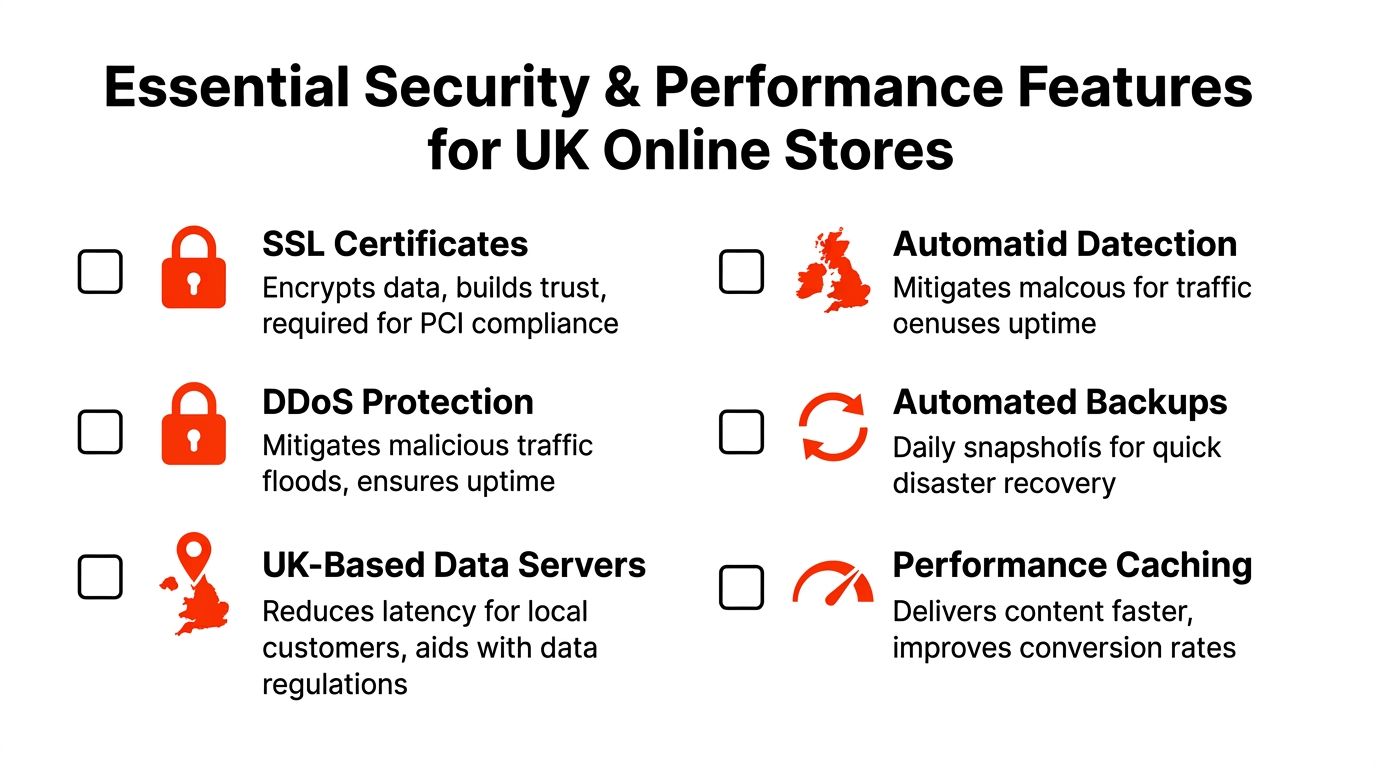
The feature list on a hosting page is easy to fake. What matters is whether the plan protects payments, keeps the site available, and avoids introducing friction at checkout. For UK stores, that means security and speed need to work together, not live in separate departments.
The video below is useful if you want a practical look at how hosting and payment layers interact.
SSL and trust are non-negotiable
SSL isn’t a premium add-on anymore. It’s the baseline. If customers see a browser warning, they leave. If checkout traffic isn’t encrypted, payment confidence collapses. That’s why I always treat SSL as a required feature, not a marketing perk.
For stores using WordPress or WooCommerce, payment processing needs to align with the hosting environment, too. A dedicated payment gateway setup is only useful if the hosting layer doesn’t become the weak link, so I’d rather see a simpler stack that’s maintained properly than a bloated one patched together. The relevant integration point is covered on the website payment gateway page.
Location and caching affect real shoppers
For UK ecommerce, location matters. Google’s UK data-centre regions use carbon-free energy 90% of the time or more, and Cloudflare says its London network location is a major UK traffic hub (HostScore360 on ecommerce hosting selection). That’s not just an environmental note, it’s a latency note. Put the origin close to the shopper, then push static assets through a CDN so product pages and cart fragments don’t need to travel further than necessary.
That path is especially important on dynamic WooCommerce or Magento flows, where every extra network hop adds delay. Keep checkout requests on a low-latency route, because the payment step is where impatience turns into abandonment.
Backups and uptime keep revenue intact
Backups are useless if nobody can restore them quickly. Uptime is useless if the provider won’t show how they measure it. UK hosting guidance from the ISPA treats service reliability as something providers should be able to demonstrate, not just advertise (EuroDNS on e-commerce web hosting essentials).
A sensible hosting plan should include:
- Automated backups so a failed update doesn’t become a full rebuild.
- Performance caching to prevent the server from buckling under repeated traffic.
- UK-based or UK-close infrastructure so checkout steps stay responsive.
- Clear support coverage for the hours you trade.
If a provider can’t explain any of those plainly, walk away. That silence usually means the plan is doing less than the sales copy suggests.
Comparing Hosting Costs and Resource Requirements
Hosting prices look tidy on a sales page and messy once a store is live. The monthly fee is only one part of the bill. You also pay in CPU headroom, memory, storage, support quality, and the hours spent keeping the stack stable. For many small businesses, the key question is not what the plan costs today, but what it costs when the site is under pressure, and someone has to fix it fast.
| E-commerce Hosting Tiers Compared | Typical Monthly Cost | Resources | Best For |
|---|---|---|---|
| Shared Hosting | Low-cost entry pricing | Shared CPU and RAM, limited control | Very small stores, early testing |
| VPS Hosting | Mid-range pricing | Dedicated slices of CPU and memory, more control | Growing stores need stability |
| Cloud Hosting | Higher pricing varies with usage | Elastic resources, easier scaling | Campaigns, seasonal spikes, larger catalogues |
| Managed E-commerce Hosting | Varies by bundle | Hosting, support, security, and maintenance wrapped together | Owners who want fewer vendors and less admin |
That table is about workload, not just sticker price. A cheap shared plan can work for a tiny catalogue, but it gets expensive quickly if you spend your time fighting slow admin screens, failed updates, and support tickets. A managed bundle can look more expensive on paper and still cost less overall if it eliminates the need for outside help. The link between hosting and maintenance costs is often ignored, so it is worth treating them as a single bill rather than separate ones. A clear breakdown of website maintenance costs helps you judge the full monthly commitment before you buy.
The resource thresholds matter more than the sales pitch
Guidance for growing stores commonly points to at least 4 vCPUs and 8 GB RAM, then 8+ cores plus 32 GB+ RAM for high-traffic catalogues (Elementor ecommerce hosting guidance). Those thresholds matter because they map to real limits, such as PHP worker concurrency, database contention, and slow recovery when cache misses hit during checkout traffic.
I tell clients to size for peak concurrency, not average traffic. A quiet Monday tells you very little if a Friday promotion knocks the site over.
Storage and testing aren’t optional extras
Use NVMe SSD storage and keep server-side caching enabled, because that setup helps the store recover faster under load (Elementor ecommerce hosting guidance). Test the build before launch, not after the first campaign goes live. If the host cannot survive a load test, it is not ready for a real promotion.
Rule of thumb: if you are planning paid campaigns, choose the host that can handle burst demand without the CPU sitting near saturation or database writes dragging. Average performance is not what pays the bills.
There is also a total-cost-of-ownership problem. A bundle that includes domain, SSL, hosting, and maintenance often makes more sense than stitching together separate services from different vendors, because every extra supplier creates another task, another renewal, and another point of failure.
The Hidden Costs and Maintenance Burden Most Guides Ignore
The cheap-hosting argument usually ignores the person doing the work. For e-commerce, that person is often the owner, and the workload never stays small for long. Once the site is live, you’re not only running a store. You’re keeping a stack healthy.
Self-managed hosting creates a long task list
The hidden jobs add up fast. Plugin updates, security patches, backup checks, bug fixes, UK GDPR and cookie compliance, payment gateway configuration, and tax settings all sit on your desk if the host doesn’t handle them for you. A UK small-business guide makes the same operational point, that buyers often miss the maintenance burden when they shop for “cheap ecommerce hosting” (Baslondigital ecommerce website hosts).
That’s where the total cost of ownership starts to bite. Every update needs time. Every conflict needs a diagnosis. Every failed change can turn into emergency developer work or lost sales while the site is down.
Conversion problems often start in the stack
Generic hosting articles love speed charts and uptime badges. They rarely connect hosting to checkout friction or mobile behaviour, which is the more useful question. If the hosting layer slows cart fragments, payment calls lag, or mobile pages feel sticky, shoppers leave before they finish.
That matters because commerce isn’t happening through a single neat channel anymore. UK businesses are selling through their own site, marketplaces, social channels, and cross-border orders, which means the website has to stay reliable while the rest of the stack shifts around it. Hosting that can’t keep up creates friction where you can least afford it.
The maintenance gap is exactly why managed hosting exists. It’s a response to the fact that most small teams don’t have time to act like a web department.
Managed bundles reduce vendor sprawl
A single provider can handle design, development, hosting, and maintenance, reducing the number of handoffs and making support easier to track down. For some UK businesses, that is the core value, not the server spec sheet. It’s also why I’d consider a bundled provider, such as 1stNet AI Ltd’s website maintenance offering, when the store owner wants a single accountable team rather than a list of separate invoices.
If your current setup only looks cheap because you’re not counting your own time, it isn’t cheap. It’s just deferred cost.
Your E-commerce Hosting Evaluation Checklist
A good provider should answer specific questions without trying to dazzle you with jargon. If they can’t, they probably rely on buyers not knowing what to ask.
Use the provider’s answers, not the sales copy
Look for the physical server location first. If your shoppers are mainly in the UK, ask where the servers sit and whether static assets are routed through a CDN. You want the answer to be plain, not wrapped in broad “global performance” claims.
Then ask about uptime, support, scalability, backups, security, and pricing clarity. Those are the things that tell you whether the host is built for real trading or just brochureware.
| Criteria | Your Requirement | Provider Score | Notes |
|---|---|---|---|
| Server Location | UK-based or close enough for low latency | ||
| Guaranteed Uptime | Clear SLA and monitoring | ||
| Support Response Time | Fast enough for UK business hours | ||
| Scalability Options | Easy upgrade path | ||
| Backup & Restore Policy | Simple restoration process | ||
| Security Features | SSL, WAF, malware scanning | ||
| Transparent Pricing | Renewal and overage fees disclosed |
Test for the launch you actually plan
If you expect campaign spikes, ask for load testing before you commit. A provider that can’t help you validate performance under stress is asking you to guess. That’s poor risk management for any store that depends on timed promotions or seasonal demand.
The commercial terms matter too. A 30-day money-back guarantee is a clearly testable term, and UK consumer law gives the broader context for why refund windows matter in distance selling (SQ Magazine web hosting statistics). That doesn’t make every guarantee equal, but it does give you a simple benchmark for comparing a provider’s confidence with the legal backdrop.
A strong answer is specific
You want direct answers like this.
- Where is the origin hosted?
- How are backups restored, and who does it?
- What happens if traffic triples during a campaign?
- Which support channel is open when my shop is busiest?
A provider that answers quickly and plainly is usually safer than one that hides behind broad promises.
If a host avoids these questions, move on. The best providers don’t need smoke and mirrors.
When Managed Hosting Makes Sense for Growing UK Businesses
Managed hosting earns its keep when the store stops being a hobby and starts acting like a business. That usually happens the moment you care more about selling than about patching servers. At that point, the value is less about raw infrastructure and more about removing decisions you shouldn’t have to make every week.
One provider means fewer moving parts
The strongest case for managed e-commerce hosting is the need for coordination. Domain, SSL, hosting, updates, support, and maintenance are all handled by one provider, so you’re not chasing five companies when something breaks. That’s not just convenient, it’s cleaner risk management.
It also helps with launch speed. A single-provider setup can go live far faster than the usual piecemeal approach, which matters if you’re trying to start trading before a campaign, a season, or a deadline slips away. For businesses that want the whole stack handled in one place, 1stNet AI Ltd’s small business hosting approach is relevant because it combines design, hosting, and maintenance rather than splitting them across separate vendors.
Predictable costs beat hidden admin
Managed hosting makes sense when the monthly bill is easier to defend than the time you’d otherwise spend coordinating updates, fixing issues, and tracking renewals. It’s especially sensible when you’re not employing a technical team in-house. The cheaper-looking option often becomes the more expensive one once you count support tickets, emergency fixes, and the hours lost to preventable problems.
That’s why I recommend managed hosting for most growing UK SMEs that want fewer surprises. You’re buying stability, accountability, and a narrower surface area for mistakes.
Choose the option that matches your capacity
If you’ve got a technical team, advanced store logic, or a bespoke build, a more flexible infrastructure layer can make sense. If you haven’t, I’d rather see a managed setup that keeps the business moving than a clever stack that nobody owns properly. The right answer is the one your team can operate on a bad day.
If you want a UK-based team to handle ecommerce website design, hosting, maintenance, SSL, and ongoing support in one place, visit 1stNet AI Ltd. They build and manage stores for small businesses that want to launch quickly, keep technical overhead low, and avoid juggling multiple vendors.