
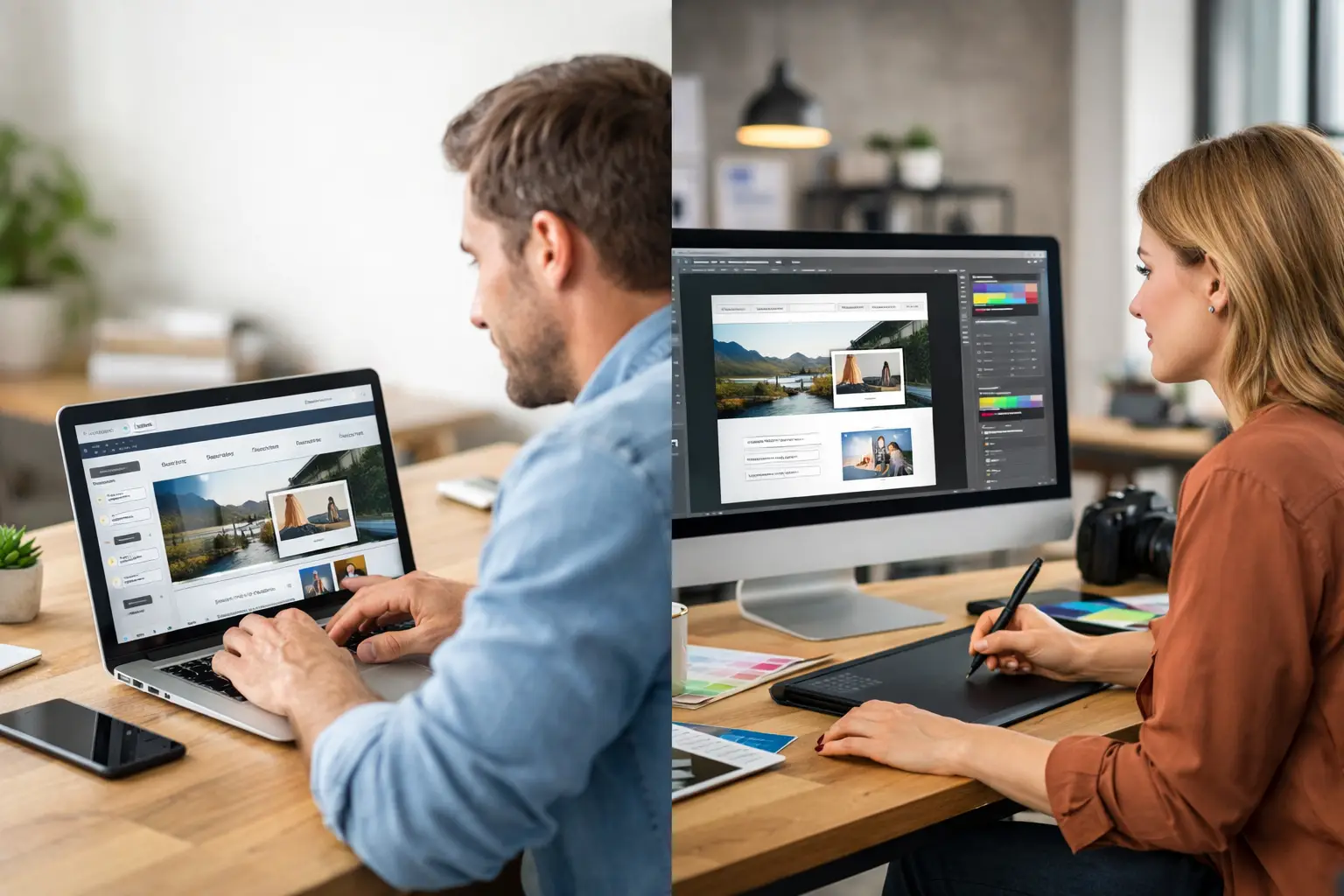
A website should help your business win enquiries, bookings and sales – not become another job on your list. The website builder versus web designer decision often looks simple at first: do it yourself for less, or pay an expert to do it for you. In practice, the right choice depends on the time you can give it, the standard your customers expect and who will keep everything working after launch.
For many UK small businesses, the real question is not whether a builder or designer is better. It is whether you want to manage the work yourself, or have one accountable team take care of the website, hosting, security, search visibility and updates while you focus on running the business.
Website builder versus web designer: the key difference
A website builder is software that lets you create and edit a website using templates, drag-and-drop sections and pre-built features. You choose the layout, write the copy, add images, connect your domain and publish the site. It can be a cost-effective route for someone with spare time, a clear eye for design and the confidence to deal with the technical details.
A web designer is a person or team that plans, designs and builds the website around your business. They should consider your customers, services, goals, branding, mobile experience and the actions you want visitors to take. Depending on the provider, they may also handle domains, hosting, security certificates, search optimisation, maintenance and support.
The difference is ownership. A builder gives you the tools. A good managed web design service gives you the result and remains available when something needs changing.
That distinction matters when you are busy quoting for work, serving customers or building a new venture. A cheap monthly builder plan can become expensive in lost time if it takes several evenings to create pages that still do not clearly explain what you do.
When a website builder is a sensible choice
A website builder can work well if your needs are modest and you genuinely want hands-on control. Perhaps you are creating a simple temporary page for an event, testing a new idea or building a basic personal portfolio. If you already have strong images, polished written content and a clear brand style, a template can help you get something live without a large upfront bill.
Builders also make small edits straightforwardly once a website is set up. You can change an opening time, add a testimonial or post a new service yourself. For businesses with someone internally who enjoys this work and understands the platform, that control can be useful.
There are trade-offs. Templates serve many businesses, so your site can end up looking very similar to your competitors’. More importantly, the builder doesn’t decide which pages your customers need, write convincing copy, organise your service information, or check whether forms, tracking, and search basics work correctly. That still falls to you.
A builder is not automatically poor quality. But it is only as effective as the decisions made inside it. A well-built template site can perform well; a rushed one can make a capable business look less established than it is.
When a web designer offers better value
A web designer is usually the stronger option when you expect your website to generate business rather than simply exist online. Local trades, consultants, clinics, retailers, professional services and growing teams need visitors to understand their offer quickly and know exactly how to get in touch, request a quote or buy.
A professional design process starts with those commercial outcomes. It considers the order of your pages, the evidence customers need before they trust you, the calls to action that fit your service and how the site performs on a phone. This is where a specialist can save you from common issues such as vague headlines, buried contact details, slow pages and confusing navigation.
The best providers do not stop at design. Your website needs a domain, secure hosting, SSL, backups, updates and a plan for keeping information current. It also needs on-page SEO foundations so search engines can understand your pages, and increasingly, clear structured content that can be surfaced in AI-led search results.
Using separate suppliers for each job can be frustrating. If your site goes down, an email form fails or your domain is due for renewal, you should not have to work out which company is responsible. A fully managed provider gives you one point of contact and one team accountable for resolving problems.
Compare the real costs, not just the starting price
The initial price is often what pushes business owners towards a website builder. It is sensible to watch spending, particularly in the early stages of a business. Yet the subscription shown on a builder’s pricing page is rarely the whole cost.
You may need to pay separately for a domain, email, premium templates, booking tools, e-commerce features, stock images, security upgrades or expert help when you get stuck. Then there is your time. If it takes 20 hours to research, write, design, upload and troubleshoot your website, what could those 20 hours have earned your business instead?
A web designer has a higher apparent price because you are paying for strategy, skill and delivery. Traditional agencies can also bring long timelines, complex project stages and unexpected extras, which is why it pays to ask clear questions before committing. Find out what is included, how quickly the site can launch, whether changes are covered, who owns the domain and what support looks like after the site goes live.
Predictable monthly plans can make professional help more accessible. You know what you are paying for, avoid a large surprise bill and have support available as your business changes. No secrets here: the value is not just a better-looking homepage. It is reduced admin, less technical risk and a website that is actively looked after.
Questions to ask before you choose
Before choosing either route, be honest about the job your website needs to do. A few direct questions will make the decision clearer:
- Do you have time to build, test and maintain it yourself?
- Will customers need to book, buy, request quotes or submit sensitive information?
- Do you need your site to appear credible beside established local competitors?
- Who will update the software, monitor security and fix issues after launch?
- Do you want help with search visibility and content, or only a template to work from?
If the answer is that you need leads quickly, need help with the technical work and cannot afford to let the website drift out of date, a managed designer-led service is likely to be the more practical choice.
A third option: managed design with simple control
You do not have to choose between an expensive, slow agency and being left alone with a website builder. The most useful middle ground combines professional design with an all-done-for-you service and straightforward support when you need a change.
This approach suits businesses that want speed without cutting corners. Your provider can create the site around your services, optimise the key pages, connect the essentials and ensure it works properly across phones, tablets and desktops. You retain the ability to request updates, but you are not expected to become a part-time web developer.
That is the thinking behind 1stNet AI: one provider for website design, hosting, security, maintenance, SEO and ongoing support, with clear plans and no long-term commitment. It removes the scramble of coordinating designers, developers and hosting companies when you simply need a professional online presence that supports growth.
Choose the option that protects your time
A website builder is a tool, and for the right project it can be enough. A web designer is an investment in expertise, presentation and accountability. Neither is automatically the correct answer for every business.
Choose a builder when you have a simple requirement, the confidence to manage it and the time to improve it properly. Choose a designer or managed service when your website needs to win trust, bring in customers and stay secure without taking your attention away from the work that pays the bills.
Your customers will judge your business by what they find online, often before they ever call. Give them a clear, fast and credible reason to choose you – then let your website keep working while you get on with growing the business.