
You’re probably at the point where the website has stopped being a nice-to-have and become a sales problem. Leads are slow, your current site looks dated, or you’ve been told by an agency that the “proper” rebuild will take weeks and cost more than you wanted to spend. That’s exactly where the ai website builder vs traditional website design decision stops being theoretical and starts affecting cash flow.
| Factor | AI Website Builder | Traditional Website Design |
|---|---|---|
| Speed to launch | Minutes to hours | Weeks |
| Upfront spend | Usually lower | Usually higher |
| Ongoing workload | Lower if managed well | Higher unless outsourced |
| Control | Good for standard needs | Strong for bespoke builds |
| Best fit | Fast launches, simple service sites | Complex, custom, performance-sensitive projects |
For UK SMEs, the right answer usually depends on three things, time, budget, and how much post-launch work you’re willing to own. If you need a live site quickly and your business is straightforward, an AI-led route is often the cleaner commercial decision. If you need deep custom functionality, granular control, or specialist performance work, traditional design still has a place.
The Two Paths to Getting Your UK Business Online
A lot of UK founders hit the same decision at the same time. The logo is ready, the domain is available, and someone has finally said, “We need the website live now.” Then the fork appears, either use an AI site to get moving quickly, or commission a traditional build and wait for the more custom result.
That choice looks straightforward until you account for the work that follows launch. A local trades business does not need weeks of workshops before it can start collecting enquiries. A consultant does not need a custom framework before the first sales call, they need a credible homepage, working contact details, and a site that does not make buyers hesitate.
What Matters First
The first filter is launch urgency. UK founders who need a live site fast should start with the route that gets them online with the least delay, because launch speed affects when enquiries, sales, and campaign traffic can begin.
The second filter is budget discipline. UK businesses do not all have the same tolerance for upfront project spend, and the country’s SME base makes that clear. The Office for National Statistics reported 5.5 million private-sector businesses in 2024, with 99.9% classified as SMEs and 5.48 million as small businesses, which means most firms need a practical route to market rather than a long build process (AIMarcus).
Practical rule: if the website must start paying for itself quickly, choose the route that gets you live with the least delay.
The hidden question most owners forget
The third filter is post-launch effort. Many owners compare only the first draft and ignore what happens after go-live, when content updates, fixes, and maintenance start landing on the business owner’s desk. That matters even more in the UK because cyber risk is part of normal website ownership, not an edge case.
The cost difference becomes apparent once the project is underway. An AI-built site may have a lower initial price, but poor management means you could still be responsible for updates, content changes, and technical upkeep. A traditionally designed site, if built and maintained well, can handle more of this ongoing work, which significantly impacts the total cost of ownership compared to just the launch price. To consider the human element of the choice, see why human creativity still matters as AI website building grows.
If your business is simple, the AI path usually wins on speed and cash preservation. If your site is a strategic product in its own right, traditional design can still justify the wait. The mistake is assuming every business needs the same level of build complexity from day one.
How AI Builders and Traditional Design Actually Work
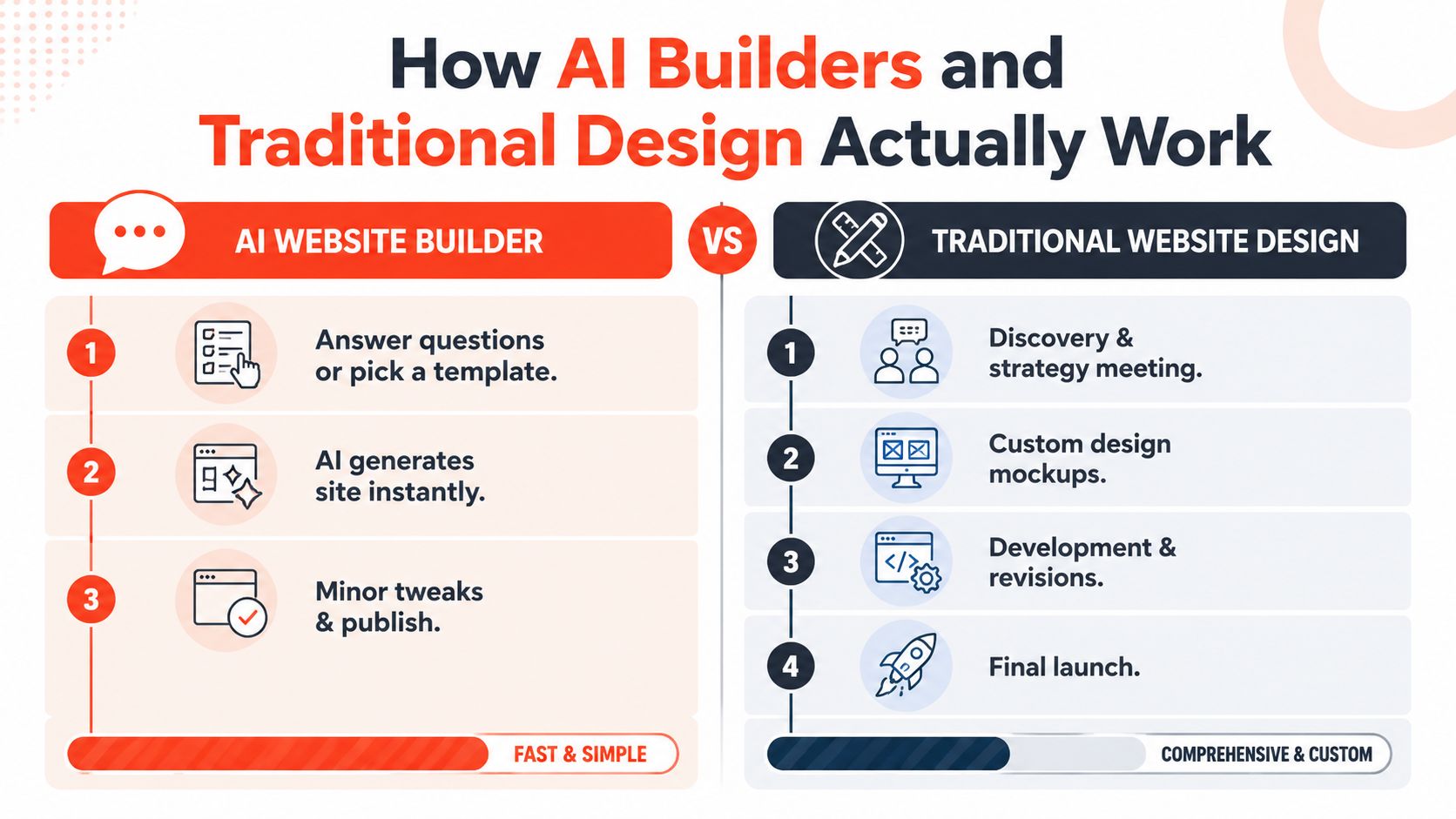
The difference starts long before design polish. An AI builder usually asks for your business type, services, brand details, and goals, then generates a starting site automatically. From there, you refine the result with chat commands or a visual editor, instead of writing every page from scratch, which is the core mechanic behind a conversational workflow (SaaSTools).
Traditional design moves like a project, because it is one. You begin with discovery, then wireframes, then mockups, then development, then content entry, then launch. That process gives you more control, but it also creates more handoffs, more review cycles, and more chances for the project to slow down.
The lived experience of each route
In an AI flow, the first useful output arrives fast. One benchmarked workflow reported a deployable page in a median 4.2 minutes, while a traditional workflow typically took 28 to 90+ minutes just to reach a comparable first deployable state (Zylocode). For a new founder, that difference is the difference between “we’re building” and “we’re live.”
Traditional design asks more of the client. Someone has to approve the structure, check copy, provide images, and make decisions at several stages. If the business owner is busy, every one of those steps can turn into a bottleneck.
A good website process isn’t the one with the most meetings. It’s the one that gets the right site live without wasting the owner’s week.
For businesses that want to understand why human oversight still matters, the tension between automation and craft is worth reading in this piece on why human creativity still matters while AI website building rises. The key point is simple. AI can handle the first pass very well, but the business still has to decide what good looks like.
Where changes happen after launch
The gap becomes operational. With an AI builder, small edits are normally faster because the system is already structured for quick iteration. With traditional design, changes after launch can be easy or painful depending on how the build was done, whether the developer is still available, and whether the site was assembled cleanly.
The smartest question is not, “Which is more advanced?” It’s, “Which workflow fits the amount of time I can realistically spend supervising a website project?”
The Total Cost of Each Approach for UK Businesses
Upfront price is the easiest figure to compare, and the least useful if you ignore ownership costs. Traditional UK web design for a business site is typically estimated at £2,000 to £5,000 for a basic site, £5,000 to £15,000 for a professional custom business site, and £10,000 to £50,000+ for e-commerce, with ongoing maintenance usually costing £50 to £200 per month on top (Zero to Startup). That is the commercial baseline most owners should start from.
AI-led tools often look cheaper at the front end, but the key question is whether the package includes the infrastructure you would otherwise buy separately. Domain, SSL, hosting, and maintenance are where many businesses get caught out later. If those are not bundled, the headline price tells only part of the story.
The Hidden Bills Are the Main Problem
The useful comparison is total cost over time, not first invoice versus first invoice. If a traditional build comes with separate maintenance, separate hosting, and separate support calls, the bill grows even when the original design looked affordable. That is why a managed package can make more sense than a piecemeal stack for a small firm that needs budget certainty.
| Cost Category | AI Website Builder | Traditional UK Agency | Managed Hybrid Service |
|---|---|---|---|
| Initial build | Lower upfront outlay | Usually highest upfront spend | Mid-range, with delivery included |
| Domain and SSL | May be separate unless bundled | Often separate or added on | Included in the managed package |
| Hosting | Often bundled in AI platforms | Usually a separate service | Included in the managed package |
| Maintenance | Lower if platform-managed | Usually £50 to £200 per month | Included in the managed package |
| Content updates | Quick if the system is simple | May require paid support | Handled as part of ongoing service |
| Surprise admin | Lower when infrastructure is bundled | Higher with multiple vendors | Lower because one provider owns the stack |
The hidden bills are the main problem because they sit outside the quote. Fixes, patching, content changes, and small site amendments all cost time somewhere, either as agency time or as the owner’s time. Once that pattern starts, a website stops feeling like an asset and starts acting like a recurring admin task.
Direct advice: if a provider does not clearly include hosting, SSL, and maintenance, assume the total monthly number will be higher than the quote.
For a straightforward comparison of packaged pricing, this breakdown of website costs from 1stNet AI is worth checking because it shows how bundling changes budgeting decisions for smaller firms. I would rather see a founder buy clarity than chase a lower sticker price and inherit a maintenance mess later.
SEO Performance and AI Search Visibility
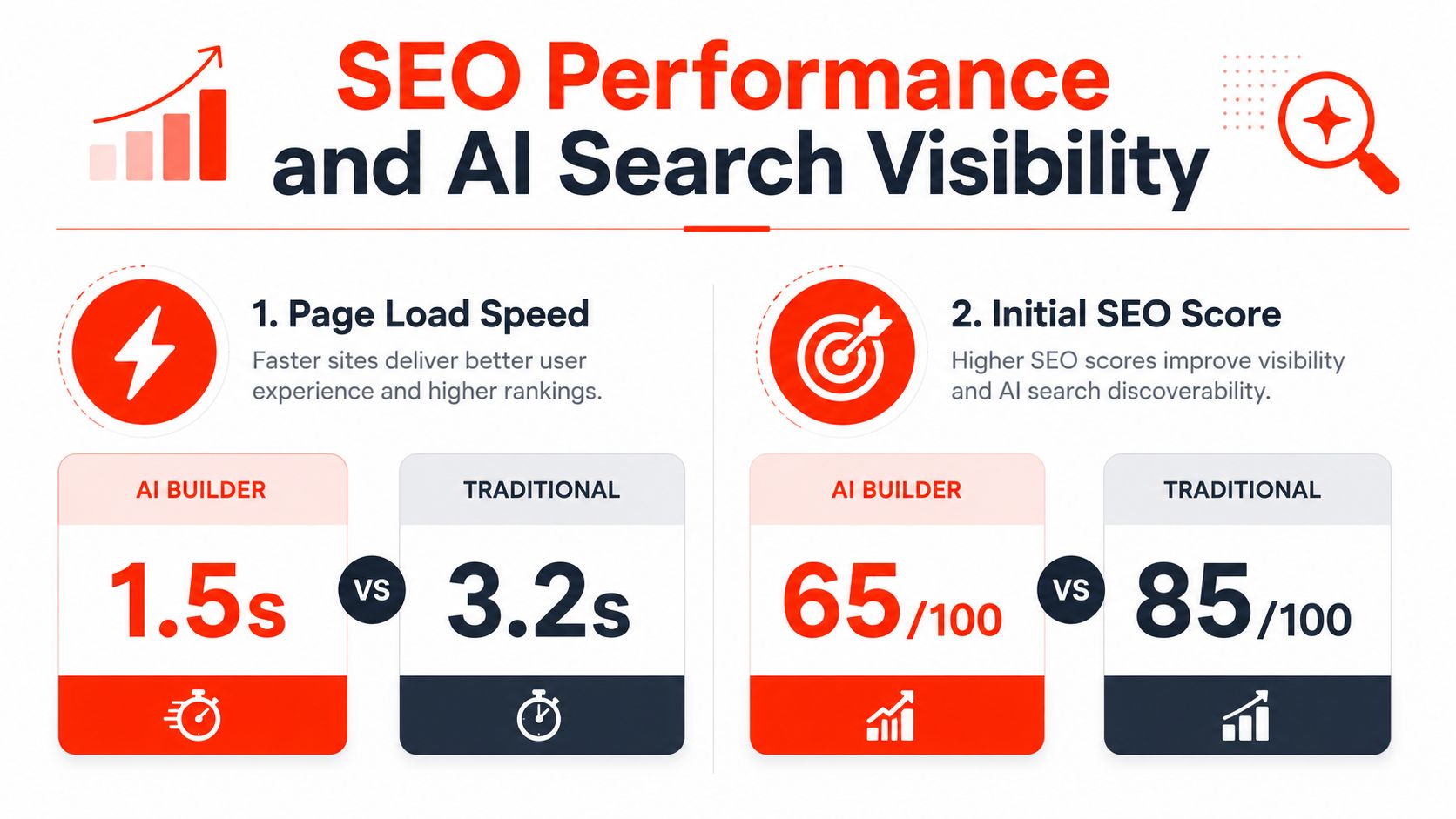
A site that looks polished but never gets found is still a cost, not a commercial asset. Search visibility comes from technical quality, page structure, and how clearly the site helps people and search systems understand what the business does. In the analysis cited by DigitalApplied, many AI-built sites still struggle with Core Web Vitals and accessibility checks, while hand-coded builds using modern frameworks tend to perform better on those basics.
That does not mean AI sites cannot rank. It means the default output matters more than the sales pitch, and founders need to judge the build on technical SEO, not broad promises about visibility.
The technical gap you cannot ignore
Performance is usually where hand-built work still has the edge. A slow site hurts search visibility, user trust, and conversion at the same time. If the build fails on speed or stability, the rest of the marketing work has to carry a heavier load.
Traditional design does better when the team behind it cares about implementation quality. The toolset is not the issue. Poor headings, weak metadata, clumsy mobile layouts, and bloated scripts will drag down even a bespoke build.
AI search visibility is now part of the brief
Search is no longer just about classic Google results. More buyers are asking answer engines and AI assistants for recommendations, so your site has to be readable by both humans and machines. Clear service pages, concise copy, clean headings, and structured content all help.
For practical steps on getting a business seen in AI-driven discovery, the guide on how to get your business featured in ChatGPT, Google Gemini, and AI search results is directly relevant. The underlying point is simple, visibility starts with structure, not just style.
Strong SEO comes from disciplined implementation, not from the label on the build method.
If you are comparing providers, ask how they handle metadata, heading hierarchy, mobile performance, and accessibility from the start. Those details separate a launch-ready site from one that merely looks finished.
Security Maintenance and Scalability After Launch
The workload starts after the site goes live. In the UK, that isn’t a theoretical warning. The 2024 Cyber Security Breaches Survey found that 50% of UK businesses experienced a cyber breach or attack in the previous 12 months, rising to 70% for medium businesses and 74% for large businesses, which makes upkeep a business issue, not just a technical one (Codewave).
Traditional builds often leave maintenance on the owner unless a separate support contract exists. That means updates, security checks, backups, and renewal admin can end up in-house whether the team wants that responsibility or not. AI builders reduce that load when the platform is managed properly, but they can also become restrictive if the business later needs more advanced customisation.
The post-launch reality most buyers miss
A website is not a one-time asset. It needs care, and the care has to match the business model. For a small firm with no technical staff, every maintenance task becomes an interruption. For a growing business, missed updates can become a risk.
That’s why bundled managed services matter. If hosting, SSL, security hardening, and updates sit in one place, the owner isn’t chasing separate vendors or wondering who owns which problem. The operational benefit is bigger than the marketing language around “all-in-one” suggests.
Scale is a feature, but only if you’ll need it
Not every business needs endless expandability on day one. A local service firm, a startup proving demand, or a solo consultant often needs a site that is easy to maintain and easy to update. A complex e-commerce brand, on the other hand, may outgrow a lightweight setup quickly and need deeper control over products, integrations, or workflows.
Rule of thumb: if you don’t have a clear reason to manage complex infrastructure, don’t volunteer for it.
The hidden cost of the wrong choice is often time, not money. A cheaper build that creates weekly admin can drain more value than a more expensive managed setup that stays out of the way. That’s the part people forget when they only compare launch-day quotes.
Which Approach Fits Your Business Right Now
The right choice depends on the business you’re running, not the trend you’ve heard about. A sole trader who needs a professional presence this week doesn’t benefit from a drawn-out agency process. A growing retailer with a complicated catalogue doesn’t want to box itself into a system that can’t keep up.
Match the build to the business type
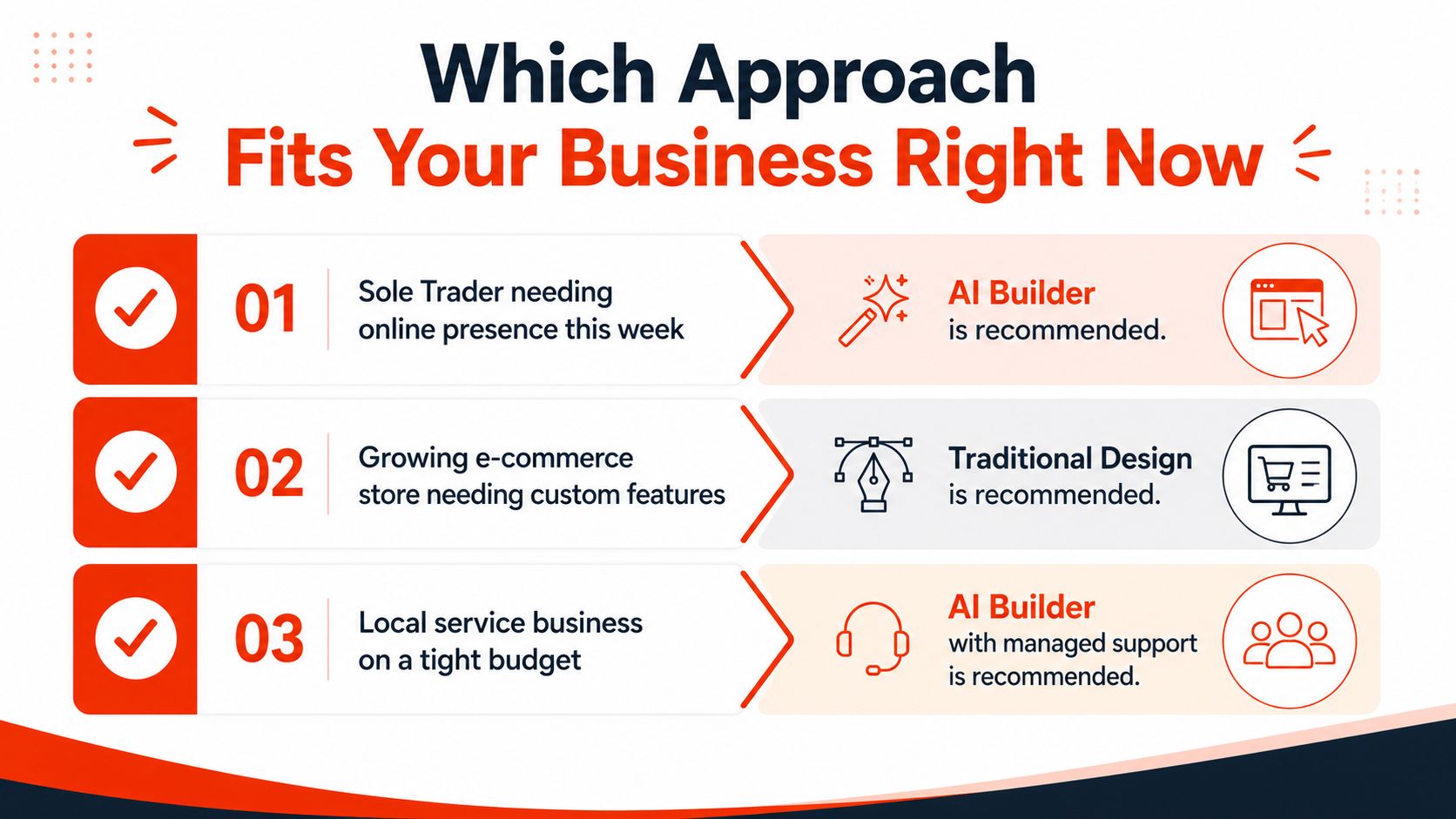
If you’re a sole trader needing an online presence this week, choose an AI website builder. Speed matters more than perfection here, and the goal is to get a credible site live, start taking calls, and stop losing leads to a blank page.
If you run a growing e-commerce store needing custom features, choose traditional design. Product complexity, integrations, and scaling pain usually justify the longer build cycle.
If you’re a local service business on a tight budget, choose an AI builder with managed support. That gives you launch speed without forcing you to become your own webmaster.
Use this checklist before you decide
- Timeline: if the site needs to be live almost immediately, lean AI.
- Budget: if you want predictable monthly spend, prefer a bundled managed model.
- Technical comfort: if you don’t want to touch updates, backups, or troubleshooting, don’t buy a system that expects you to.
- Growth plans: if you already know you’ll need specialist functionality, start with a traditional build.
- Search ambition: if ranking is central to the business, ask hard questions about technical SEO and ongoing optimisation.
The business that wins is usually the one that matches the website to the next 12 months, not the next fantasy version of the company. A founder testing a market needs speed and control over cash. A mature business planning a bigger digital footprint needs a platform that can carry more weight.
A Faster Way to Launch with Professional Results
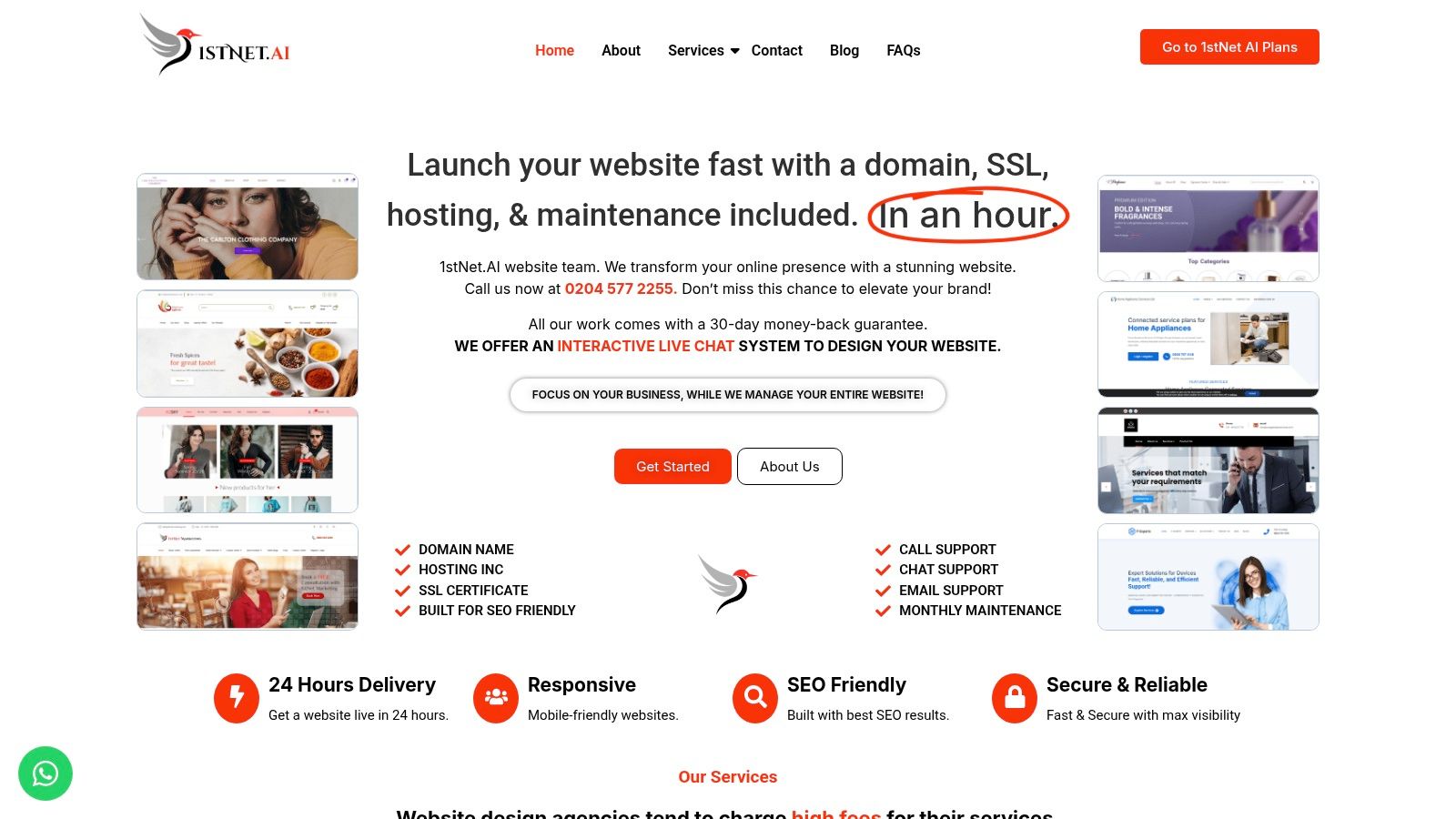
There is a sensible middle ground between a bare-bones AI builder and a slow agency project. 1stNet AI Ltd combines AI-accelerated website production with managed infrastructure, so the site can go live with domain, SSL, hosting, and maintenance included, plus a 30-day money-back guarantee and an interactive live chat design workflow. For a UK business that wants the speed of automation without inheriting the usual aftercare mess, that model is far easier to live with than a fragmented setup.
The live chat workflow matters because it replaces endless revision emails with direct collaboration. You can shape the site as it’s being built, then publish without waiting for a long chain of handoffs. For founders, that’s often the difference between shipping this week and still discussing mockups next month.
The site can also be launched within 24 hours, which is the practical answer for time-sensitive projects that need a live presence now. The point isn’t that every business should take that route. The point is that a managed hybrid option exists for the many SMEs that want a fast launch and don’t want to become their own support desk.
If you’re weighing speed against post-launch workload, stop comparing only the design phase and look at the full year of ownership. Visit 1stNet AI Ltd to see how a managed AI-led build can get a UK business online quickly, with the infrastructure and support already built in.